 Indietro
Chemical Equilibrium: Principles, Manipulation, and Le Châtelier’s Principle
Guida di studio - Note intelligenti
 Appunti personalizzati basati sui tuoi materiali, ampliati con definizioni chiave, esempi e contesto.
Chemical Equilibrium
Introduction to Equilibrium
Chemical equilibrium is a fundamental concept in chemistry, describing the state in which the concentrations of reactants and products remain constant over time because the forward and reverse reactions occur at equal rates. This chapter explores how equilibrium is established, manipulated, and disturbed, and introduces the reaction quotient (Q) and equilibrium constant (K).
Key Points
Equilibrium Condition: At equilibrium, the rate of the forward reaction equals the rate of the reverse reaction.
Equilibrium Constant (K): A numerical value that characterizes the ratio of product to reactant concentrations at equilibrium for a given reaction at a specific temperature.
Manipulating Equilibria: Equilibrium constants can be manipulated mathematically when reactions are reversed, multiplied, or added.
Mathematical Representation of Equilibrium
The equilibrium constant expression for a general reaction is: 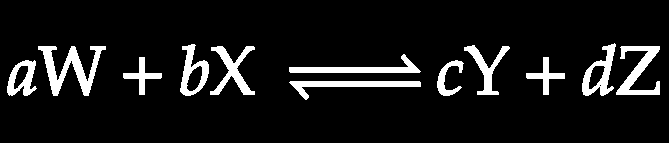
Example:
For the reaction: PbCl2(s) → Pb2+(aq) + 2 Cl-(aq),
The Reaction Quotient (Q)
The reaction quotient, Q, is used to describe the composition of a reaction mixture at any point in time, not necessarily at equilibrium. Q is calculated using the same formula as K, but with current (not equilibrium) concentrations. 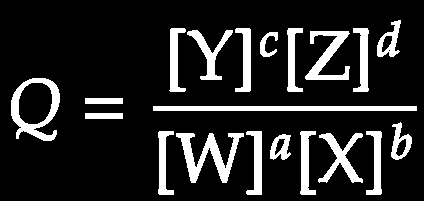
Key Points
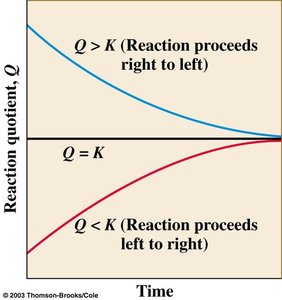
At equilibrium: Q = K
Q > K: The reaction proceeds to the left (toward reactants) until equilibrium is reached.
Q < K: The reaction proceeds to the right (toward products) until equilibrium is reached.
Q changes over time; K is constant for a given temperature.
Manipulating Equilibrium Constants
Multiplication: If a reaction is multiplied by a factor n, the new equilibrium constant is Kn.
Inversion: If a reaction is reversed, the new equilibrium constant is 1/K.
Addition: When reactions are added, the new equilibrium constant is the product of the individual constants.
Reaching Equilibrium and Disturbing Equilibrium
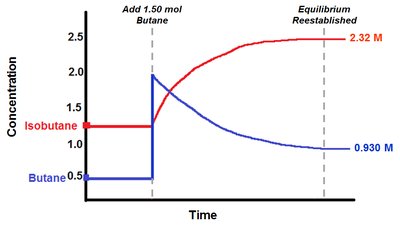
Example: Isomerization of Butane
The isomerization of butane demonstrates how equilibrium is established and how the system responds to disturbances.
Starting with a mixture of butane and isobutane, the system will adjust concentrations until the equilibrium ratio is achieved.
Adding more reactant or product disturbs equilibrium, causing the system to shift to re-establish equilibrium.
Visualizing Equilibrium: Cis- and Trans-2-Butene
At 1000 K, K = 0.67 for the isomerization of trans-2-butene to cis-2-butene.
Starting with equal amounts, the system shifts to favor the reactant (trans-2-butene) until the equilibrium ratio is reached.
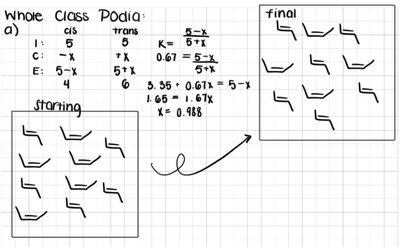
Example Calculation:
If starting with 5 of each, at equilibrium: 6 trans, 4 cis.
Le Châtelier’s Principle
Le Châtelier’s Principle provides a qualitative prediction of how a system at equilibrium responds to disturbances.
Principle: When a system at equilibrium is subjected to a change in concentration, pressure, or temperature, the system shifts to minimize the effect of the disturbance.
Application: Adding or removing reactants/products, changing volume, or introducing inert gases can shift the equilibrium position.
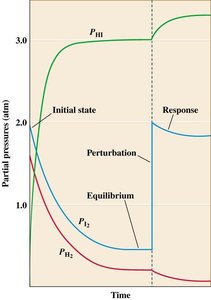
Examples of Equilibrium Disturbances
Removing a reactant: Q increases, reaction shifts left.
Compressing the container: Partial pressures increase, Q increases, reaction shifts left.
Adding a drying agent: Removes water vapor, Q increases, reaction shifts left.

Summary Table: Q vs K and Reaction Direction
Condition | Reaction Direction |
|---|---|
Q > K | Left (toward reactants) |
Q < K | Right (toward products) |
Q = K | No net change |
Additional info:
Le Châtelier’s Principle is a qualitative tool; quantitative predictions require calculation of Q and comparison to K.
Energy considerations (thermodynamics) explain why these shifts occur, which will be discussed in later chapters.
