 Indietro
Chemical Kinetics: Factors Affecting Reaction Rates and Mechanisms
Guida di studio - Note intelligenti
 Appunti personalizzati basati sui tuoi materiali, ampliati con definizioni chiave, esempi e contesto.
Chemical Kinetics
Introduction to Chemical Kinetics
Chemical kinetics is the branch of chemistry that studies the rates of chemical reactions and the factors that influence these rates. Understanding reaction rates is crucial for controlling chemical processes in both laboratory and industrial settings.
Reaction Rate: The speed at which reactants are converted to products.
Importance: Allows chemists to optimize conditions for desired outcomes, such as maximizing product yield or minimizing unwanted byproducts.
Factors Affecting Reaction Rate
Several factors influence how quickly a chemical reaction proceeds:
Reactant Concentration: Higher concentrations increase the frequency of molecular collisions, leading to faster reactions.
Temperature: Raising temperature increases kinetic energy, resulting in more frequent and energetic collisions. For many reactions, a 10°C increase doubles the rate.
Nature of Reactants: Small molecules and ions react faster than large molecules or solids. Gases react faster than liquids, which react faster than solids.
Structure and Orientation: The spatial arrangement and orientation of reactant molecules during collisions can affect whether a reaction occurs.
Catalysts: Substances that speed up (positive catalysts) or slow down (negative catalysts) reactions without being consumed.
Reaction Rate: Fast vs. Slow Reactions
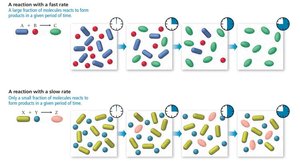
The fraction of molecules reacting in a given period determines whether a reaction is fast or slow.
Fast Rate: Large fraction of molecules react quickly.
Slow Rate: Small fraction of molecules react over a longer period.
Defining and Measuring Reaction Rate
Mathematical Expression of Reaction Rate
The rate of a chemical reaction is defined as the change in concentration of a reactant or product per unit time.
General Formula:
Units: Typically M/s (molarity per second).
Reactant and Product Concentrations Over Time
As a reaction proceeds, reactant concentrations decrease and product concentrations increase. The rate often slows as reactants are depleted. 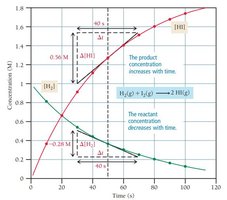
Average Rate vs. Instantaneous Rate
Average Rate: Calculated over a finite time interval; may not reflect the true rate at a specific moment.
Instantaneous Rate: The rate at a particular instant, determined by the slope of the tangent to the concentration vs. time curve.
Stoichiometry and Reaction Rate
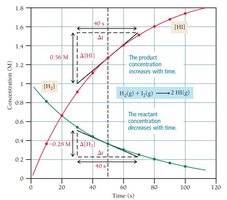
The rate of change for each reactant or product is related to its stoichiometric coefficient in the balanced equation.
For the reaction:
Rate expressions must account for coefficients:
Experimental Methods for Measuring Reaction Rate
Continuous Monitoring
Pressure Changes: Useful for reactions involving gases.
Polarimetry: Measures changes in optical rotation.
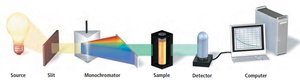
Spectroscopy: Monitors absorbance changes at specific wavelengths.
Sampling at Specific Times
Titration: Quantifies concentration of a component.
Gravimetric Analysis: Measures mass changes.
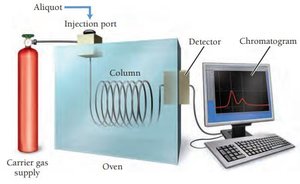
Gas Chromatography: Separates and quantifies volatile components.
Rate Laws and Reaction Order
Rate Law Definition
The rate law expresses the relationship between reaction rate and the concentrations of reactants (and sometimes catalysts).
General Form:
k: Rate constant, specific to each reaction and temperature.
n, m: Orders with respect to each reactant.
Overall Order: Sum of exponents (n + m).
Determining Reaction Order
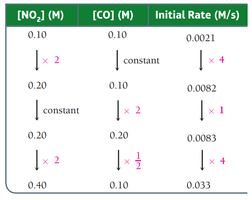
Reaction order is determined experimentally by varying reactant concentrations and observing changes in rate.
[NO2] (M) | [CO] (M) | Initial Rate (M/s) |
|---|---|---|
0.10 | 0.10 | 0.0021 |
0.20 | 0.10 | 0.0082 |
0.20 | 0.20 | 0.0083 |
0.40 | 0.10 | 0.033 |
Types of Rate Laws
Zero Order: (independent of concentration)
First Order: (rate proportional to [A])
Second Order: (rate proportional to [A]2)
Integrated Rate Laws
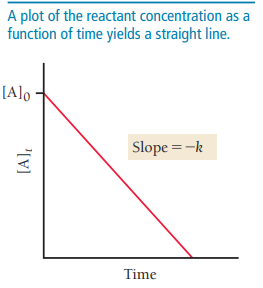
Zero-Order Integrated Rate Law
Integrated Form:
Graph: [A] vs. time yields a straight line with slope -k.
First-Order Integrated Rate Law
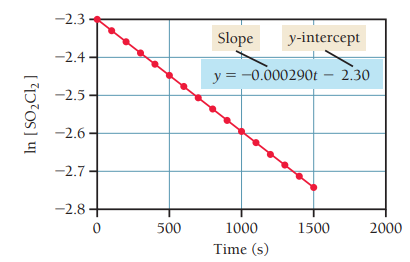
Integrated Form:
Graph: ln[A] vs. time yields a straight line with slope -k.
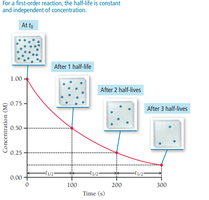
Half-life: (constant for first-order reactions)
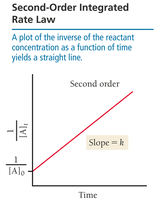
Second-Order Integrated Rate Law
Integrated Form:
Graph: 1/[A] vs. time yields a straight line with slope k.
Half-life: (depends on initial concentration)
Half-Life and Reaction Order
Zero Order: Half-life decreases as initial concentration decreases.
First Order: Half-life is constant, independent of concentration.
Second Order: Half-life decreases as initial concentration increases.
Temperature and Reaction Rate
Arrhenius Equation
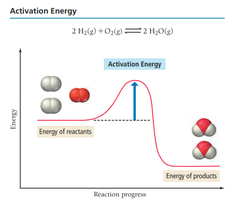
The Arrhenius equation relates the rate constant to temperature and activation energy:
A: Frequency factor (number of approaches to activation barrier per unit time)
Ea: Activation energy (energy barrier to reaction)
R: Gas constant
T: Temperature in Kelvin
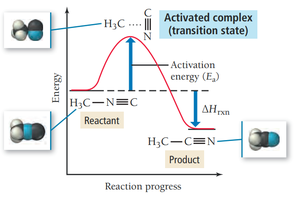
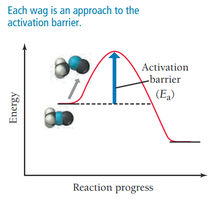
Thermal Energy Distribution
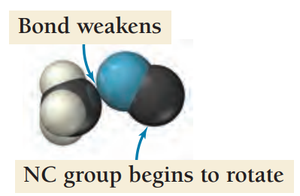
As temperature increases, more molecules have enough energy to overcome the activation energy barrier, increasing reaction rate. 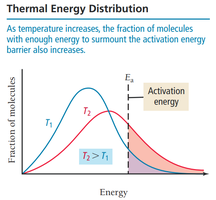
Arrhenius Plot
Plotting ln k vs. 1/T yields a straight line, allowing determination of activation energy and frequency factor. 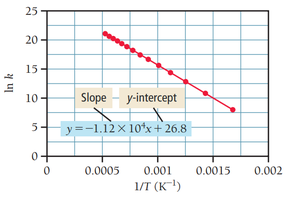
Collision Theory
Effective Collisions
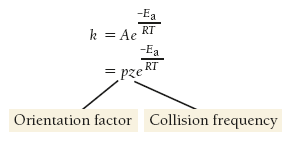
For a reaction to occur, molecules must collide with sufficient energy and proper orientation.
Collision Frequency (z): Number of collisions per second.
Orientation Factor (p): Fraction of collisions with correct orientation.
Effective Collision: Collision that leads to product formation.
Reaction Mechanisms
Elementary Steps and Molecularity
Elementary Step: A single reaction event; cannot be broken down further.
Molecularity: Number of reactant particles involved (unimolecular, bimolecular, termolecular).
Intermediates
Intermediate: Species produced in one step and consumed in another; does not appear in overall reaction.
Rate-Determining Step
The slowest step in a mechanism determines the overall reaction rate.
The rate law for the rate-determining step often matches the experimentally observed rate law.
Catalysts and Enzymes
Catalysts
Catalyst: Substance that increases or decreases reaction rate without being consumed.
Homogeneous Catalyst: Same phase as reactants.
Heterogeneous Catalyst: Different phase from reactants.
Enzymes
Enzyme: Biological catalyst, usually a protein.
Enzymes bind substrates at an active site, orienting them for reaction (lock-and-key mechanism).
Summary Table: Rate Laws
Rate Law Summary Table
Order | Rate Law | Integrated Rate Law | Half-Life |
|---|---|---|---|
Zero | |||
First | |||
Second |
Conclusion
Chemical kinetics provides a framework for understanding how and why reactions occur at different rates. By manipulating factors such as concentration, temperature, and catalysts, chemists can control reaction speed and efficiency. Additional info: Some explanations and context were expanded for clarity and completeness.
