 Indietro
Chemical Kinetics: Principles, Rate Laws, and Mechanisms
Guida di studio - Note intelligenti
 Appunti personalizzati basati sui tuoi materiali, ampliati con definizioni chiave, esempi e contesto.
Chemical Kinetics
Introduction to Chemical Kinetics.
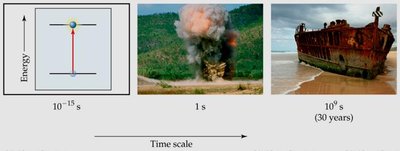
Chemical kinetics is the study of the rates at which chemical reactions occur and the factors that affect these rates. It provides insight into the reaction mechanism, which is the stepwise pathway from reactants to products at the molecular level.
Reaction Rate: The change in concentration of a reactant or product per unit time.
Stoichiometry: The quantitative relationship between reactants and products.
Spontaneity vs. Speed: Spontaneity refers to whether a reaction will occur, while kinetics deals with how fast it occurs.
Reaction Rate and Measurement
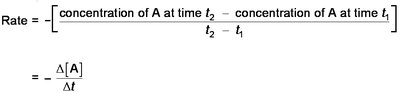
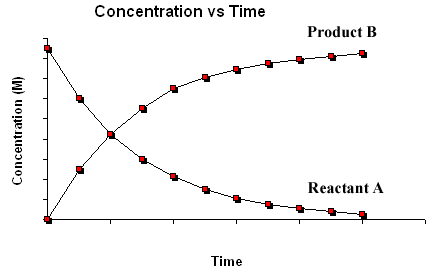
The reaction rate is typically measured as the change in concentration of a reactant or product over a specified time interval.
Mathematical Expression: , where is the concentration of reactant A.
Units: Usually mol/L·s.
Factors Affecting Reaction Rates
Several factors influence how quickly a chemical reaction proceeds:
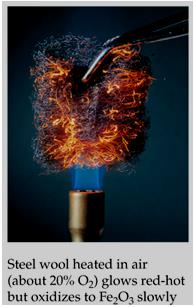
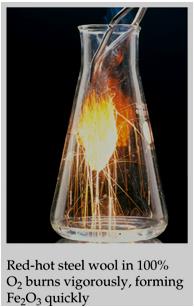
Nature of Reactants: Physical state and bonding type affect collision frequency and energy requirements.
Concentration: Higher concentration increases collision frequency and rate.
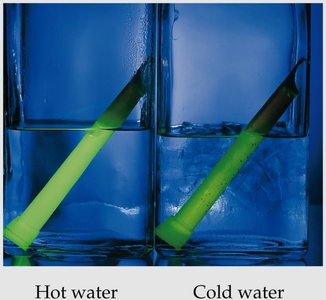
Temperature: Higher temperature increases kinetic energy and collision frequency, often doubling the rate for every 10°C rise.
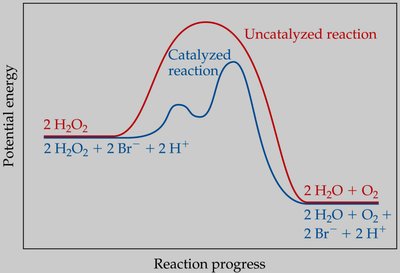
Catalysts: Catalysts alter the reaction pathway, lowering activation energy and increasing rate without being consumed.
Types of Reaction Rates
Reaction rates can be measured in different ways:
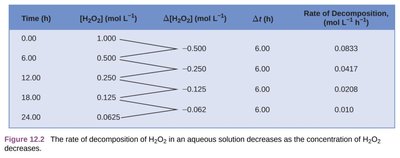
Average Rate: Change in concentration over a finite time interval.
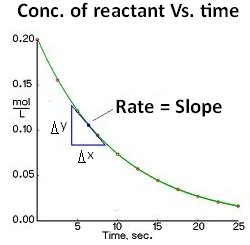
Instantaneous Rate: Rate at a specific moment, determined by the slope of the concentration vs. time curve.
Initial Rate: Rate at the very start of the reaction.
Rate Laws and Reaction Order
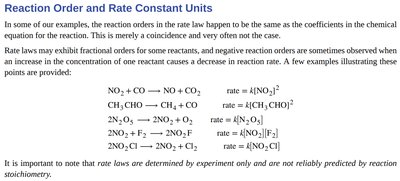
Rate laws express the relationship between reaction rate and reactant concentrations. The order of a reaction is determined experimentally and indicates how the rate depends on each reactant.
General Rate Law:
Overall Order: Sum of exponents ()
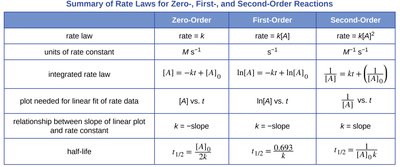
Units of Rate Constant: Depend on reaction order (see table below).
Method of Initial Rates
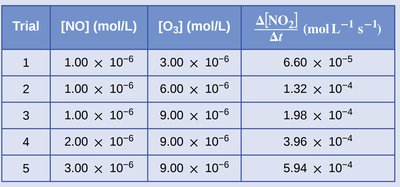
The initial rate method involves measuring the rate at the start of the reaction for various initial concentrations to determine the rate law and reaction order.
Experimental Data: Multiple trials with varying concentrations.
Analysis: Compare how changes in concentration affect the initial rate.
Integrated Rate Laws
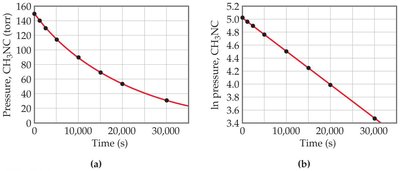
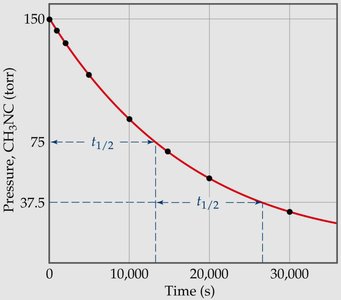
Integrated rate laws relate reactant concentration to time and are used to analyze reaction progress and determine rate constants.
First Order:
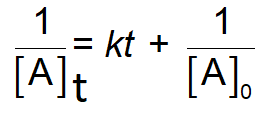
Second Order:
Zero Order:
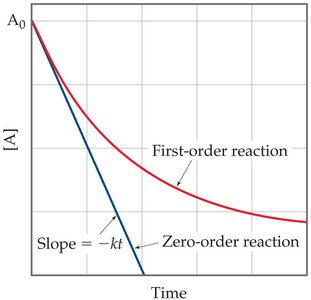
Summary Table: Rate Laws for Zero, First, and Second Order Reactions
Order | Rate Law | Units of k | Integrated Rate Law | Plot for Linear Fit | Half-life |
|---|---|---|---|---|---|
Zero | Rate = k | mol L-1 s-1 | [A]t = -kt + [A]0 | [A] vs t | t1/2 = [A]0/2k |
First | Rate = k[A] | s-1 | ln[A]t = -kt + ln[A]0 | ln[A] vs t | t1/2 = 0.693/k |
Second | Rate = k[A]2 | L mol-1 s-1 | 1/[A]t = kt + 1/[A]0 | 1/[A] vs t | t1/2 = 1/(k[A]0) |
Collision Theory and Activation Energy
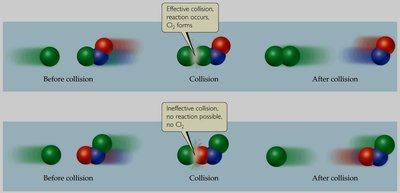
Collision theory explains how reactions occur at the molecular level. Molecules must collide with sufficient energy and proper orientation to react.
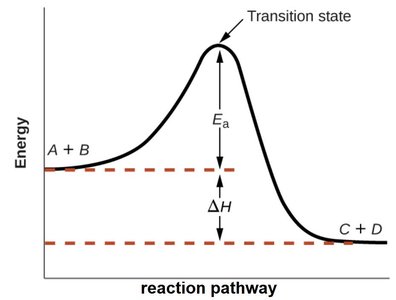
Activation Energy (Ea): Minimum energy required for a reaction to occur.
Transition State: High-energy state during the reaction pathway.
Arrhenius Equation
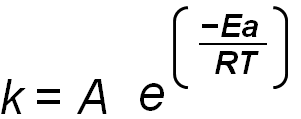
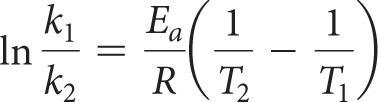
The Arrhenius equation relates the rate constant to temperature and activation energy:
Where A is the frequency factor, Ea is activation energy, R is the gas constant, and T is temperature in Kelvin.

Reaction Mechanisms and Rate-Determining Step
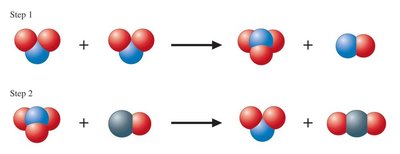
Reaction mechanisms describe the sequence of elementary steps in a reaction. The slowest step is the rate-determining step, which controls the overall reaction rate.
Elementary Reaction: A single step in a mechanism.
Intermediate: Formed in one step, consumed in another.
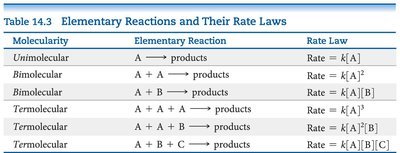
Molecularity: Number of reactant molecules involved in an elementary step.
Catalysis
Catalysts increase reaction rates by lowering activation energy and providing an alternative pathway. They are not consumed in the reaction.
Homogeneous Catalysts: Same phase as reactants.
Heterogeneous Catalysts: Different phase from reactants.
Enzymes: Biological catalysts with specific active sites.
Practice and Application
Understanding chemical kinetics is essential for predicting reaction rates, designing chemical processes, and interpreting experimental data. Practice problems and real-life examples reinforce these concepts.
Example: The rate of decomposition of hydrogen peroxide decreases as its concentration decreases.
Example: The effect of temperature on chemiluminescence in light sticks.
Conclusion
Chemical kinetics provides a framework for understanding how and why reactions occur at different rates. Mastery of rate laws, reaction mechanisms, and the factors affecting rates is fundamental for success in general chemistry.
