Indietro
Chemical Kinetics: Principles, Rate Laws, and Mechanisms
Guida di studio - Note intelligenti
 Appunti personalizzati basati sui tuoi materiali, ampliati con definizioni chiave, esempi e contesto.
Chemical Kinetics
Introduction to Chemical Kinetics
Chemical kinetics is the branch of chemistry that studies the rate at which chemical processes occur. Understanding reaction rates and mechanisms is crucial for optimizing industrial processes, medical applications, and laboratory experiments.
Reaction Rate: The speed at which reactants are converted to products.
Reaction Mechanism: The sequence of steps by which a reaction occurs.
Applications: Radioactive decay, pharmaceuticals, and chemical manufacturing.
Factors Affecting Reaction Rates
Several factors influence how quickly a chemical reaction proceeds:
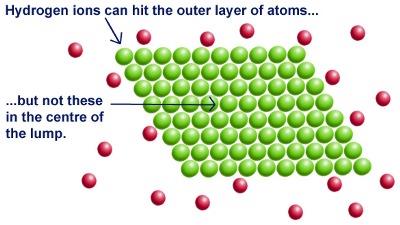
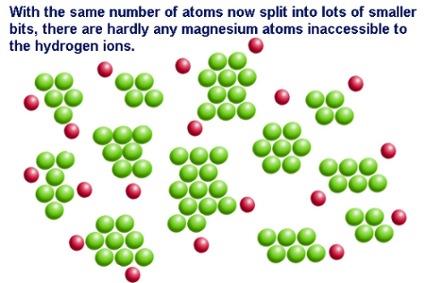
Physical State of Reactants: Reactants must collide to react. The more accessible the reactant molecules, the faster the reaction.
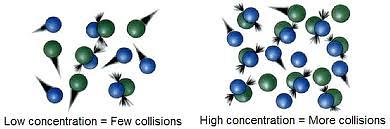
Reactant Concentration: Higher concentrations lead to more frequent collisions and increased reaction rates.
Temperature: Increasing temperature raises kinetic energy, resulting in more collisions and faster reactions.
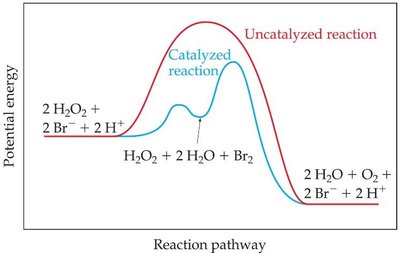
Catalysts: Catalysts increase reaction rates by providing alternative pathways with lower activation energy, without being consumed.
Homogeneous reactions involve reactants in the same phase (gas or liquid), while heterogeneous reactions involve mixed phases, often limited by surface area.
Reaction Rate and Stoichiometry
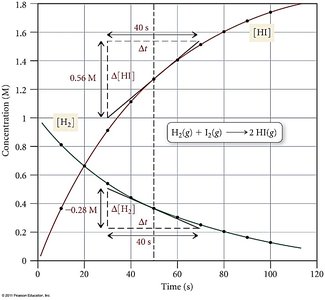
The rate of a reaction is measured as the change in concentration of reactants or products per unit time. The rate is not constant and depends on the stoichiometric coefficients in the balanced equation.
Average Rate:
Instantaneous Rate: The slope of the tangent to the concentration vs. time curve at a specific point.
Stoichiometry: The rate expressions must reflect the coefficients of reactants and products.
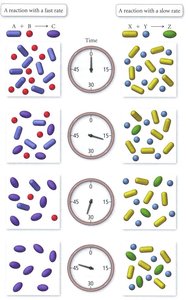
The Rate Law: Effect of Concentration
The rate law expresses the relationship between reaction rate and reactant concentrations. The general form is:
k: Rate constant
n: Reaction order (determined experimentally)
Common reaction orders:
Zero Order: Rate is independent of concentration ()
First Order: Rate is directly proportional to concentration ()
Second Order: Rate is proportional to the square of concentration ()
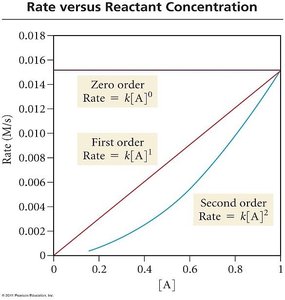
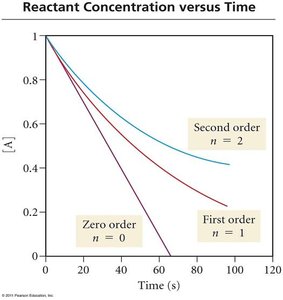
Zero Order Reactions
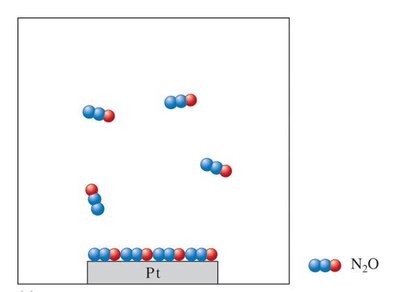
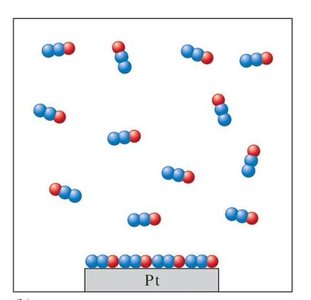
Zero order reactions have rates independent of reactant concentration. This often occurs when a catalyst surface is saturated.
Example: Decomposition of N2O on platinum.
Determining Reaction Order: Method of Initial Rates
Reaction order is determined experimentally by measuring initial rates at varying concentrations.
Compare rates from different experiments to deduce order with respect to each reactant.
Overall order is the sum of individual orders.
Integrated Rate Laws
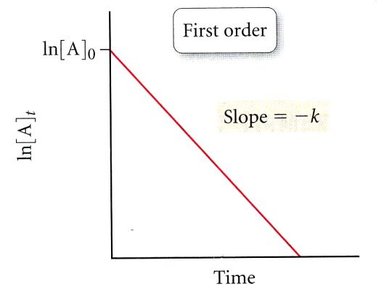
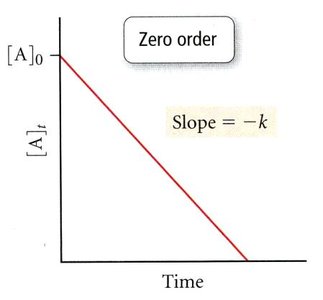
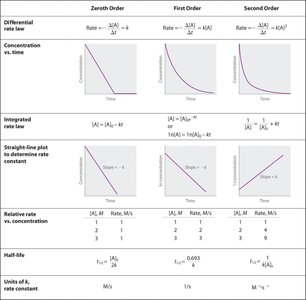
Integrated rate laws relate reactant concentration to time, depending on reaction order.
First Order:
Second Order:
Zero Order:
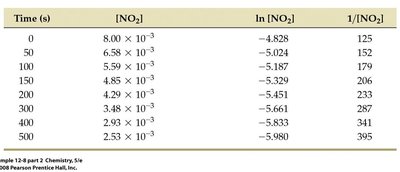
![ln[NO2] vs. time plot](https://static.studychannel.pearsonprd.tech/study_guide_files/general-chemistry/sub_images/67893d66_image_15.png)
![1/[NO2] vs. time plot](https://static.studychannel.pearsonprd.tech/study_guide_files/general-chemistry/sub_images/67893d66_image_16.png)
Half-Life of Reactions
Half-life is the time required for the concentration of a reactant to decrease by half.
First Order: (independent of initial concentration)
Second Order: (depends on initial concentration)
Zero Order: (directly proportional to initial concentration)
Effect of Temperature and Collision Theory
Temperature and Reaction Rate
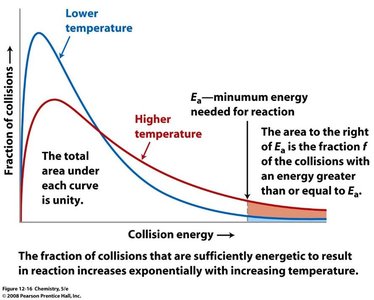
Increasing temperature raises the average kinetic energy of molecules, leading to more frequent and energetic collisions, thus increasing reaction rate.
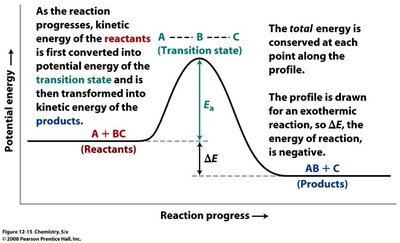
Activation Energy (Ea): Minimum energy required for a reaction to occur.
Transition State: The highest energy configuration during a reaction.
Arrhenius Equation
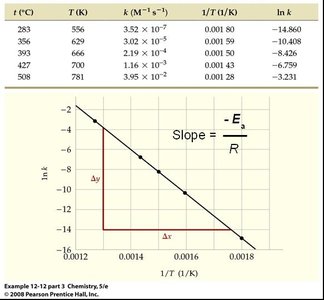
The Arrhenius equation relates the rate constant to temperature and activation energy:
R = gas constant (8.314 J/mol·K), T = temperature (K), Ea = activation energy (J/mol), A = frequency factor
Taking the natural log yields:
Molecular Orientation and Reaction Mechanisms
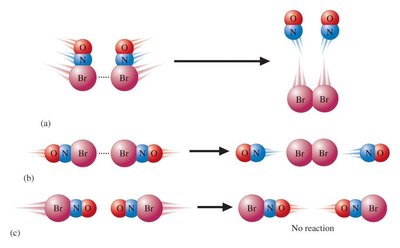
Only collisions with proper orientation and sufficient energy result in reactions. Most reactions occur via multiple steps, each with its own molecularity and rate law.
Unimolecular: One reactant particle ()
Bimolecular: Two reactant particles ( or )
Termolecular: Three reactant particles (rare)
Rate-Determining Step and Valid Mechanisms
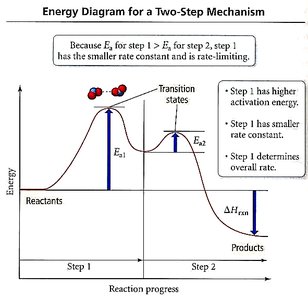
In multi-step reactions, the slowest step (rate-determining step) controls the overall rate. A valid mechanism must sum to the overall reaction and match the experimentally observed rate law.
Catalysts and Enzymes
Catalysts
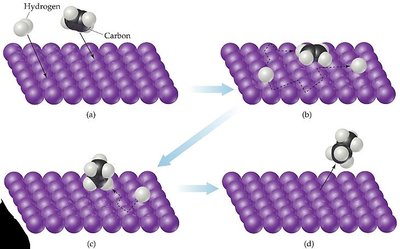
Catalysts increase reaction rates by lowering activation energy and changing the reaction mechanism. They are classified as homogeneous (same phase as reactants) or heterogeneous (different phase).
Enzymes
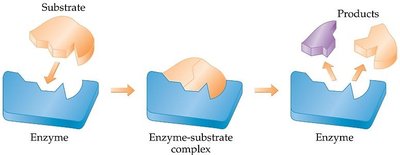
Enzymes are biological catalysts. The substrate binds to the enzyme's active site, forming an enzyme-substrate complex, which then converts to products.