 Indietro
Chemical Kinetics: Rates, Laws, and Reaction Orders
Guida di studio - Note intelligenti
 Appunti personalizzati basati sui tuoi materiali, ampliati con definizioni chiave, esempi e contesto.
Chemical Kinetics
Introduction to Chemical Kinetics
Chemical kinetics is the study of the rates at which chemical reactions occur and the factors that affect these rates. Understanding kinetics allows chemists to predict how fast reactions proceed and how conditions can be manipulated to control reaction speed.
Reaction Rate: The change in concentration of a reactant or product per unit time.
Factors Affecting Rate: Concentration, temperature, structure, and orientation of reacting particles.
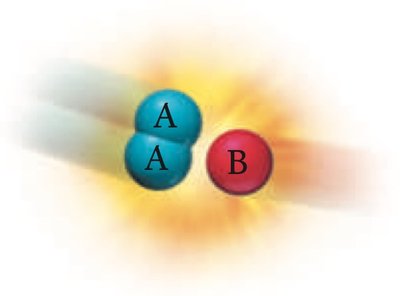
Collision Theory: Reactions occur when particles collide with sufficient energy and proper orientation.
Rate Expressions and Rate Laws
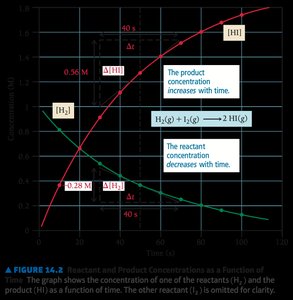
The rate of a reaction can be expressed mathematically, relating the change in concentration of reactants or products to time.
Average Rate: Determined by measuring the change in concentration over a time interval.
Instantaneous Rate: The rate at a specific moment, often determined from the slope of a concentration vs. time graph.
Rate Law: An equation that relates the reaction rate to the concentrations of reactants, typically in the form:
Order of Reaction: The sum of the exponents in the rate law; can be zero, first, or second order.
Method of Initial Rates
The method of initial rates is used to determine the rate law by measuring initial reaction rates at varying reactant concentrations.
By comparing how the initial rate changes with changes in concentration, the order with respect to each reactant can be deduced.
Example: For the reaction , initial rates are measured for different concentrations of O2 and NO.
Integrated Rate Laws
Integrated rate laws relate the concentration of reactants to time, allowing calculation of concentrations at any point during the reaction.
First Order:
Second Order:
Zero Order:
Reaction Order Determination: Example with C4H6
The order of a reaction can be determined by analyzing concentration data over time.
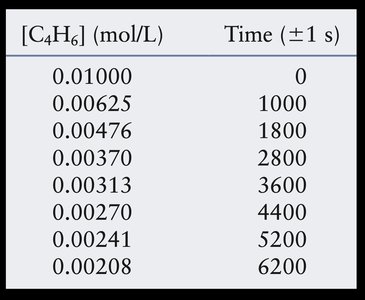
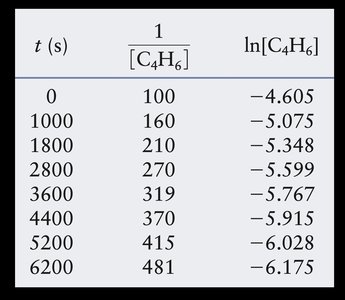
For the reaction , concentration data is collected at various times.
By plotting vs. time and vs. time, the linearity of the plot indicates the reaction order.
[C4H6] (mol/L) | Time (±1 s) |
|---|---|
0.01000 | 0 |
0.00625 | 1000 |
0.00476 | 1800 |
0.00370 | 2800 |
0.00313 | 3600 |
0.00270 | 4400 |
0.00241 | 5200 |
0.00208 | 6200 |
t (s) | 1/[C4H6] | ln[C4H6] |
|---|---|---|
0 | 100 | -4.605 |
1000 | 160 | -5.075 |
1800 | 210 | -5.348 |
2800 | 270 | -5.599 |
3600 | 319 | -5.767 |
4400 | 370 | -5.915 |
5200 | 415 | -6.028 |
6200 | 481 | -6.175 |
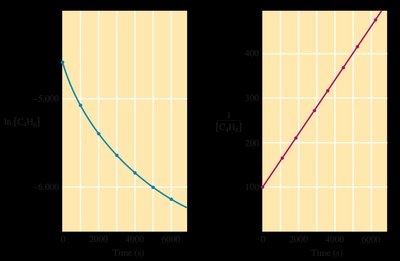
If vs. time is linear, the reaction is first order.
If vs. time is linear, the reaction is second order.
Zero Order Reactions
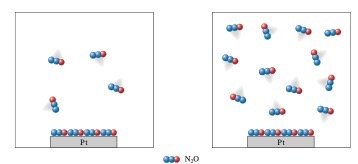
In zero order reactions, the rate is independent of the concentration of the reactant.
Rate law:
Integrated rate law:
Example: Decomposition of N2O on a platinum surface.
Practice Problems: Rate Expressions
Practice problems help reinforce understanding of rate expressions and calculation of reaction rates.
Example: For the reaction , calculate rates of disappearance and appearance for each species.

Example: For the reaction , determine the overall rate and rates for each reactant and product.

Practice Problem: Method of Initial Rates
Determining the rate law and rate constant from experimental data is a key skill in kinetics.
Example: The reaction of peroxydisulfate ion with iodide ion.
Experiment | [S2O82-] (M) | [I-] (M) | Initial Rate (M s-1) |
|---|---|---|---|
1 | 0.080 | 0.034 | 2.2 x 10⁻⁴ |
2 | 0.080 | 0.017 | 1.1 x 10⁻⁴ |
3 | 0.190 | 0.025 | 3.8 x 10⁻⁴ |
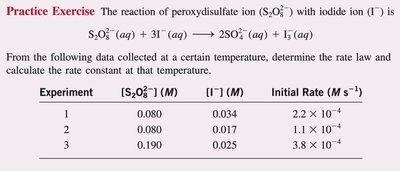
By comparing rates and concentrations, the order with respect to each reactant and the rate constant can be determined.
Kinetics Summary: Zero, First, and Second Order
Zero Order: Rate is independent of concentration.
First Order: Rate is directly proportional to concentration.
Second Order: Rate is proportional to the square of concentration or to the product of two concentrations.
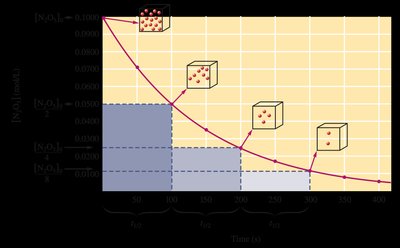
Example: The decomposition of N2O5 and C4H6 are classic cases for first and second order kinetics, respectively. Additional info: Integrated rate laws and graphical analysis are essential tools for determining reaction order and rate constants in chemical kinetics.
