 Indietro
Chemical Kinetics: Reaction Rates and Rate Laws
Guida di studio - Note intelligenti
 Appunti personalizzati basati sui tuoi materiali, ampliati con definizioni chiave, esempi e contesto.
Chemical Kinetics: Reaction Rates and Rate Laws
Introduction to Reaction Rates
Chemical kinetics is the study of the speed at which chemical reactions occur and the factors that influence these rates. Understanding reaction rates is essential for controlling chemical processes in both laboratory and industrial settings.
Factors Affecting Reaction Rates
Physical State of Reactants: Homogeneous mixtures (all reactants in the same phase, such as all gases or all liquids) generally react faster than heterogeneous mixtures (reactants in different phases) due to increased molecular contact.
Reactant Concentrations: Higher concentrations of reactants typically lead to faster reactions because more molecules are available to collide and react.
Temperature: Increasing temperature usually increases reaction rates by providing more energy for collisions and increasing the frequency of collisions.
Presence of a Catalyst: Catalysts speed up reactions by providing an alternative pathway with a lower activation energy, without being consumed in the reaction.
Measuring Reaction Rates
The rate of a reaction can be measured by monitoring the change in concentration of a reactant or product over time. Rates can be expressed as average or instantaneous values.
Average Reaction Rate
The average rate of appearance of a product B over a time interval is given by:
The average rate of disappearance of a reactant A is:
By convention, rates are always reported as positive values.
Example: Consider the reaction A → B in a 1 L flask. The following image shows the change in moles of A and B over time:
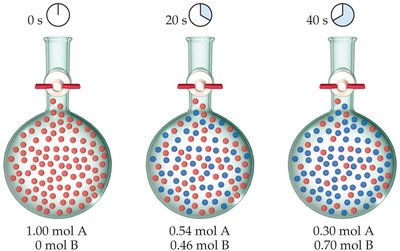
At 0 s: 1.00 mol A, 0 mol B
At 20 s: 0.54 mol A, 0.46 mol B
At 40 s: 0.30 mol A, 0.70 mol B
Average rate of appearance of B from 0 to 20 s:
Average rate of appearance of B from 20 to 40 s:
Instantaneous Rate
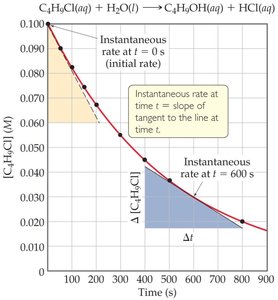
The instantaneous rate is the rate at a specific moment in time and is determined by the slope of the tangent to the concentration vs. time curve at that point.
Reaction Rate and Stoichiometry
For a general reaction: , the rates of change for each species are related by their stoichiometric coefficients:
Rate Laws
Rate laws express the relationship between the reaction rate and the concentrations of reactants. They must be determined experimentally.
General form:
k is the rate constant, which depends on temperature.
m and n are the reaction orders with respect to A and B, respectively, and are not necessarily related to the stoichiometric coefficients.
Reaction Order
The overall reaction order is the sum of the exponents in the rate law:
Example: If , the reaction is second order in A, first order in B, and third order overall.
Units of Rate and Rate Constants
Rate is typically expressed in M/s (molarity per second).
The units of the rate constant k depend on the overall reaction order and must yield units of M/s for the rate.
For a second-order reaction (), k has units of .
Determining Rate Laws from Experimental Data
Experimental data is used to determine the rate law by comparing how changes in concentration affect the reaction rate.
Experiment | [ClO2] | [OH-] | Initial Rate (M/s) |
|---|---|---|---|
1 | 0.060 M | 0.030 M | 2.48 × 10⁻² |
2 | 0.020 M | 0.030 M | 2.76 × 10⁻³ |
3 | 0.020 M | 0.090 M | 8.28 × 10⁻³ |
By analyzing how the rate changes with concentration, the reaction order with respect to each reactant can be determined.
Beer’s Law and Spectrophotometry
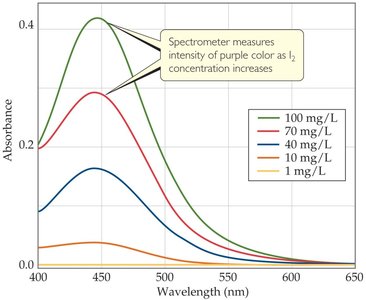
Beer’s Law relates the absorbance of light by a solution to its concentration, allowing for the monitoring of reaction progress using spectrophotometry.
A = absorbance, = molar extinction coefficient, b = path length, c = concentration
Integrated Rate Laws
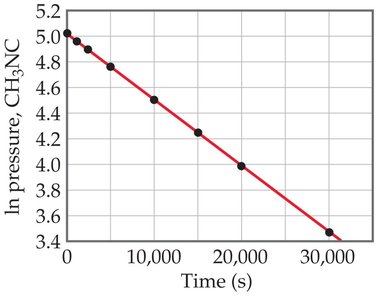
Integrated rate laws allow calculation of reactant or product concentrations at any time during a reaction. The form of the integrated rate law depends on the reaction order.
First-Order Reactions
Rate law:
Integrated form:
Or:
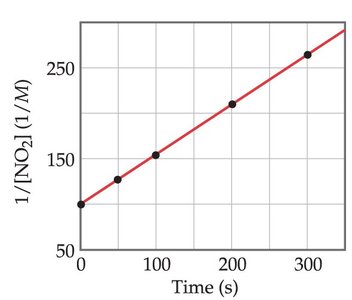
Second-Order Reactions
Rate law:
Integrated form:
Or:
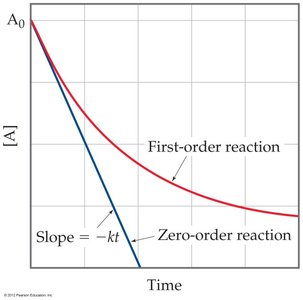
Zero-Order Reactions
Rate law:
Integrated form:
Zero-order reactions are often observed in catalytic processes where the catalyst surface is saturated.
Summary Table: Integrated Rate Laws and Plots
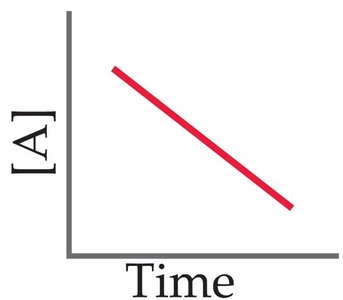
Order | Integrated Rate Law | Linear Plot |
|---|---|---|
Zero | [A] vs. t | |
First | ln[A] vs. t | |
Second | 1/[A] vs. t |
Key Takeaways
Reaction rates depend on physical state, concentration, temperature, and catalysts.
Rate laws must be determined experimentally and are not always predictable from stoichiometry.
Integrated rate laws allow calculation of concentrations at any time and help identify reaction order by the linearity of specific plots.
