 Indietro
Chemical Kinetics: Reaction Rates and Rate Laws
Guida di studio - Note intelligenti
 Appunti personalizzati basati sui tuoi materiali, ampliati con definizioni chiave, esempi e contesto.
Chemical Kinetics
Introduction to Chemical Kinetics
Chemical kinetics is the branch of chemistry that studies the speed (rate) at which chemical reactions occur and the factors that affect these rates. It provides insight into how quickly reactants are converted into products, the energy required to initiate reactions (activation energy), and the mechanisms by which reactions proceed.
Reaction Rate: The change in concentration of reactants or products per unit time.
Activation Energy: The minimum energy required for a reaction to occur.
Reaction Mechanism: The stepwise sequence of elementary reactions by which overall chemical change occurs.
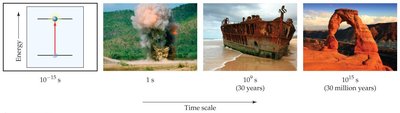
Time Scales of Chemical Reactions
Chemical reactions can occur over a wide range of time scales, from extremely fast (explosions) to extremely slow (rusting, geological changes).
Fast reactions: Occur in fractions of a second (e.g., explosions).
Slow reactions: May take years or millions of years (e.g., rusting, erosion).
Measuring Reaction Rates
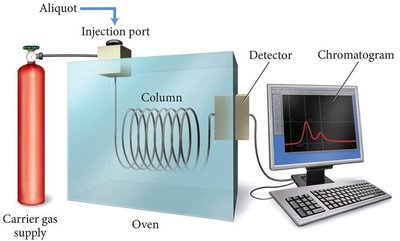
Laboratory Techniques for Measuring Reaction Rates
To measure reaction rates, chemists monitor the concentration of reactants or products over time using various analytical techniques.
Spectroscopy: Measures absorbance or emission of light by a sample to determine concentration.
Gas Chromatography: Separates and quantifies components in a gas mixture.
HPLC (High Performance Liquid Chromatography): Used for liquid samples.
Polarimetry: Measures optical rotation to track concentration changes.

Reaction Rate vs. Time
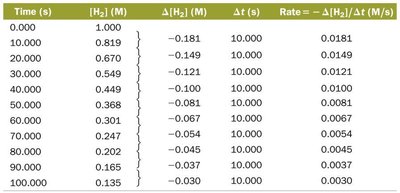
The rate of a reaction typically decreases over time as the concentration of reactants falls, reducing the frequency of effective collisions.
At the start, reactant concentration is highest, so the rate is fastest.
As reactants are consumed, the rate slows.
The reaction may stop when reactants are depleted or equilibrium is reached.

Quantifying Reaction Rates
Average and Relative Reaction Rates
The average rate of a reaction is calculated over a specific time interval. For a reaction: , the rate can be expressed as:
By convention, rates are reported as positive values; the negative sign for reactants ensures this.

Instantaneous Rate and Initial Rate
Instantaneous Rate: The rate at a specific moment, determined by the slope of the tangent to the concentration vs. time curve.
Initial Rate: The instantaneous rate at the very start of the reaction (t = 0).

Rate Laws
Definition and Formulation of Rate Laws
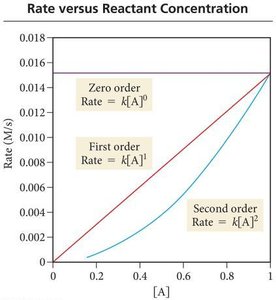
A rate law expresses the relationship between the rate of a reaction and the concentrations of reactants. It is determined experimentally and has the general form:
= rate constant (specific to each reaction and temperature)
= order of reaction with respect to each reactant

Order of Reaction
Order with respect to a reactant: The exponent of its concentration in the rate law.
Overall order: The sum of the exponents for all reactants.
Order can be zero, positive, negative, or fractional, and must be determined experimentally.

Integrated Rate Laws
First Order Reactions
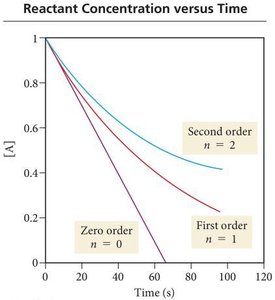
For a first-order reaction, the integrated rate law relates concentration to time:
A plot of vs. time yields a straight line for first-order reactions.
Second Order Reactions
For a second-order reaction:
A plot of vs. time yields a straight line for second-order reactions.
Zero Order Reactions
For a zero-order reaction:
A plot of vs. time yields a straight line for zero-order reactions.

Half-Life
Definition and Calculation
The half-life () is the time required for the concentration of a reactant to decrease by half.
For first-order reactions:
For second-order reactions:
For zero-order reactions:
Factors Affecting Reaction Rates
Temperature
Increasing temperature generally increases reaction rate by providing more kinetic energy to reactant molecules, leading to more frequent and energetic collisions.
Concentration
Higher concentration of reactants increases the rate by increasing the frequency of collisions.
Physical State
Reactions are faster in phases with higher kinetic energy (gas > liquid > solid). Surface area also affects rate for solids.
Catalysts
Catalysts increase reaction rate by lowering activation energy and providing an alternative reaction pathway. They are not consumed in the reaction.
Collision Theory
Principles of Collision Theory
Molecules must collide with sufficient energy to react.
Molecules must collide with the correct orientation.
Reaction Mechanisms
Elementary Steps and Rate-Determining Step
Each mechanism consists of a series of elementary steps.
The slowest step (rate-determining step) controls the overall reaction rate.
Intermediates are produced in one step and consumed in another; catalysts are present at the start and end but not consumed.
Molecularity
Unimolecular: One reactant particle.
Bimolecular: Two reactant particles.
Termolecular: Three reactant particles (rare).
Arrhenius Equation
Temperature Dependence of Rate Constant
The Arrhenius equation relates the rate constant () to temperature () and activation energy ():
Where is the frequency factor, is the gas constant (8.314 J/K·mol).
Summary Table: Rate Laws and Integrated Rate Laws
Order | Rate Law | Integrated Rate Law | Half-Life |
|---|---|---|---|
Zero | |||
First | |||
Second |
Practice and Application
Use experimental data to determine rate laws and reaction order.
Apply integrated rate laws to calculate concentrations at any time.
Use Arrhenius equation to relate rate constant to temperature and activation energy.
