 Indietro
Chemical Reactions and Balancing Chemical Equations
Guida di studio - Note intelligenti
 Appunti personalizzati basati sui tuoi materiali, ampliati con definizioni chiave, esempi e contesto.
Chemical Reactions: An Introduction
Evidence for a Chemical Reaction
Chemical reactions are fundamental processes in chemistry where substances are transformed into new substances. Recognizing when a chemical reaction has occurred is essential for understanding chemical changes.
Color Change: A visible alteration in color often indicates a chemical reaction.
Formation of a Solid: The appearance of a precipitate signals a new substance has formed.
Bubble Formation: The evolution of gas bubbles is a clue that a reaction is taking place.
Heat or Flame Production/Absorption: Energy changes, such as heat release or absorption, are common in chemical reactions.
Example: When a glow stick is activated, it emits light due to a chemical reaction that produces energy in the form of visible light.
Chemical Equations
Representing Chemical Reactions
Chemical equations are used to represent the reactants and products in a chemical reaction. The reactants are written to the left of the arrow, and the products are written to the right. The arrow indicates the direction of the reaction and is read as "yields" or "produces."
Reactants: Substances present before the reaction.
Products: Substances formed as a result of the reaction.
Arrow: Indicates the transformation from reactants to products.
Example: The reaction of methane with oxygen:
Balancing Chemical Equations
Principle of Conservation of Mass
Balancing chemical equations ensures that the number of atoms of each element is the same on both sides of the equation, reflecting the law of conservation of mass. Atoms are neither created nor destroyed in a chemical reaction; they are simply rearranged.
All atoms present in the reactants must be accounted for among the products.
The same number of each type of atom must appear on both sides of the arrow.
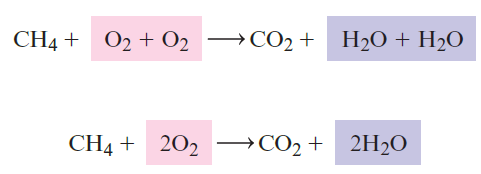
Example: For methane combustion:
Unbalanced: Balanced:
Steps for Balancing Equations
Balancing equations is typically done by inspection, following these steps:
Identify reactants and products: Write their formulas and physical states.
Write the unbalanced equation: Summarize the reaction.
Balance by inspection: Adjust coefficients to ensure equal numbers of each atom on both sides.
Check coefficients: Ensure they are the smallest possible integers.
Example: Balancing the decomposition of potassium chlorate:
Unbalanced: Balanced:
Information in a Balanced Equation
What a Chemical Equation Tells Us
A balanced chemical equation provides:
The identities of the reactants and products
The relative numbers of each substance (given by coefficients)
Physical States in Chemical Equations
Symbols for Physical States
Physical states are indicated in chemical equations using specific symbols:
Symbol | State |
|---|---|
(s) | Solid |
(l) | Liquid |
(g) | Gas |
(aq) | Dissolved in water (aqueous solution) |
Example: Aluminum reacts with oxygen to form aluminum oxide:
Unbalanced:
Practice: Balancing Equations
Sample Balanced Equations
Balancing equations is a fundamental skill in chemistry, ensuring the conservation of mass and correct representation of chemical reactions.
Reflection
Key Objectives
List four observations that suggest a chemical reaction has occurred.
Identify the information given by a chemical equation.
Write a balanced equation for a chemical reaction.
