 Indietro
Chemical Reactions and Chemical Quantities: Stoichiometry, Limiting Reactants, and Types of Reactions
Guida di studio - Note intelligenti
 Appunti personalizzati basati sui tuoi materiali, ampliati con definizioni chiave, esempi e contesto.
Chemical Reactions and Chemical Quantities
Introduction to Chemical Reactions
Chemical reactions involve the transformation of reactants into products, governed by the conservation of mass and atoms. Understanding how to represent, balance, and quantify chemical reactions is fundamental in chemistry.
Writing and Balancing Chemical Equations
Structure of Chemical Equations
Reactants are substances present before the reaction; products are substances formed as a result.
General format: reactants → products
Coefficients indicate the number of molecules or moles involved.
Phase labels: (s) solid, (l) liquid, (g) gas, (aq) aqueous.
Conditions (e.g., heat Δ, electricity, light hν) and catalysts may be indicated above the arrow.
Balancing Chemical Equations
Count atoms of each element on both sides.
Adjust coefficients (not subscripts) to balance atoms.
Check that all elements are balanced in the final equation.
Example:
Stoichiometry and Mole Relationships
Stoichiometric Coefficients and Interpretations
Coefficients represent the relative number of molecules or moles.
Molecular interpretation: 1 molecule C3H8 + 5 molecules O2 → 3 molecules CO2 + 4 molecules H2O
Molar interpretation: 1 mol C3H8 + 5 mol O2 → 3 mol CO2 + 4 mol H2O
Example:
Stoichiometric Calculations
Use mole ratios from balanced equations to convert between amounts of reactants and products.
Common types: mole-to-mole, mass-to-mole, mass-to-mass conversions.
Example: How many moles of H2O are produced when 3.5 mol H2 react with O2?
Example: How many grams of O2 are needed to yield 57 g H2O?
Limiting Reactant, Theoretical Yield, and Percent Yield
Limiting Reactant Concept
In reactions with multiple reactants, the limiting reactant is the one that is completely consumed first, thus limiting the amount of product formed. The excess reactant is not fully consumed.
Theoretical yield: Maximum amount of product possible, based on the limiting reactant.
Actual yield: Amount of product actually obtained from an experiment (usually less than theoretical yield).
Percent yield: Efficiency of a reaction, calculated as:
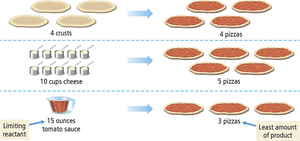
Limiting Reactant Analogy
Consider making pizzas with limited ingredients. The ingredient that runs out first determines the maximum number of pizzas you can make, analogous to the limiting reactant in a chemical reaction.
Types of Chemical Reactions
Combustion Reactions
Combustion involves a substance reacting with O2 to form oxygen-containing compounds and release heat.
Example:
Reactions of Alkali Metals
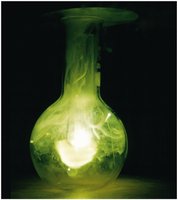
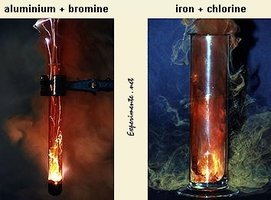
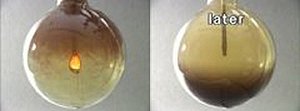
Alkali metals react vigorously with halogens to form metal halides.
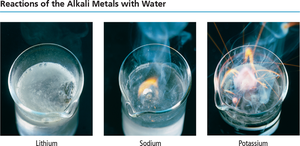
They also react with water to produce metal hydroxides and hydrogen gas. The reactivity increases down the group.
Reactions of Halogens
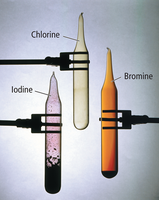
Halogens react with metals to form metal halides.
They react with hydrogen to form hydrogen halides.
Halogens can also react with each other to form interhalogen compounds.
Summary Table: Types of Chemical Reactions
Reaction Type | General Equation | Example |
|---|---|---|
Combustion | Substance + O2 → Oxides + Energy | CH4 + 2O2 → CO2 + 2H2O |
Alkali metal + Halogen | 2Na + Cl2 → 2NaCl | Na + Cl2 → NaCl |
Alkali metal + Water | 2Na + 2H2O → 2NaOH + H2 | Na + H2O → NaOH + H2 |
Metal + Halogen | Fe + Cl2 → FeCl2 | Fe + Cl2 → FeCl2 |
Halogen + Halogen | Cl2 + Br2 → ClBr | Cl2 + Br2 → ClBr |
Practice Problems and Applications
Calculate the theoretical yield and percent yield for given reactions.
Identify the limiting reactant in multi-reactant systems.
Balance chemical equations and use stoichiometry to solve quantitative problems.
Example: If 209 g of methanol are combusted, how much water is produced? (Use stoichiometry and molar masses.)
Example: Given the empirical composition of serotonin, determine its empirical and molecular formulas.
Additional info: The notes above expand on the provided slides by including definitions, general procedures, and academic context for each topic, ensuring a comprehensive and self-contained study guide for General Chemistry students.
