 Indietro
Chemical Reactions and Chemical Quantities: Structured Study Notes
Guida di studio - Note intelligenti
 Appunti personalizzati basati sui tuoi materiali, ampliati con definizioni chiave, esempi e contesto.
Chemical Reactions and Chemical Quantities
Introduction to Chemical Reactions
Chemical reactions are fundamental processes in chemistry where substances are transformed into new substances. These reactions involve the rearrangement of atoms and are represented by chemical equations, which provide a concise way to describe the reactants and products involved.
Chemical Reaction: A process in which one or more substances are converted into one or more different substances, involving a chemical change of matter.
Chemical Equation: A symbolic representation of a chemical reaction, showing reactants and products.
Reactants: Substances undergoing change.
Products: Substances formed as a result of the reaction.
Direction of Reaction: Indicated by arrows (→ for one-sided, ⇌ for reversible).
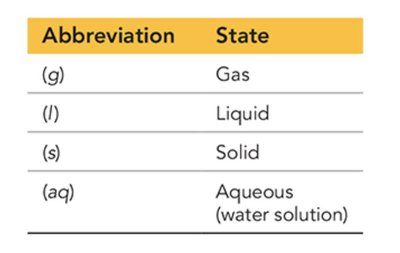
Physical States: Indicated in parentheses next to each substance.
Combustion Reactions
Combustion reactions are a specific type of chemical reaction where a substance combines with oxygen to form oxygen-containing compounds and emits heat. These reactions are important in energy production and are commonly observed with hydrocarbons.
Definition: Combustion is the reaction of a substance with oxygen, producing heat and new compounds.
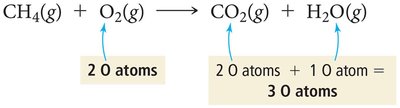
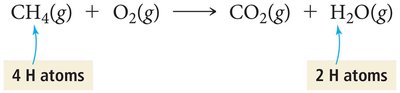
Example: Combustion of methane:
Products: Hydrocarbons always produce carbon dioxide and water.

Balancing Chemical Equations
Balancing chemical equations ensures that the number of atoms for each element is the same on both sides of the equation, reflecting the law of conservation of mass. This is achieved by adjusting coefficients, not subscripts.
Steps to Balance:
Write a skeletal equation with chemical formulas for reactants and products.
Balance atoms in complex substances first, then free elements.
Balance metal ions (cations) first, then nonmetal ions (anions).
If fractions appear, multiply all coefficients by the denominator to clear them.
Check by summing atoms on both sides.
Do not change subscripts: Only coefficients are adjusted.
Stoichiometry: Mole and Mass Relationships
Stoichiometry is the study of quantitative relationships between reactants and products in a chemical reaction. The coefficients in a balanced equation specify the relative amounts in moles, which can be used as conversion factors.
Mole-to-Mole Conversion: Use the ratio of coefficients to convert between moles of different substances.
Mass-to-Mass Conversion: Use molar mass to convert between mass and moles, then use stoichiometric ratios.
Example: For the reaction , 2 moles of produce 4 moles of .

Limiting Reactant and Excess Reactant
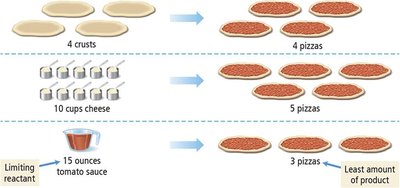
In a chemical reaction, the limiting reactant is the substance that is completely consumed first, thus limiting the amount of product formed. The excess reactant is not completely consumed and remains after the reaction.
Limiting Reactant: Determines the maximum amount of product.
Excess Reactant: Remains after the reaction is complete.
Example: In making pizzas, the ingredient that runs out first limits the number of pizzas produced.
Theoretical Yield, Actual Yield, and Percent Yield
Theoretical yield is the maximum amount of product that can be formed from the limiting reactant. Actual yield is the amount actually obtained from the experiment. Percent yield is calculated to assess the efficiency of the reaction.
Theoretical Yield: Calculated from stoichiometry based on the limiting reactant.
Actual Yield: Measured experimentally.
Percent Yield:
Special Types of Reactions
Combustion of Organic Compounds
Combustion reactions involving organic compounds (carbon, hydrogen, oxygen) always produce carbon dioxide and water. If only carbon or hydrogen is present, only carbon dioxide or water is produced, respectively.
Reactions of Alkali Metals
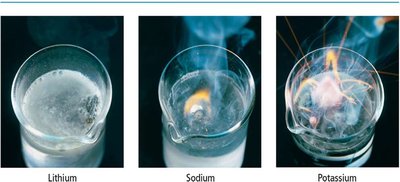
Alkali metals (group 1/1A) react vigorously with nonmetals and water, producing heat, sparks, and characteristic products. The reactivity increases down the group.
Reaction with Water: Produces metal ion, hydroxide ion, and hydrogen gas.
Example:
Reactions of Halogens
Halogens react with metals to form metal halides, with hydrogen to form hydrogen halides, and with each other to form interhalogen compounds.
Example:
Example:
Example:
Lab Data and Calculations
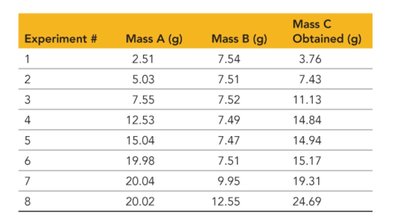
Experimental data is often presented in tables, showing masses of reactants and products. This data is used to calculate yields and assess reaction efficiency.
Experiment # | Mass A (g) | Mass B (g) | Mass C Obtained (g) |
|---|---|---|---|
1 | 2.51 | 7.54 | 3.76 |
2 | 5.03 | 7.51 | 7.43 |
3 | 7.55 | 7.52 | 11.13 |
4 | 12.53 | 7.49 | 14.84 |
5 | 15.04 | 7.47 | 14.94 |
6 | 19.98 | 7.51 | 15.17 |
7 | 20.04 | 9.95 | 19.31 |
8 | 20.02 | 12.55 | 24.69 |
Summary Table: Physical States in Chemical Equations
Abbreviation | State |
|---|---|
(g) | Gas |
(l) | Liquid |
(s) | Solid |
(aq) | Aqueous (water solution) |
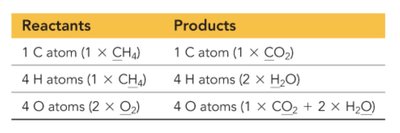
Summary Table: Atom Balancing Example
Reactants | Products |
|---|---|
1 C atom (1 × CH4) | 1 C atom (1 × CO2) |
4 H atoms (1 × CH4) | 4 H atoms (2 × H2O) |
4 O atoms (2 × O2) | 4 O atoms (1 × CO2 + 2 × H2O) |
