 Indietro
Chemical Reactions and Chemical Quantities: Study Guide
Guida di studio - Note intelligenti
 Appunti personalizzati basati sui tuoi materiali, ampliati con definizioni chiave, esempi e contesto.
Chapter 4: Chemical Reactions and Chemical Quantities
Introduction to Chemical Reactions
Chemical reactions involve the reorganization of atoms in one or more substances, resulting in the formation of new products. Atoms are neither created nor destroyed during a reaction, and the process is represented by a chemical equation.
Reactants: Substances present at the start of the reaction, shown on the left side of the arrow.
Products: Substances formed as a result of the reaction, shown on the right side of the arrow.
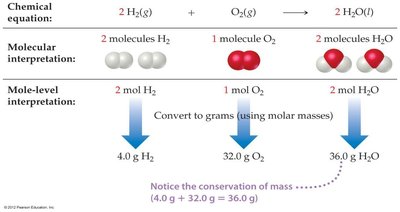
Conservation of Mass: The total mass of reactants equals the total mass of products.
Greenhouse Gases and Global Warming
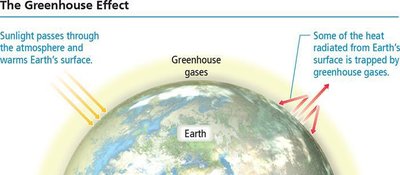
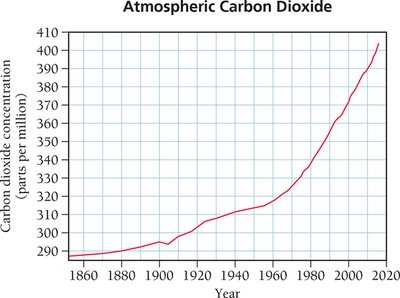
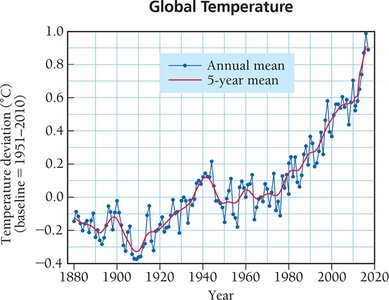
Greenhouse gases such as CO2, H2O, and CH4 play a crucial role in warming Earth's surface by trapping heat. The increase in atmospheric CO2 levels is closely linked to global temperature rise.
Greenhouse Effect: Sunlight passes through the atmosphere and warms Earth's surface. Some heat radiated from Earth's surface is trapped by greenhouse gases.
Global Warming: Scientists have measured an average ~1°C rise in atmospheric temperature since 1860, with a 38% increase in atmospheric CO2 levels during the same period.
Combustion of Fuels
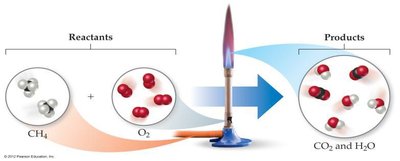
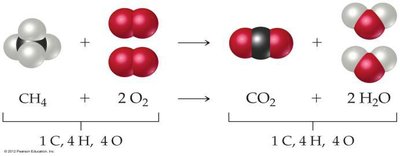
Combustion is a reaction with oxygen, typically producing carbon dioxide and water when a carbon compound burns completely.
Example: Combustion of methane:
Balancing Chemical Equations
Balancing equations is based on the conservation of mass. The number of atoms of each element must be the same on both sides of the equation. Coefficients are adjusted, not subscripts.
Key Steps: Change coefficients to balance atoms; never change subscripts.
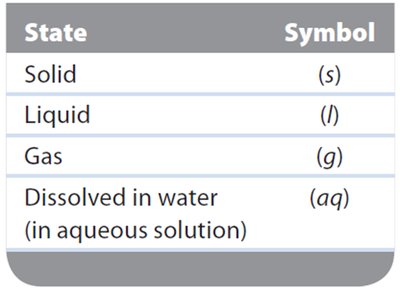
Physical States: Indicate the state of each substance (solid, liquid, gas, aqueous).
Information Provided by Chemical Equations
Chemical equations provide information about the nature and physical states of reactants and products, as well as their relative quantities.
Coefficients: Indicate the ratio of molecules or moles.
Physical States: Shown by symbols (s, l, g, aq).
Stoichiometry
Stoichiometry is the study of the numerical relationships between reactants and products in a chemical reaction. It allows chemists to predict the amounts of substances consumed and produced.
Example: Combustion of octane:
Mole Ratios: Coefficients in a balanced equation give the ratio of molecules and moles.
Stoichiometry: Problem Solving Strategy
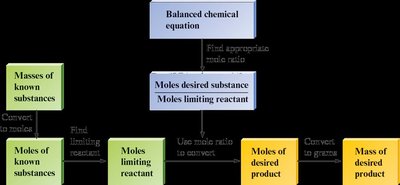
To solve stoichiometry problems, follow these steps:
Balance the equation for the reaction.
Convert the known mass of the reactant or product to moles.
Use the balanced equation to set up the appropriate mole ratios.
Calculate the number of moles of the desired reactant or product.
Convert moles to grams if required.
Limiting Reactant
The limiting reactant is the reactant that is completely consumed first, thus limiting the amount of product formed. Identifying the limiting reactant is essential for calculating theoretical yield.
Stoichiometric Mixture: Contains reactants in exact ratios as given by the balanced equation.
Limiting Reactant: The reactant that produces the smallest amount of product.
Example: Making pizzas with limited ingredients illustrates the concept of limiting reactant.
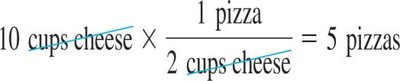
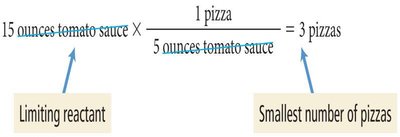
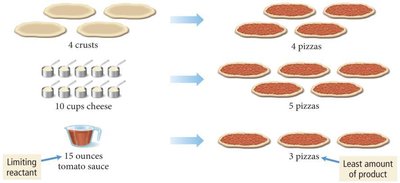
Theoretical Yield, Actual Yield, and Percent Yield
Theoretical yield is the maximum amount of product that can be formed from the limiting reactant. Actual yield is the amount obtained experimentally, and percent yield is the ratio of actual to theoretical yield, expressed as a percentage.
Theoretical Yield: Calculated from the limiting reactant.
Actual Yield: Measured experimentally.
Percent Yield:
Applications and Practice Problems
Practice problems include calculations involving limiting reactants, theoretical yield, and percent yield for various reactions such as the synthesis of ammonia, combustion reactions, and the production of methanol.
Example: Calculate the mass of aluminum needed to react with 2.5 mols of HCl.
Example: Determine the theoretical yield and percent yield for the formation of MgCl2 from Mg(OH)2.
Summary Table: Physical States in Chemical Equations
State | Symbol |
|---|---|
Solid | (s) |
Liquid | (l) |
Gas | (g) |
Dissolved in water (aqueous solution) | (aq) |
Conservation of Mass in Chemical Reactions
Balanced chemical equations demonstrate the conservation of mass, where the total mass of reactants equals the total mass of products.
Example:
4.0 g H2 + 32.0 g O2 = 36.0 g H2O
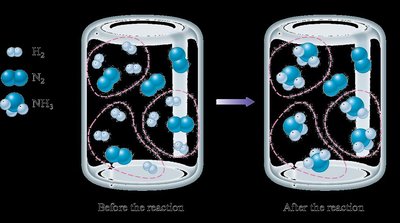
Visualizing Limiting Reactant in Chemical Reactions
Diagrams can help visualize the concept of limiting reactant, showing how reactant molecules decrease and product molecules increase during a reaction.
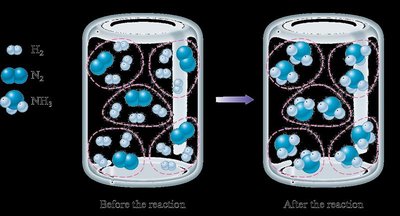
Additional info:
Some practice problems and examples were expanded for clarity and completeness. The pizza analogy was used to illustrate limiting reactant and theoretical yield concepts. All images included are directly relevant to the explanation of the adjacent paragraphs.
