 Indietro
Chemical Reactions, Stoichiometry, and Limiting Reactants
Guida di studio - Note intelligenti
 Appunti personalizzati basati sui tuoi materiali, ampliati con definizioni chiave, esempi e contesto.
Chemical Reactions and Balanced Equations
Law of Conservation of Mass and Charge
Balanced chemical equations are fundamental in chemistry because they reflect the law of conservation of mass and charge. This law states that the total mass and total charge must remain constant throughout a chemical reaction. Thus, the number of atoms of each element and the total charge on both sides of the equation must be equal.
Mass Conservation: The total mass of each element in the reactants equals the total mass in the products.
Charge Conservation: The total charge on the reactant side equals the total charge on the product side.
Balanced Equations: Used to represent chemical transformations accurately.
Steps for Balancing Chemical Equations
Balancing chemical equations ensures that the law of conservation of mass is obeyed. The following steps are typically used:
Write correct formulas for all reactants and products, including their physical states.
Balance elements that appear in only one reactant and one product first.
Adjust coefficients to balance the remaining elements as needed.
Check your work to ensure both mass and charge are balanced.
Combustion Reactions
Combustion reactions involve the reaction of a substance with oxygen, producing energy, carbon dioxide, and water. Hydrocarbons (compounds containing only hydrogen and carbon) are common reactants in combustion reactions.
General Form: Hydrocarbon + O2 → CO2 + H2O
Example: The combustion of methane:
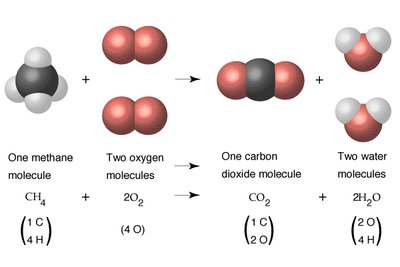
Each methane molecule reacts with two oxygen molecules to produce one carbon dioxide and two water molecules.
Balancing Complex Equations
When balancing equations with polyatomic ions that appear unchanged on both sides, treat them as units. For example, in the reaction:
Balance sodium (Na) and the nitrate ion (NO3-) as units.
Practice: Balancing Combustion Reactions
Balancing combustion reactions often involves fractional coefficients, which are then multiplied to obtain whole numbers. For example:
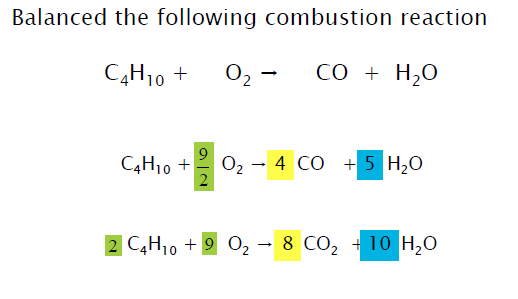
Another example for pentane:

Stoichiometric Calculations
Stoichiometry and Molar Ratios
Stoichiometry involves using balanced chemical equations to calculate the relationships between reactants and products. The coefficients in a balanced equation provide the molar ratios needed for these calculations.
Mole-to-mole conversions: Use the coefficients to convert between moles of different substances.
Mass-to-mole conversions: Use molar mass to convert between grams and moles.
For example, in the combustion of pentane ():
1 mole of pentane reacts with 8 moles of oxygen to produce 5 moles of carbon dioxide and 6 moles of water.
Lab Measurement: Graduated Cylinder Reading
Accurate measurement of liquid volumes is essential in stoichiometric calculations. Always read the meniscus at eye level for correct volume determination.
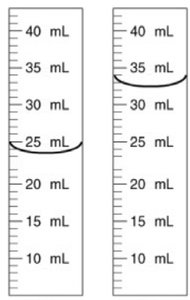
Example: Combustion Stoichiometry
Given a volume of a liquid hydrocarbon and its density, you can calculate the mass, moles, and the amount of oxygen required for complete combustion.
Calculate mass:
Calculate moles:
Use the balanced equation to find moles of O2 needed.
Convert moles of O2 to grams:
Combustion Analysis
Determining Empirical Formulas
Combustion analysis is used to determine the empirical formula of compounds containing carbon, hydrogen, and oxygen. The masses of CO2 and H2O produced are measured to calculate the amounts of C and H in the original sample. The remaining mass is attributed to O.
Calculate mass of C from CO2:
Calculate mass of H from H2O:
Calculate mass of O by difference:
Convert masses to moles and find the simplest whole-number ratio.
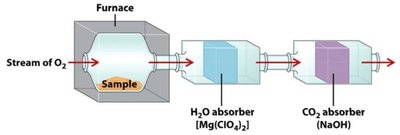
Limiting Reactant
Definition and Identification
The limiting reactant is the substance that is completely consumed first in a chemical reaction, thus limiting the amount of product formed. The reaction stops when the limiting reactant is used up, and any other reactants are in excess.
Calculate the amount of product formed from each reactant.
The reactant that produces the least amount of product is the limiting reactant.

Example: Limiting Reactant Calculation
For the reaction:
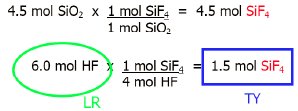
Given 4.5 mol SiO2 and 6.0 mol HF:
SiO2 can produce 4.5 mol SiF4, but HF can only produce 1.5 mol SiF4.
HF is the limiting reactant.
Visual Representation of Limiting Reactant
Limiting reactant problems can be visualized using molecular diagrams, which show which reactant is consumed first and which is in excess.

Summary Table: Key Concepts in Stoichiometry
Concept | Definition | Key Equation |
|---|---|---|
Balanced Equation | Represents the conservation of mass and charge | |
Stoichiometry | Quantitative relationship between reactants and products | |
Limiting Reactant | Reactant that determines the maximum amount of product | Compare product amounts from each reactant |
Combustion Analysis | Determines empirical formula from combustion products | Mass CO2, H2O → moles C, H, O |
