 Indietro
Chemistry 1210 Midterm Study Guidance
Guida di studio - Note intelligenti
 Appunti personalizzati basati sui tuoi materiali, ampliati con definizioni chiave, esempi e contesto.
Q1. How many grams of AgNO3 are needed to make 250 mL of a 0.135 M solution?
Background
Topic: Solution Preparation & Molarity
This question tests your ability to use molarity to calculate the mass of a solute required to prepare a specific volume of solution.
Key Terms and Formulas:
Molarity ():
Moles: (where is in liters)
Mass:
Step-by-Step Guidance
Convert the volume from mL to L: .
Calculate the moles of AgNO3 needed using .
Find the molar mass of AgNO3 using the periodic table: , , .
Set up the calculation for mass: .
Try solving on your own before revealing the answer!
Final Answer: 5.73 g
We calculated the mass using the correct molarity and molar mass.
Q2. What is the concentration of HCl if 10.00 mL of HCl is titrated with 0.1250 M NaOH and requires 12.33 mL to reach the endpoint?
Background
Topic: Acid-Base Titration
This question tests your ability to use titration data to determine the concentration of an unknown acid solution.
Key Terms and Formulas:
Titration equation: (for monoprotic acid and base)
= concentration of HCl (unknown), = volume of HCl
= concentration of NaOH, = volume of NaOH
Step-by-Step Guidance
Write the balanced equation: .
Identify the known values: , , .
Set up the titration equation: .
Rearrange to solve for : .
Try solving on your own before revealing the answer!
Final Answer: 0.1541 M
We used the titration equation and plugged in the values correctly.
Q3. If the concentration of SO42- is 0.500 M in a solution of Al2(SO4)3, what is the molar concentration of Al3+?
Background
Topic: Stoichiometry & Solution Chemistry
This question tests your ability to relate the concentration of ions in a solution to the formula of the compound.
Key Terms and Formulas:
Formula unit: Al2(SO4)3 dissociates into 2 Al3+ and 3 SO42-
Stoichiometric ratio:
Step-by-Step Guidance
Write the dissociation equation: .
Use the given SO42- concentration to find the concentration of Al3+ using the stoichiometric ratio.
Set up the proportion: .
Try solving on your own before revealing the answer!
Final Answer: 0.333 M
We used the stoichiometric ratio from the formula unit to relate the ion concentrations.
Q4. What is the oxidation number of sulfur in Al2(SO4)3?
Background
Topic: Oxidation Numbers
This question tests your ability to assign oxidation numbers to elements in a compound.
Key Terms and Formulas:
Oxidation number rules: Oxygen is usually -2, total charge of SO42- is -2.
Sum of oxidation numbers in SO42-:
Step-by-Step Guidance
Assign oxidation numbers: Oxygen is -2.
Set up the equation for SO42-: .
Solve for the oxidation number of sulfur.
Try solving on your own before revealing the answer!
Final Answer: +6
Sulfur has an oxidation number of +6 in sulfate.
Q5. Which statement best describes an atomic orbital?
Background
Topic: Atomic Structure & Quantum Mechanics
This question tests your understanding of the quantum mechanical model of the atom and the concept of orbitals.
Key Terms:
Atomic orbital: A region in space with a high probability of finding an electron.
Quantum mechanical model: Electrons are not in fixed paths but in probability regions.
Step-by-Step Guidance
Recall the definition of an atomic orbital from quantum theory.
Eliminate answers that refer to fixed paths or orbits.
Focus on the statement that mentions probability and regions in space.
Try solving on your own before revealing the answer!
Final Answer: (e) a region in space around the nucleus where there is a high probability that the electron can be found
This is the quantum mechanical definition of an atomic orbital.
Q6. How many valence electrons does an atom of aluminum (Al) have?
Background
Topic: Electron Configuration & Periodic Table
This question tests your ability to determine the number of valence electrons using the periodic table.
Key Terms:
Valence electrons: Electrons in the outermost shell.
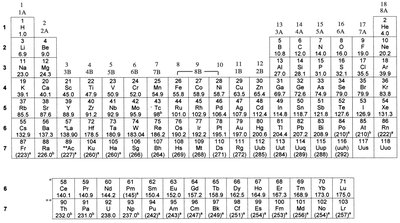
Periodic table group: Al is in group 13 (3A).
Step-by-Step Guidance
Locate aluminum (Al) on the periodic table.
Identify its group number (13 or 3A).
Recall that group number for main group elements indicates the number of valence electrons.
Try solving on your own before revealing the answer!
Final Answer: 3
Aluminum has 3 valence electrons, as indicated by its position in group 13 (3A).
Q7. Which set of four quantum numbers (n, l, ml, ms) is not possible for an electron in an atom?
Background
Topic: Quantum Numbers
This question tests your understanding of the rules for quantum numbers in atomic structure.
Key Terms:
Quantum numbers: (principal), (angular), (magnetic), (spin)
Allowed values: ranges from 0 to , from to , is
Step-by-Step Guidance
Check each set for valid combinations: must be less than .
Verify that is within the range to .
Confirm that is either or .
Try solving on your own before revealing the answer!
Final Answer: (d) 2, 0, 1, -½
For , must be 0, not 1. This set is not possible.
Q8. What is the energy (in joules) of a photon of light with a wavelength of 0.0010 m?
Background
Topic: Light & Photons
This question tests your ability to use the relationship between energy, wavelength, and frequency for photons.
Key Terms and Formulas:
Energy of a photon:
Frequency:
Combine:
,
Step-by-Step Guidance
Write the formula: .
Plug in the values for , , and .
Set up the calculation for energy.
Try solving on your own before revealing the answer!
Final Answer: 2.0 x 10⁻²² J
We used the correct formula and plugged in the values for Planck's constant, speed of light, and wavelength.
Q9. For each species, give the complete ground state electron configuration and the number of unpaired electrons.
Background
Topic: Electron Configuration
This question tests your ability to write full electron configurations and determine unpaired electrons.
Key Terms:
Electron configuration: Order of filling orbitals using the periodic table.
Unpaired electrons: Electrons not paired in orbitals.
Step-by-Step Guidance
Find the atomic number for S and V using the periodic table.
Write the full electron configuration for each element.
Identify the number of unpaired electrons by filling the orbitals according to Hund's rule.
Try solving on your own before revealing the answer!
Final Answer:
S: ; 2 unpaired electrons
V: ; 3 unpaired electrons
We used the periodic table to determine the electron configuration and counted the unpaired electrons.
Q10. Draw pictures representing separate aqueous solutions of HF and FeBr2. Show all relevant detail including charge and water molecules.
Background
Topic: Solution Chemistry & Dissociation
This question tests your understanding of how ionic and molecular compounds behave in water.
Key Terms:
Dissociation: Ionic compounds split into ions in water.
Hydration: Water molecules surround ions.
HF: Weak acid, partial dissociation.
FeBr2: Strong electrolyte, full dissociation.
Step-by-Step Guidance
For HF, show some molecules dissociated into H+ and F-, and some as intact HF.
For FeBr2, show Fe2+ and Br- ions fully separated and surrounded by water molecules.
Indicate charges and water molecules as circles around ions.
Try drawing on your own before revealing the answer!
Final Answer:
HF (aq): Some HF molecules, some H+ and F- ions, each surrounded by water molecules.
FeBr2 (aq): Fe2+ ions and Br- ions, each surrounded by water molecules.
Water molecules are shown as circles, charges are indicated, and ions are separated.
Q11. Balance the half-reaction MnO4- → MnO2 in acidic solution.
Background
Topic: Redox Reactions & Balancing
This question tests your ability to balance redox half-reactions in acidic solution.
Key Terms and Steps:
Half-reaction: Only one part of a redox reaction.
Balance atoms other than O and H.
Balance O with H2O, H with H+, and charge with electrons.
Step-by-Step Guidance
Balance Mn atoms (already balanced).
Balance O atoms by adding H2O.
Balance H atoms by adding H+.
Balance charge by adding electrons.
Try balancing on your own before revealing the answer!
Final Answer:
All atoms and charges are balanced in acidic solution.
Q12. Balance the redox reaction in basic solution: 2 H+ + 3 CN- + 2 NO3- → 3 CNO- + 2 NO + H2O
Background
Topic: Redox Reactions & Balancing in Basic Solution
This question tests your ability to convert a balanced acidic redox equation to basic conditions.
Key Terms and Steps:
Balanced in acid: Add OH- to both sides to neutralize H+.
Cancel water and other species as needed.
Step-by-Step Guidance
Add 2 OH- to both sides to neutralize 2 H+.
Combine H+ and OH- to form H2O.
Cancel any water molecules that appear on both sides.
Try balancing on your own before revealing the answer!
Final Answer:
We converted the acidic equation to basic by adding OH- and canceling water.
Q13. Give the names and molecular formulas for the following compounds:
Background
Topic: Nomenclature & Chemical Formulas
This question tests your ability to name compounds and write their formulas.
Key Terms:
Systematic naming rules for ionic and molecular compounds.
Polyatomic ions and their formulas.
Step-by-Step Guidance
For each compound, identify the cation and anion.
Apply naming rules: transition metals use Roman numerals, polyatomic ions use standard names.
Write the correct molecular formula for each name.
Try naming and writing formulas on your own before revealing the answer!
Final Answer:
(a) Co2(SO4)3: Cobalt(III) sulfate
(b) NaClO4: Sodium perchlorate
(c) HBrO2: Bromous acid
(d) (NH4)2CO3: Ammonium carbonate
(e) Calcium phosphate: Ca3(PO4)2
(f) Aluminum cyanide: Al(CN)3
(g) Copper(II) nitrate: Cu(NO3)2
(h) Sodium nitrite: NaNO2
Q14. What is the maximum mass in grams of Hg2Br2 that could be produced from mixing 30.0 mL of 0.300 M Hg2(NO3)2 with 25.0 mL of 0.500 M NaBr?
Background
Topic: Stoichiometry & Limiting Reactant
This question tests your ability to use stoichiometry to determine the maximum mass of product formed in a reaction.
Key Terms and Formulas:
Limiting reactant: The reactant that determines the maximum amount of product.
Stoichiometry: Use balanced equation to relate moles of reactants and products.
Mass:
Step-by-Step Guidance
Write the balanced equation: .
Calculate moles of each reactant using molarity and volume.
Determine the limiting reactant by comparing mole ratios.
Calculate moles of Hg2Br2 produced based on the limiting reactant.
Set up the calculation for mass using the molar mass of Hg2Br2.
Try solving on your own before revealing the answer!
Final Answer: 8.98 g
Limiting reactant is Hg2(NO3)2 (0.00900 mol). Moles of Hg2Br2 produced = 0.00900 mol.
Molar mass of Hg2Br2 = 8.98 g.
We used stoichiometry and limiting reactant analysis to find the maximum mass.
Q15. For each reaction, give the balanced molecular and net ionic equations. Include physical states. If no reaction occurs, write "no reaction."
Background
Topic: Chemical Reactions & Precipitation
This question tests your ability to write balanced equations and identify precipitates.
Key Terms:
Molecular equation: Shows all reactants and products.
Net ionic equation: Shows only species that change during the reaction.
Physical states: (s), (l), (g), (aq)
Step-by-Step Guidance
For each reaction, identify possible products and check solubility rules.
Write the balanced molecular equation, including physical states.
Write the net ionic equation, showing only the ions involved in forming a precipitate.
Try writing equations on your own before revealing the answer!
Final Answer:
(a) Ba(NO3)2 (aq) + Na2SO4 (aq) → BaSO4 (s) + 2 NaNO3 (aq)
Net ionic: Ba2+ (aq) + SO42- (aq) → BaSO4 (s)
(b) Al2(SO4)3 (aq) + 6 KOH (aq) → 2 Al(OH)3 (s) + 3 K2SO4 (aq)
Net ionic: 2 Al3+ (aq) + 6 OH- (aq) → 2 Al(OH)3 (s)
(c) HCN (aq) + Ca(OH)2 (aq) → Ca(CN)2 (aq) + 2 H2O (l)
Net ionic: 2 HCN (aq) + Ca(OH)2 (aq) → Ca(CN)2 (aq) + 2 H2O (l)
(d) HClO4 (aq) + NH3 (aq) → NH4ClO4 (aq)
Net ionic: H+ (aq) + NH3 (aq) → NH4+ (aq)
