 Indietro
Chemistry and Measurements: Unit Conversions, Density, and Concentration
Guida di studio - Note intelligenti
 Appunti personalizzati basati sui tuoi materiali, ampliati con definizioni chiave, esempi e contesto.
Chapter 2: Chemistry and Measurements
Arithmetic of Scientific Numbers
Understanding how to handle scientific numbers is essential in chemistry for accurate calculations and reporting. This includes recognizing exact numbers, significant figures, and the rules for arithmetic operations.
Exact Numbers: Numbers from definitions or counting (e.g., 1 kg = 1000 g, 12 eggs = 1 dozen) are considered exact and have infinite significant figures.
Measured Numbers: Numbers obtained from measurements have a limited number of significant figures and are subject to uncertainty.
Significant Figures: The number of meaningful digits in a measured or calculated quantity. When multiplying or dividing, the result should have the same number of significant figures as the value with the fewest significant figures.
Example: (5 significant figures)
Chemistry and Measurements: SI and British Units
Chemistry relies on the International System of Units (SI) for consistency and accuracy. However, conversions between SI and British units are often necessary.
SI Units: Standard units such as meter (m) for length and kilogram (kg) for mass.
British Units: Units such as inch (in) and pound (lb).
Unit Conversion: The process of converting a quantity expressed in one unit to another unit using conversion factors.
Example Conversion Factors: 1.00 m = 3.28 ft, 1.000 kg = 2.205 lbs, 1 ft = 12 in
Dimensional Analysis and Derived Units
Dimensional analysis is a systematic approach to unit conversions, especially when dealing with derived units such as area, volume, and density.
Derived Units: Formed by combining base units (e.g., area in , volume in , density in ).
Conversion of Derived Units: When converting derived units, apply the conversion factor to each dimension. For example, to convert to , cube the conversion factor for length: .
Example:
Density and Its Applications
Density is a fundamental property that relates the mass of a substance to its volume. It is crucial for understanding why substances float or sink and for performing various chemical calculations.
Definition: , where d is density, m is mass, and V is volume.
Units: Commonly expressed in or .
Example: The density of gold:
Density and Floating: In a mixture, the substance with lower density floats above the substance with higher density.
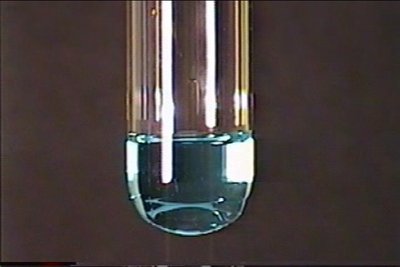
Table: Densities of Common Substances
Substance | Density () |
|---|---|
Water, H2O(l) | 1.00 |
Ice, H2O(s) | 0.92 |
Salt, NaCl(s) | 2.16 |
Copper, Cu(s) | 8.96 |
Iron, Fe(s) | 7.86 |
Specific Gravity
Specific gravity is a dimensionless quantity that compares the density of a substance to the density of water at 4°C (1.00 g/mL).
Formula:
Example: Density of ethanol is 0.79 g/mL, so
Note: Specific gravity has no units.
Percent, Parts Per Million (ppm), and Parts Per Billion (ppb)
These expressions are used to describe the concentration of a component in a mixture.
Percent (%):
Parts per million (ppm):
Parts per billion (ppb):
Units: The numerator and denominator must be in the same units for these calculations.
Example: If 3.00 kg of water contains 1.75 mg of cadmium,
Dimensional Analysis: Dealing with Denominator Units
When units appear in the denominator, they represent a unity in that unit. For example, speed and density can be rewritten to show the hidden denominator unity.
Example:
Example:
Practice Problems and Applications
Applying these concepts to solve real-world chemistry problems is essential for mastery.
Convert between units (e.g., meters to inches, kilograms to pounds).
Calculate the density, specific gravity, and concentration (percent, ppm, ppb) of substances in mixtures.
Use dimensional analysis to solve problems involving derived units and denominator units.
Apply significant figures rules to ensure accuracy in calculations.
