 Indietro
Classification of Pure Substances and Mixtures Using Particle Diagrams
Guida di studio - Note intelligenti
 Appunti personalizzati basati sui tuoi materiali, ampliati con definizioni chiave, esempi e contesto.
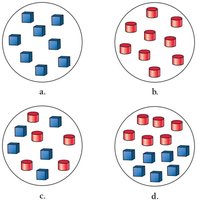
Q1. Each shape represents a type of particle (such as an atom or a molecule). Classify each image as a pure substance, homogeneous mixture, or heterogeneous mixture.
Background
Topic: Classification of Matter
This question tests your understanding of how to distinguish between pure substances, homogeneous mixtures, and heterogeneous mixtures based on particle diagrams. In chemistry, these classifications help us understand the composition and properties of materials.
Key Terms:
Pure Substance: Matter that has a fixed composition and distinct properties. It can be an element (one type of atom) or a compound (two or more types of atoms chemically bonded).
Homogeneous Mixture: A mixture where the composition is uniform throughout; the different components are not visually distinguishable.
Heterogeneous Mixture: A mixture where the composition is not uniform; the different components are visually distinguishable.
Step-by-Step Guidance
Examine each diagram and identify the types of particles present. Are all particles the same, or are there different types?
For diagrams with only one type of particle, consider whether it represents an element (single shape) or a compound (two shapes bonded together).
For diagrams with more than one type of particle, determine if the mixture is homogeneous (evenly distributed) or heterogeneous (unevenly distributed or clustered).
Compare the arrangement and distribution of particles in each diagram to decide which classification fits best.
Set up your answers for each diagram (a, b, c, d) based on your observations, but pause before finalizing your classifications.
Try solving on your own before revealing the answer!
Final Answer:
a) Pure substance (all particles are identical, likely an element)
b) Pure substance (all particles are identical, but a different type from a, likely another element)
c) Homogeneous mixture (two types of particles evenly distributed throughout the sample)
d) Heterogeneous mixture (two types of particles, but they are clustered or unevenly distributed)
Each diagram is classified based on the uniformity and type of particles present. Pure substances have only one type of particle, while mixtures have more than one. Homogeneous mixtures are uniform, and heterogeneous mixtures are not.
