 Indietro
Compounds, Bonding, and Nomenclature in General Chemistry
Guida di studio - Note intelligenti
 Appunti personalizzati basati sui tuoi materiali, ampliati con definizioni chiave, esempi e contesto.
Bonds and Compounds
Introduction to Compounds
Compounds are substances formed from two or more elements in a fixed ratio, held together by chemical bonds. The properties of a compound differ from those of its constituent elements, and compounds cannot be separated by physical methods.
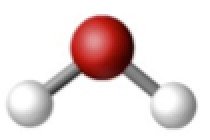
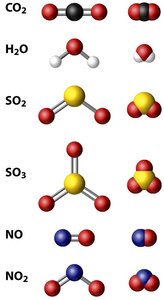
Molecular formula: Shows the exact number and type of atoms in a molecule (e.g., H2O).
Structural formula: Indicates the spatial arrangement of atoms (e.g., H-O-H).
Ball-and-stick model: Visualizes atoms as spheres and bonds as sticks.
Space-filling model: Represents the relative sizes and spatial relationships of atoms.
Chemical Reactions and Formulas
Chemical Equations
Chemical equations use chemical formulas to express the identities and quantities of substances involved in a reaction.
Reactants: Substances consumed during the reaction.
Products: Substances formed as a result of the reaction.
Example:
Law of Multiple Proportions
Combining Elements in Different Ratios
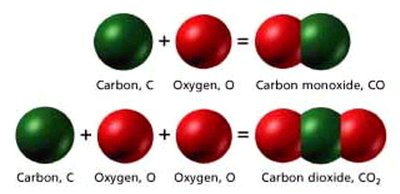
The same elements can combine in different ratios to form different compounds. The law of multiple proportions states that if two elements form more than one compound, the masses of one element that combine with a fixed mass of the other are in the ratio of small whole numbers.
Example: Carbon and oxygen form CO and CO2 in different ratios.

Types of Compounds and Bonding
Classification of Compounds
Compounds are classified based on the types of bonds holding their atoms together.
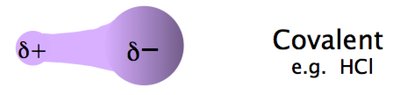
Molecular (Covalent) Compounds: Atoms held together by covalent bonds (sharing electrons).
Ionic Compounds: Composed of positively charged cations and negatively charged anions held together by electrostatic attraction.
Metallic Bonds: Attraction between positive ions and freely mobile electrons ("electron sea").

Properties Related to Bond Type
Bonding and Physical Properties
The type of bonding in a compound determines its physical properties, such as malleability, conductivity, and solubility.
Metals: Malleable due to the absence of electrostatic repulsion; metallic bonds allow deformation.
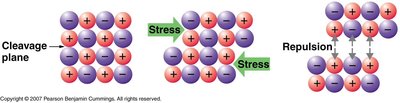
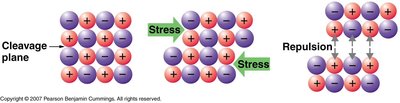
Ionic Crystals: Brittle due to repulsion between like charges when stress is applied.

Nomenclature of Compounds
Molecular and Empirical Formulas
Molecular formula: Exact number and type of atoms in a molecule (e.g., C6H6).
Empirical formula: Simplest whole-number ratio of elements (e.g., CH for benzene).
Formula unit: Smallest electrically neutral unit in an ionic compound.
Binary Molecular/Covalent Compounds
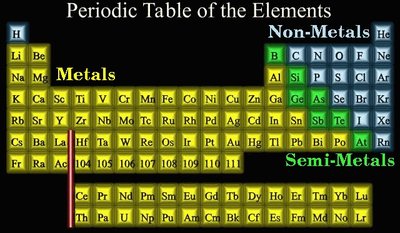
Binary molecular compounds consist of two nonmetals.
First element is named first.
Second element is named with the suffix "-ide".
Prefixes indicate the number of atoms: mono-, di-, tri-, tetra-, penta-, hexa-, hepta-, octa-, nona-, deca-.
Never use "mono-" for the first element.
Example: P2O5 is diphosphorus pentoxide.
Examples of Binary Molecular Compounds
NF3: nitrogen trifluoride
NO: nitrogen monoxide
NO2: nitrogen dioxide
N2O: dinitrogen monoxide (laughing gas)
N2O4: dinitrogen tetraoxide
PCl5: phosphorous pentachloride
S2F10: disulfur decafluoride
H2O: dihydrogen monoxide (water)
NH3: nitrogen trihydride (ammonia)
PH3: phosphorous trihydride (phosphine)
Binary Ionic Compounds
Binary ionic compounds consist of cations (usually metals) and anions (usually nonmetals).
Formulas must be electrically neutral.
Cation is named first using the elemental name.
Anion is named with the "-ide" ending.
No numerals for the number of atoms in the name.
Example: Na2O is sodium oxide, not disodium monoxide.
Naming Cations
Cations can be single atom ions or polyatomic ions (e.g., NH4+ is ammonium).
Group I metals (charge 1+), Group II metals (charge 2+), Al3+ (aluminium), Zn2+ (zinc), Ag+ (silver).
Metals with multiple charges: name followed by Roman numerals or suffixes (-ous for lower, -ic for higher valency).
Examples: Cu+ (copper(I), cuprous), Cu2+ (copper(II), cupric), Fe2+ (iron(II), ferrous), Fe3+ (iron(III), ferric).

Naming Anions
Negatively charged elements have the suffix "-ide" (e.g., O2- is oxide, S2- is sulfide).
Polyatomic ions (usually oxoanions) have suffixes "-ate" or "-ite". "-ate" indicates more oxygen than "-ite".
Examples: SO42- (sulfate), SO32- (sulfite), NO3- (nitrate), NO2- (nitrite).
Common Oxoanions
Anion | Anion Name |
|---|---|
SO32- | Sulfite |
SO42- | Sulfate |
ClO- | Hypochlorite |
ClO2- | Chlorite |
ClO3- | Chlorate |
ClO4- | Perchlorate |
Other Common Polyatomic Ions
Acetate: C2H3O2-
Carbonate: CO32-
Perchlorate: ClO4-
Nitrate: NO3-
Sulfate: SO42-
Chromate: CrO42-
Hydrogen carbonate: HCO3-
Naming Ionic Compounds: Examples
NaOH: sodium hydroxide
CaCO3: calcium carbonate
FeSO4: iron(II) sulfate or ferrous sulfate
FeSO3: iron(II) sulfite or ferrous sulfite
(NH4)3PO4: ammonium phosphate
Naming Acids and Acid Salts
Binary Acids
Binary acids contain hydrogen and a nonmetal (usually a halogen).
Name: "hydro" + base name + "ic" + "acid"
Examples: HBr(aq): hydrobromic acid, HCl(aq): hydrochloric acid
Oxoacids
Oxoacids have the general formula HaXbOc, where X is an element other than hydrogen or oxygen. The name is derived from the polyatomic oxoanion.
If the anion ends in "-ate", the acid name ends in "-ic".
If the anion ends in "-ite", the acid name ends in "-ous".
Examples: SO32- (sulfite) → H2SO3 (sulfurous acid); SO42- (sulfate) → H2SO4 (sulfuric acid)
Anion | Anion Name | Acid | Acid Name |
|---|---|---|---|
SO32- | Sulfite | H2SO3 | Sulfurous acid |
SO42- | Sulfate | H2SO4 | Sulfuric acid |
ClO- | Hypochlorite | HClO | Hypochlorous acid |
ClO2- | Chlorite | HClO2 | Chlorous acid |
ClO3- | Chlorate | HClO3 | Chloric acid |
ClO4- | Perchlorate | HClO4 | Perchloric acid |
Naming Acid Salts
Acid salts contain extra hydrogens on the anion, which are acidic and can be released as H+ in water.
Name: [cation name] [anion name]
Examples: calcium hydrogen carbonate, magnesium dihydrogen phosphite
Nomenclature Summary Table
Compound Type | Naming Rule |
|---|---|
Binary molecular compound | numeral-first + numeral(root)ide |
Ionic compound | cation name (I,II,III…) or –rous, -ic; anion –ide; polyatoms: hypo(root)ite, –ite, -ate, per(root)ate |
Acid compound | cation + anion; binary acid: hydro(root)ic acid; oxoacid: hypo(root)ous, –ous, -ic, per(root)ic + acid |

Conclusion
Understanding the types of compounds, their bonding, and the rules for naming them is fundamental in general chemistry. Mastery of these concepts enables students to interpret chemical formulas, write chemical equations, and predict compound properties. Additional info: Some images and tables were inferred to clarify the academic context and reinforce the explanations.
