 Indietro
Covalent Bonding and Electron-Dot Structures: Chapter 7 Study Guide
Guida di studio - Note intelligenti
 Appunti personalizzati basati sui tuoi materiali, ampliati con definizioni chiave, esempi e contesto.
Chapter 7: Covalent Bonding and Electron-Dot Structures
Covalent Bonding in Molecules
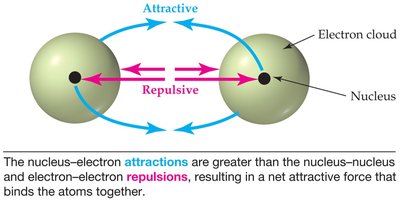
Covalent bonds are formed when atoms share electrons to achieve stable electron configurations. The shared electrons are attracted to the nuclei of both atoms, resulting in a net attractive force that binds the atoms together.
Covalent Bond: A bond resulting from the sharing of electrons between atoms.
Bond Formation: The balance between attractive forces (nucleus-electron) and repulsive forces (nucleus-nucleus, electron-electron) determines bond length and stability.
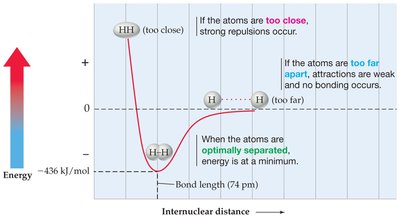
Bond Formation: Energy vs. Internuclear Distance
As two atoms approach each other, the energy of the system changes. The optimal bond length is the distance at which the energy is minimized, balancing attraction and repulsion.
If atoms are too close, repulsion dominates and energy increases.
If atoms are too far apart, attraction is weak and no bond forms.
At optimal separation, energy is at a minimum and a stable bond forms.
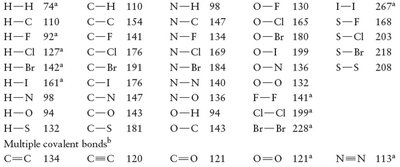
Strengths and Lengths of Covalent Bonds
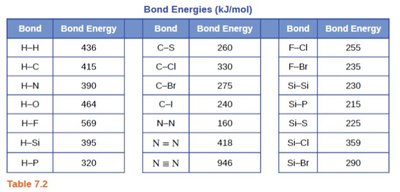
The strength and length of covalent bonds depend on the types of atoms involved and the number of shared electrons. Multiple bonds (double, triple) are shorter and stronger than single bonds.
Bond Length: The optimum distance between nuclei in a covalent bond, predictable from atomic radii.
Bond Dissociation Energy (D): The energy required to break a bond in an isolated gaseous molecule.
Bonds between larger atoms are generally longer and weaker.
Multiple bonds are shorter and stronger than single bonds.
Polar Covalent Bonds: Electronegativity
Electronegativity is the ability of an atom in a molecule to attract shared electrons. Differences in electronegativity between atoms lead to bond polarity.
Electronegativity (EN): The tendency of an atom to attract electrons in a bond.
EN increases left to right across a period and decreases top to bottom in a group.
Fluorine (F) is the most electronegative element.
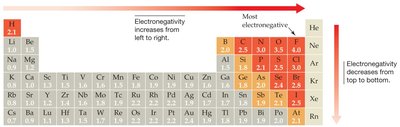
Bond Polarity: Nonpolar, Polar, and Ionic Bonds
Bonds can be classified based on the difference in electronegativity between the atoms:
Nonpolar Covalent: Electrons are shared equally (ΔEN < 0.5).
Polar Covalent: Electrons are shared unequally, resulting in partial charges (ΔEN = 0.5–2.0).
Ionic: Electrons are transferred, resulting in full charges (ΔEN > 2.0).
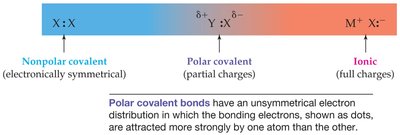

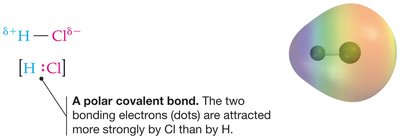
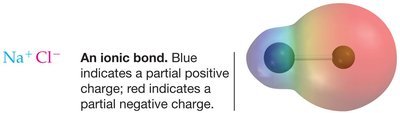
Bond Polarity Assessment Summary
The type of bond can be predicted from the electronegativity difference (ΔEN) between atoms:
ΔEN | Bond Type | Example |
|---|---|---|
< 0.5 | Nonpolar covalent | Cl–Cl (ΔEN = 0) |
0.5 – 2.0 | Polar covalent | H–Cl (ΔEN = 0.9) |
> 2.0 | Ionic | Na+Cl– (ΔEN = 2.1) |
The more electronegative atom carries the partial negative charge (δ–).
A Comparison of Ionic and Covalent Compounds
Ionic and covalent compounds differ in their physical properties due to the nature of their bonding.
Property | NaCl | HCl |
|---|---|---|
Formula mass | 58.44 amu | 36.46 amu |
Physical appearance | White solid | Colorless gas |
Type of bond | Ionic | Covalent |
Melting point | 801 °C | −115 °C |
Boiling point | 1465 °C | −84.9 °C |
Ionic: High melting and boiling points due to strong lattice energy.
Covalent: Strong bonds within molecules, but weak intermolecular forces.
Lewis Symbols and Structures
Lewis symbols represent the valence electron configuration of atoms and ions. Each dot represents a valence electron.
Lewis Symbol: Elemental symbol surrounded by dots for each valence electron.
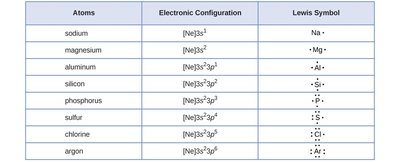
Formation of Ions Using Lewis Symbols
Lewis symbols can illustrate the formation of cations and anions by showing the loss or gain of electrons.


Formation of Ionic and Covalent Compounds
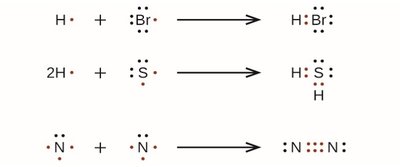
Lewis symbols are used to show the transfer of electrons in ionic compounds and the sharing of electrons in covalent bonds.
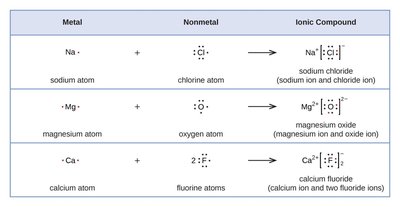
The Octet Rule
Main group elements tend to form enough bonds to obtain eight valence electrons, achieving a stable octet. Hydrogen is an exception, requiring only two electrons.
Octet Rule: Atoms form bonds to achieve eight valence electrons.
Hydrogen achieves stability with two electrons.
Transition metals and some other elements may not follow the octet rule.
Electron-Dot Structures (Lewis Structures)
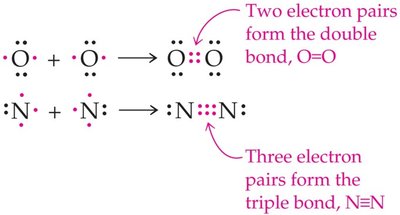
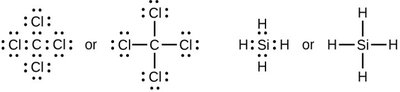
Lewis structures represent the distribution of valence electrons in molecules, showing bonding pairs and lone pairs.
Single, Double, Triple Bonds: Atoms share one, two, or three pairs of electrons, respectively.
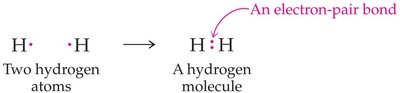

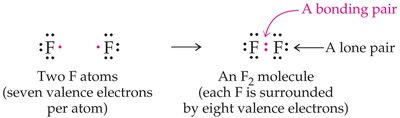
Procedure for Drawing Electron-Dot Structures
Follow these steps to draw Lewis structures for molecules and ions:
Count total valence electrons for all atoms in the molecule.
Connect atoms using lines for bonding pairs, choosing the central atom (usually less electronegative).
Distribute remaining electrons as lone pairs to complete octets on terminal atoms, then central atom.
Form multiple bonds if necessary to complete octets.

Exceptions to the Octet Rule
Some molecules do not follow the octet rule:
Odd-electron molecules: Free radicals with an unpaired electron.
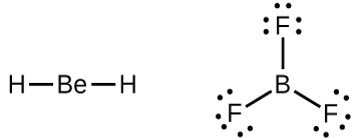
Electron-deficient molecules: Central atoms with fewer than eight electrons (e.g., BeH2, BF3).
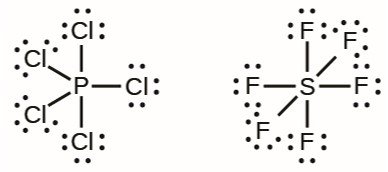
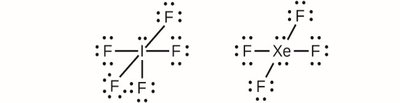
Hypervalent molecules: Central atoms with more than eight electrons (e.g., PF5, SF6, ICl3).
Resonance
Some molecules have multiple valid Lewis structures, called resonance structures. The actual electronic structure is an average of these forms.
Resonance: Distribution of electrons among multiple equivalent structures.
Resonance is indicated by double-headed arrows between structures.

Formal Charges
Formal charge helps determine the most accurate Lewis structure when multiple possibilities exist. It is calculated as:
Formal charge = # valence e− − # lone pair e− − 1/2 # bonding e−
The sum of formal charges in a molecule must equal the overall charge.
Structures with formal charges closest to zero are preferred.
Negative formal charges should be on the more electronegative atoms.
Example: Determining the best structure and major resonance contributor for the thiocyanate ion (CNS−).
Summary Table: Bond Lengths and Energies
Bond | Bond Length (pm) | Bond Energy (kJ/mol) |
|---|---|---|
H–H | 74 | 436 |
H–C | 110 | 415 |
H–N | 98 | 390 |
H–O | 92 | 464 |
H–F | 92 | 569 |
N≡N | 113 | 946 |
O=O | 121 | 418 |
C=C | 134 | 330 |
Additional info: Bond length and energy values are useful for predicting molecular stability and reactivity.
