 Indietro
Electrochemistry: Redox Reactions, Galvanic Cells, and Cell Potentials
Guida di studio - Note intelligenti
 Appunti personalizzati basati sui tuoi materiali, ampliati con definizioni chiave, esempi e contesto.
Electrochemistry
Introduction to Electrochemistry
Electrochemistry is the branch of chemistry that studies the relationship between electricity and chemical reactions, particularly those involving oxidation and reduction (redox) processes. It encompasses the generation of electrical energy from spontaneous chemical reactions and the use of electrical energy to drive non-spontaneous reactions. Batteries are practical devices based on these principles, converting stored chemical energy into electrical energy via redox reactions.
Redox Reaction: A chemical reaction involving the transfer of electrons between species, resulting in changes in oxidation numbers.
Oxidation: Loss of electrons or an increase in oxidation number.
Reduction: Gain of electrons or a decrease in oxidation number.
Oxidizing Agent: The species that is reduced and causes oxidation.
Reducing Agent: The species that is oxidized and causes reduction.
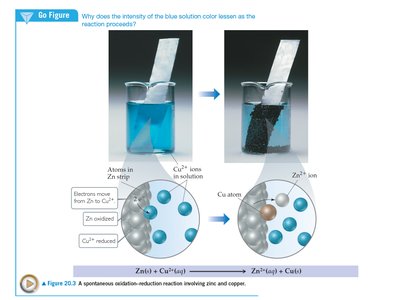
Example: The reaction between zinc metal and copper(II) ion:
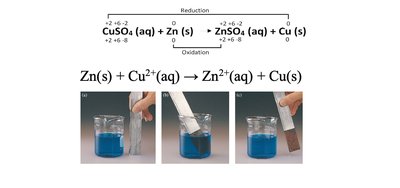
This reaction demonstrates the direct transfer of electrons from zinc to copper(II) ions, resulting in the deposition of copper metal and the formation of zinc ions.
Oxidation Numbers
Oxidation numbers (or states) are assigned to elements in compounds to track electron transfer in redox reactions. The rules for assigning oxidation numbers are:
Free elements: 0
Monatomic ions: Equal to the ion charge
Sum in a compound: Equals the overall charge
Fluorine: -1 in compounds
Hydrogen: +1 in most compounds
Oxygen: -2 in most compounds
These rules help identify which species are oxidized and reduced in a reaction.
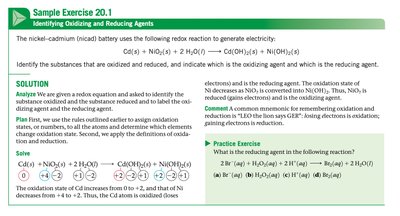
Balancing Redox Reactions
Balancing in Acidic Solution
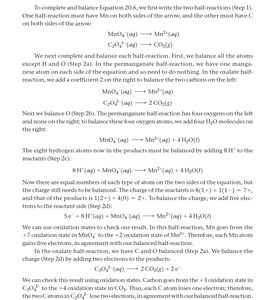
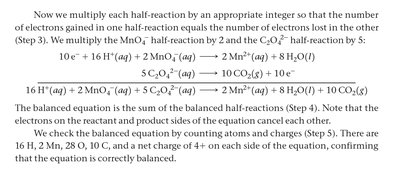
Redox reactions are balanced using the half-reaction method, especially in aqueous solutions. The steps are:
Divide the reaction into oxidation and reduction half-reactions.
Balance all elements except H and O.
Balance O by adding H2O.
Balance H by adding H+.
Balance charge by adding electrons (e-).
Multiply half-reactions by integers to equalize electron transfer.
Add the half-reactions and cancel species as needed.
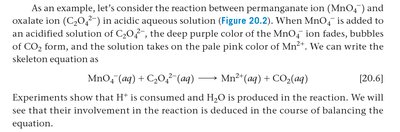
Example: Balancing the reaction between permanganate and oxalate ions:
Galvanic (Voltaic) Cells
Structure and Function
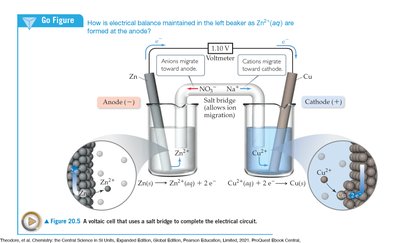
Galvanic cells (or voltaic cells) are devices that convert chemical energy from spontaneous redox reactions into electrical energy. They consist of two electrodes (anode and cathode) immersed in electrolyte solutions and connected by a wire and a salt bridge.
Anode: Electrode where oxidation occurs (loss of electrons).
Cathode: Electrode where reduction occurs (gain of electrons).
Salt Bridge: Maintains electrical neutrality by allowing ion migration.
Cell Notation: A shorthand to represent the components of a galvanic cell. For example:
Cell Potential (Ecell)
The cell potential (also called electromotive force, emf) is the voltage generated by a galvanic cell. It is measured in volts (V) and depends on the nature of the electrodes, the concentrations of the solutions, and the temperature.
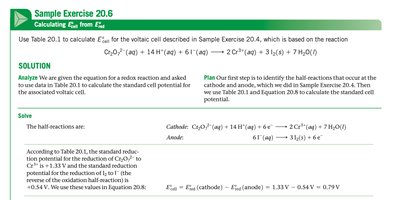
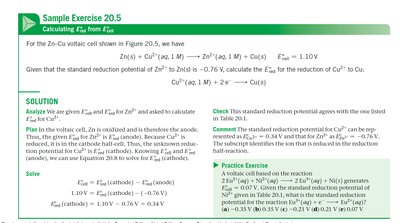
Standard Cell Potential (E0cell): The cell potential under standard conditions (1 M, 1 atm, 25°C).
Calculation:
Cell Potentials under Nonstandard Conditions
The Nernst Equation
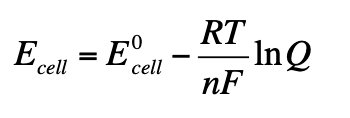
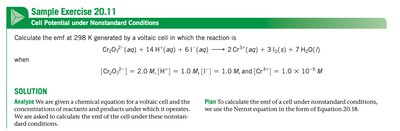
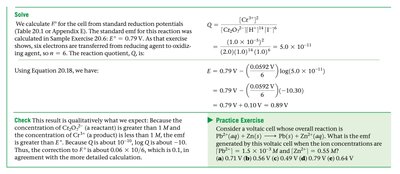
The Nernst equation allows calculation of cell potential under nonstandard conditions by accounting for the effect of ion concentrations (reaction quotient Q):
Relationship Between Emf, Free Energy, and Equilibrium Constant
Thermodynamic Connections
The cell potential is directly related to the Gibbs free energy change (ΔG) and the equilibrium constant (K) for the cell reaction:
These equations show that a positive cell potential corresponds to a spontaneous reaction (negative ΔG), and a large equilibrium constant (K) indicates the reaction strongly favors products.
Standard Reduction Potentials
Reference Table
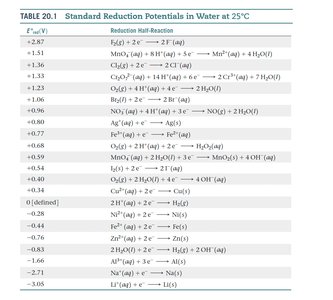
Standard reduction potentials (E0) are measured relative to the standard hydrogen electrode (SHE), which is assigned a potential of 0.00 V. These values are used to predict the direction of redox reactions and to calculate cell potentials.
E0 (V) | Reduction Half-Reaction |
|---|---|
+2.87 | F2(g) + 2e- → 2F-(aq) |
+1.51 | MnO4-(aq) + 8H+(aq) + 5e- → Mn2+(aq) + 4H2O(l) |
+0.34 | Cu2+(aq) + 2e- → Cu(s) |
0.00 | 2H+(aq) + 2e- → H2(g) |
-0.76 | Zn2+(aq) + 2e- → Zn(s) |
-2.71 | Al3+(aq) + 3e- → Al(s) |
-3.05 | Li+(aq) + e- → Li(s) |

Summary Table: Key Equations in Electrochemistry
Equation | Description |
|---|---|
Cell potential from standard reduction potentials | |
Nernst equation for nonstandard conditions | |
Gibbs free energy and cell potential | |
Free energy and equilibrium constant | |
Standard cell potential and equilibrium constant |
Additional info: The above notes integrate textbook-style explanations, stepwise procedures, and relevant worked examples to provide a comprehensive overview of electrochemistry for college-level general chemistry students.
