 Indietro
Lec 6 notes chem
Guida di studio - Note intelligenti
 Appunti personalizzati basati sui tuoi materiali, ampliati con definizioni chiave, esempi e contesto.
Electron Configurations
Ground State Electron Configuration Principles
The arrangement of electrons in the ground state of an atom is governed by several fundamental principles that ensure the lowest possible energy configuration. Understanding these rules is essential for predicting chemical behavior and periodic trends.
Aufbau Principle: Electrons fill orbitals starting from the lowest energy level and move upwards. This process is often visualized using the diagonal rule or by referencing the periodic table blocks.
Pauli Exclusion Principle: No two electrons in an atom can have the same set of four quantum numbers. Each orbital can hold a maximum of two electrons with opposite spins.
Hund’s Rule: When orbitals of equal energy (degenerate orbitals) are available, electrons occupy them singly as far as possible, maximizing the number of unpaired electrons with parallel spins.
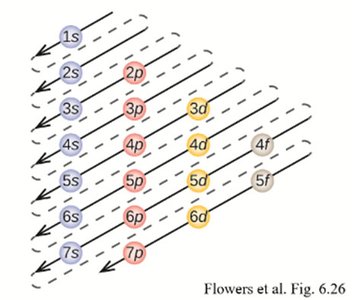
Additional info: The Aufbau principle is named from the German word for "building up." While the diagram above is helpful, the periodic table itself provides a straightforward guide to electron filling order.
Quantum Numbers and Electron Configuration
Each electron in an atom is described by a unique set of four quantum numbers: principal (n), angular momentum (l), magnetic (ml), and spin (ms). For example, the two electrons in a helium atom (He) have opposite spins in the same 1s orbital.
Principal quantum number (n): Indicates the main energy level (shell).
Angular momentum quantum number (l): Defines the subshell (s, p, d, f).
Magnetic quantum number (ml): Specifies the orbital within the subshell.
Spin quantum number (ms): Indicates the electron's spin direction (+1/2 or -1/2).
Orbital Diagrams and spdf Notation
Electron configurations can be represented in two main ways:
Orbital diagrams: Boxes or lines represent orbitals, with arrows indicating electrons and their spins.
spdf notation: Lists the occupied subshells and the number of electrons in each (e.g., 1s2 2s2 2p6).
For example, the electron configuration for carbon (C, Z=6) is:
Orbital diagram: 1s ↑↓ 2s ↑↓ 2p ↑_ ↑_ _
spdf notation: 1s2 2s2 2p2
Periodic Table and Electron Configurations
The periodic table is divided into blocks (s, p, d, f) that correspond to the filling of specific subshells. Elements in the same group have similar valence electron configurations, which explains their similar chemical properties.
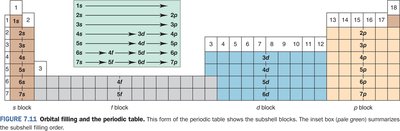
Additional info: The s-block includes Groups 1 and 2, the p-block includes Groups 13–18, the d-block contains the transition metals, and the f-block contains the lanthanides and actinides.
Electron Configurations of Ions
Formation of Cations and Anions
Atoms gain or lose electrons to form ions, achieving more stable electron configurations (often resembling noble gases).
Metals: Tend to lose valence electrons to form cations. For transition metals, ns electrons are removed before (n–1)d electrons.
Nonmetals: Tend to gain electrons to form anions, filling their valence shell.
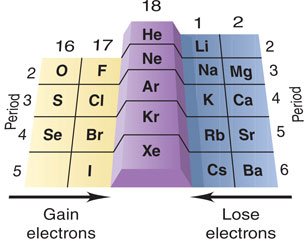
Example: Sodium (Na) loses one electron to form Na+ with the configuration [Ne]. Chlorine (Cl) gains one electron to form Cl– with the configuration [Ne]3s23p6.
Magnetic Properties and Electron Configurations
Paramagnetism and Diamagnetism
Magnetic behavior is determined by the presence of unpaired electrons:
Paramagnetic: Substances with one or more unpaired electrons; attracted to magnetic fields.
Diamagnetic: Substances with all electrons paired; weakly repelled by magnetic fields.
Example: CrO2 contains Cr4+ and O2– ions. The electron configuration of Cr4+ is [Ar]3d2, which has unpaired electrons, making it paramagnetic.
Additional info: Perfect diamagnetism is a property of superconductors, which can expel magnetic fields entirely (Meissner effect).
Trends in Ionic Radii
Comparing Atomic and Ionic Sizes
The size of an ion compared to its parent atom depends on electron gain or loss:
Cations: Smaller than their parent atoms due to loss of electrons and reduced electron-electron repulsion.
Anions: Larger than their parent atoms due to gain of electrons and increased electron-electron repulsion.
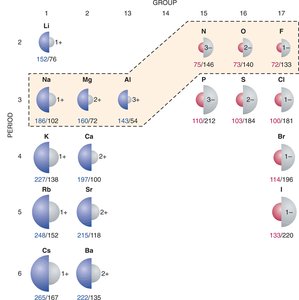
Example: Rank K+, S2–, and Cl– in order of increasing size: K+ < Cl– < S2–.
Summary Table: Electron Configurations for Selected Elements
Z | Element | spdf Notation |
|---|---|---|
1 | H | 1s1 |
2 | He | 1s2 |
6 | C | 1s2 2s2 2p2 |
10 | Ne | 1s2 2s2 2p6 |
11 | Na | [Ne] 3s1 |
17 | Cl | [Ne] 3s2 3p5 |
18 | Ar | [Ne] 3s2 3p6 |
19 | K | [Ar] 4s1 |
26 | Fe | [Ar] 4s2 3d6 |
Additional info: For d- and f-block elements, exceptions to the Aufbau principle may occur due to electron stability in half-filled or fully filled subshells.
