 Indietro
Electronic Structure of Atoms: Quantum Theory, Atomic Orbitals, and Electron Configurations
Guida di studio - Note intelligenti
 Appunti personalizzati basati sui tuoi materiali, ampliati con definizioni chiave, esempi e contesto.
Electronic Structure of Atoms
Introduction to the Wave Nature of Light
The study of atomic structure begins with understanding the dual nature of light, which exhibits both wave-like and particle-like properties. This duality is fundamental to quantum mechanics and underpins the behavior of electrons in atoms.
Wave Properties: Light demonstrates interference and diffraction, phenomena characteristic of waves.
Particle Properties: Light can also behave as discrete packets of energy called photons.
Energy of a Photon: The energy of a photon is given by , where is Planck's constant, is frequency, is the speed of light, and is wavelength.
Photoelectric Effect: Demonstrates that light energy is quantized; electrons are ejected from a metal surface only when the incident light exceeds a threshold frequency.

Two-Slit Interference and Diffraction
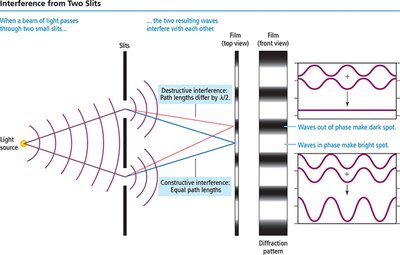
When light passes through two closely spaced slits, it produces an interference pattern, confirming its wave nature. This experiment is foundational in understanding quantum behavior.
Constructive Interference: Occurs when path lengths differ by integer multiples of the wavelength, resulting in bright spots.
Destructive Interference: Occurs when path lengths differ by half-integer multiples, resulting in dark spots.

Quantization of Energy
Unlike classical systems, quantum systems such as electrons in atoms can only possess certain discrete energy values. This quantization is not noticeable at macroscopic scales but is crucial for atomic and molecular systems.
Quantized States: Energy levels are separated by fixed amounts, depending on the system's properties.
Applications: Explains discrete atomic emission spectra, molecular vibrations, and rotations.

Atomic Spectroscopy and the Bohr Model
Atoms emit light at characteristic wavelengths when excited, producing unique emission spectra. The Bohr model explains these spectra for hydrogen-like atoms by proposing quantized electron orbits.
Emission Spectrum: Each element emits a unique set of wavelengths, useful for identification (e.g., fireworks, neon lights).
Bohr Model: Electrons occupy fixed orbits with quantized energies. Transitions between orbits result in absorption or emission of photons.
Rydberg Equation: Describes the wavelengths of hydrogen's spectral lines: , where is the Rydberg constant.
Energy Change:


Limitations of the Bohr Model
While the Bohr model successfully explains the hydrogen atom, it fails for multi-electron atoms and does not account for electron-electron interactions or the wave nature of electrons.
Applicability: Only works for hydrogen and hydrogen-like ions.
Classical Contradiction: Classical physics predicts electrons should spiral into the nucleus, which does not occur.
Wave Behavior of Matter: de Broglie Wavelength
Louis de Broglie proposed that all matter exhibits wave-like properties, with a wavelength inversely proportional to its momentum.
de Broglie Wavelength: , where for non-relativistic speeds.
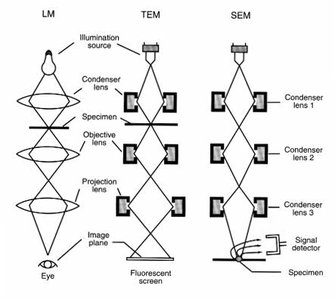
Applications: Electron diffraction and electron microscopy rely on the wave nature of electrons.

Quantum Mechanics and Atomic Orbitals
Schrödinger Equation and Quantum Numbers
Quantum mechanics, formulated by Erwin Schrödinger, describes electrons as wavefunctions (ψ) that provide probability distributions for electron positions. The solutions to the Schrödinger equation yield atomic orbitals, each defined by a set of quantum numbers.
Principal Quantum Number (n): Indicates the energy level and size of the orbital ().
Angular Momentum Quantum Number (l): Defines the shape of the orbital ( to ; s, p, d, f correspond to ).
Magnetic Quantum Number (m_l): Specifies the orientation of the orbital ( to ).
Spin Quantum Number (m_s): Describes the electron's intrinsic spin ( or ).
Pauli Exclusion Principle: No two electrons in an atom can have the same set of four quantum numbers. Each orbital can hold a maximum of two electrons with opposite spins.
Shapes and Representations of Orbitals
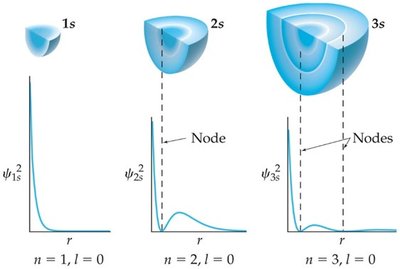
Atomic orbitals have characteristic shapes and nodal structures, determined by their quantum numbers.
s Orbitals (): Spherical shape; number of radial nodes = .
p Orbitals (): Dumbbell-shaped with a nodal plane.
d Orbitals (): Four-lobed shapes with two angular nodes.
f Orbitals (): Complex shapes with three angular nodes.
Quantum Numbers and Orbital Classification
The relationship among quantum numbers determines the number and types of orbitals in each shell and subshell.
n | l | Subshell | ml values | Number of Orbitals |
|---|---|---|---|---|
1 | 0 | 1s | 0 | 1 |
2 | 0 | 2s | 0 | 1 |
2 | 1 | 2p | -1, 0, 1 | 3 |
3 | 0 | 3s | 0 | 1 |
3 | 1 | 3p | -1, 0, 1 | 3 |
3 | 2 | 3d | -2, -1, 0, 1, 2 | 5 |
4 | 0 | 4s | 0 | 1 |
4 | 1 | 4p | -1, 0, 1 | 3 |
4 | 2 | 4d | -2, -1, 0, 1, 2 | 5 |
4 | 3 | 4f | -3, -2, -1, 0, 1, 2, 3 | 7 |
Electron Configurations and the Periodic Table
Writing Electron Configurations
Electron configuration describes the arrangement of electrons in an atom's orbitals. The most stable (ground state) configuration fills orbitals in order of increasing energy, following the Aufbau principle, Pauli exclusion principle, and Hund's rule.
Notation: The configuration is written as a sequence of numbers (principal quantum number), letters (orbital type), and superscripts (number of electrons).
Condensed (Noble Gas) Notation: Core electrons are represented by the symbol of the preceding noble gas in brackets, followed by the valence electron configuration.
Hund's Rule: Electrons fill degenerate orbitals singly with parallel spins before pairing.
Examples:
Sodium (Na): 1s22s22p63s1, [Ne]3s1
Oxygen (O): 1s22s22p4, [He]2s22p4
Vanadium (V): 1s22s22p63s23p64s23d3, [Ar]4s23d3
Periodic Table and Electron Filling Order
The periodic table is structured according to the filling of atomic orbitals. The s, p, d, and f blocks correspond to the filling of these respective orbitals. Main-group elements are found in the s and p blocks, transition metals in the d block, and inner transition elements in the f block.
Order of Filling: Orbitals fill in order of increasing energy, but there are exceptions (e.g., 4s fills before 3d).
Transition Metals: After filling 4s, electrons begin to fill 3d orbitals.
Lanthanides and Actinides: Involve filling of 4f and 5f orbitals, respectively.
Exceptions: Some elements (e.g., chromium, copper) have anomalous configurations due to stability associated with half-filled or fully filled subshells.
Mathematical Operations and Applications
Photon Energy and de Broglie Calculations
Understanding the relationships among energy, wavelength, and frequency is essential for solving problems in atomic structure.
Photon Energy:
de Broglie Wavelength:
Kinetic Energy:
Example: For a neutron (mass ≈ kg) moving at 2200 m/s:
Kinetic Energy: J
Momentum: kg·m/s
de Broglie Wavelength: m
Summary Table: Quantum Numbers and Orbitals
Quantum Number | Symbol | Allowed Values | Physical Meaning |
|---|---|---|---|
Principal | n | 1, 2, 3, ... | Energy level, size of orbital |
Angular Momentum | l | 0 to n-1 | Shape of orbital (s, p, d, f) |
Magnetic | m_l | -l to +l | Orientation of orbital |
Spin | m_s | +1/2, -1/2 | Spin direction of electron |
Additional info: This guide covers the foundational quantum mechanical concepts necessary for understanding atomic structure, electron configurations, and their relationship to the periodic table. Mastery of these topics is essential for further study in general chemistry.
