 Indietro
Electronic Structure of Atoms: Wave Nature, Quantization, and the Bohr Model
Guida di studio - Note intelligenti
 Appunti personalizzati basati sui tuoi materiali, ampliati con definizioni chiave, esempi e contesto.
Electronic Structure of Atoms
The Wave Nature of Light
The electronic structure of atoms is fundamentally linked to the properties of light, which exhibits both wave-like and particle-like behavior. Light is a form of electromagnetic radiation, consisting of oscillating electric and magnetic fields that propagate through space.
Electromagnetic Radiation: Includes visible light, ultraviolet, infrared, X-rays, and more. All types travel at the speed of light in a vacuum, c = 3.00 × 10⁸ m/s.
Wave Properties: Light waves are characterized by their wavelength (λ), frequency (ν), and amplitude.
Wavelength (λ): The distance between two consecutive wave crests.
Frequency (ν): The number of wave cycles passing a point per second, measured in Hertz (Hz).
Amplitude: The height of the wave, related to the intensity of the radiation.
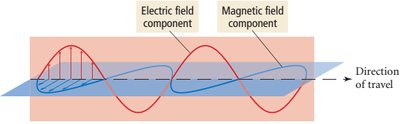
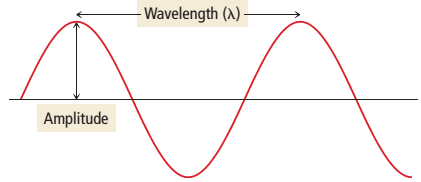
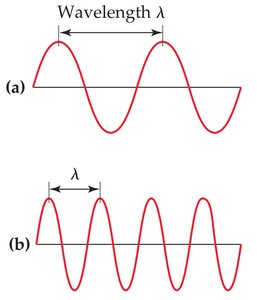
Relationship between wavelength and frequency:
$\lambda = \frac{c}{\nu}$
Where c is the speed of light, λ is wavelength, and ν is frequency.
Electromagnetic Spectrum: The spectrum includes all types of electromagnetic radiation, with visible light occupying a small portion. Wavelengths range from gamma rays (shortest) to radio waves (longest).
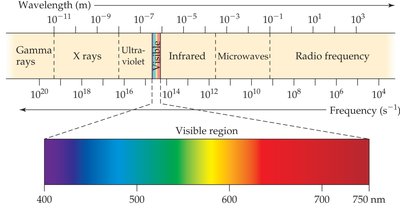
Example: Calculate the wavelength (in nm) of light emitted by a barcode scanner with a frequency of 4.62 × 10¹⁴ s-1:
$\lambda = \frac{c}{\nu} = \frac{3.00 \times 10^8\ \text{m/s}}{4.62 \times 10^{14}\ \text{s}^{-1}} = 6.49 \times 10^{-7}\ \text{m} = 649\ \text{nm}$
Quantized Energy and Photons
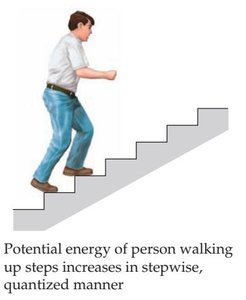
Energy in atoms is not continuous, but quantized. Max Planck proposed that energy is absorbed or emitted in discrete units called quanta.
Quantum: The smallest unit of energy, given by $E = h\nu$ where h is Planck's constant (6.626 × 10⁻³⁴ J·s).
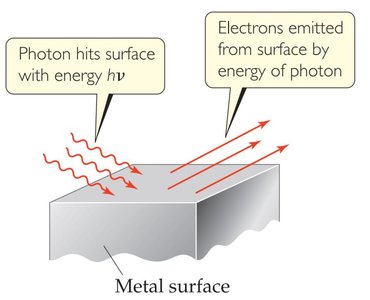
Photoelectric Effect: Einstein showed that light can behave as particles (photons), each carrying energy $E_{\text{photon}} = h\nu$.
Photon: A quantum of light; energy depends on frequency or wavelength.
Energy of a photon: $E_{\text{photon}} = \frac{hc}{\lambda}$
Example: Calculate the energy of a photon with wavelength 3.75 × 10⁴ nm:
$E_{\text{photon}} = \frac{hc}{\lambda} = \frac{6.626 \times 10^{-34}\ \text{J·s} \times 3.00 \times 10^8\ \text{m/s}}{3.75 \times 10^{-5}\ \text{m}} = 5.30 \times 10^{-21}\ \text{J}$
Line Spectra and the Bohr Model
Atoms emit light at specific wavelengths, producing line spectra rather than continuous spectra. This is evidence for quantized energy levels in atoms.
Line Spectra: Each element emits light at characteristic wavelengths, seen as lines in a spectrum.
Bohr Model: Niels Bohr proposed that electrons in hydrogen atoms move in circular orbits with quantized energies. Energy is absorbed or emitted only when electrons jump between these orbits.
Bohr's Postulates:
Electrons occupy only certain allowed orbits with specific energies.
Electrons in allowed orbits do not lose energy.
Energy is emitted/absorbed only during transitions between orbits.
Energy of photon emitted/absorbed: $E_{\text{photon}} = \frac{hc}{\lambda}$
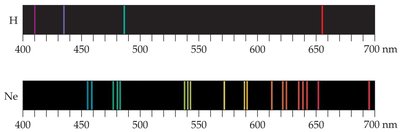
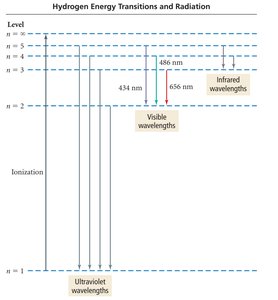
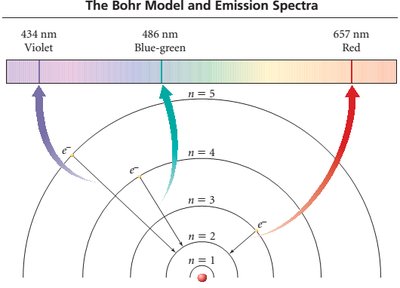
Example: The hydrogen atom emits light at 434 nm (violet), 486 nm (blue-green), and 657 nm (red) as electrons transition between energy levels.
Summary Table: Key Properties of Electromagnetic Radiation
Type | Wavelength (nm) | Frequency (Hz) | Energy per Photon (J) |
|---|---|---|---|
Microwaves | 106 - 109 | 109 - 1012 | Low |
Visible Light | 400 - 750 | 4 × 10¹⁴ - 7.5 × 10¹⁴ | Medium |
X-rays | 0.01 - 10 | 1016 - 1020 | High |
Additional info: The notes cover the fundamental concepts of the electronic structure of atoms, including the wave nature of light, quantization of energy, the photoelectric effect, and the Bohr model. All images included directly reinforce the explanations of electromagnetic waves, quantization, line spectra, and atomic models.
