 Indietro
Electronic Structure of Atoms: Waves, Photons, and Quantum Mechanics
Guida di studio - Note intelligenti
 Appunti personalizzati basati sui tuoi materiali, ampliati con definizioni chiave, esempi e contesto.
Electronic Structure of Atoms
Waves and Electromagnetic Radiation
Understanding the electronic structure of atoms begins with the study of electromagnetic radiation, which exhibits wave-like properties. Key characteristics of waves include wavelength and frequency, which are fundamental to describing electromagnetic phenomena.
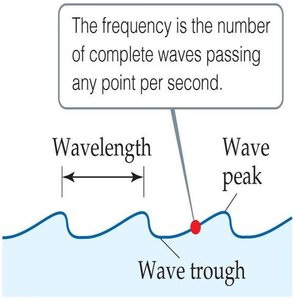
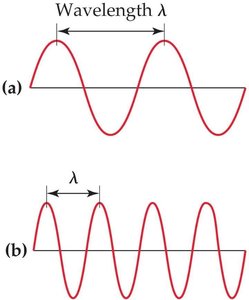
Wavelength (\(\lambda\)): The distance between corresponding points on adjacent waves, typically measured in meters (m).
Frequency (\(\nu\)): The number of complete waves passing a given point per second, measured in hertz (Hz).
Relationship: For waves traveling at the same velocity, the longer the wavelength, the lower the frequency, and vice versa.
Speed of Light (c): All electromagnetic radiation travels at the same speed in a vacuum: \(c = 3.00 \times 10^8\) m/s.
Wave Equation: The speed of a wave is the product of its wavelength and frequency:

The Electromagnetic Spectrum
The electromagnetic spectrum encompasses all types of electromagnetic radiation, ordered by wavelength or frequency. The visible region is only a small part of the spectrum, with gamma rays having the shortest wavelengths and radio waves the longest.
Order of Increasing Wavelength: Gamma rays < X-rays < Ultraviolet < Visible < Infrared < Microwaves < Radio waves.
Energy Relation: The larger the frequency, the more energy the wave holds.
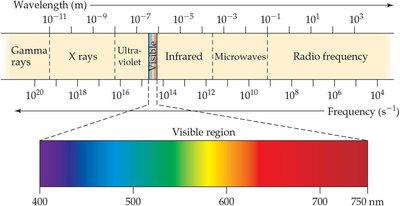
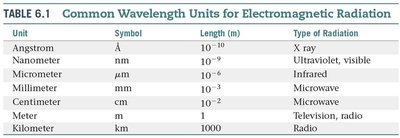
Table: Common Wavelength Units for Electromagnetic Radiation
Unit | Symbol | Length (m) | Type of Radiation |
|---|---|---|---|
Angstrom | Å | 10-10 | X ray |
Nanometer | nm | 10-9 | Ultraviolet, visible |
Micrometer | μm | 10-6 | Infrared |
Millimeter | mm | 10-3 | Microwave |
Centimeter | cm | 10-2 | Microwave |
Meter | m | 1 | Television, radio |
Kilometer | km | 1000 | Radio |

Photons and the Nature of Energy
The wave nature of light does not explain phenomena such as the photoelectric effect. Max Planck proposed that energy is quantized and comes in discrete packets called quanta. Albert Einstein extended this idea to photons, the particles of light, and explained the photoelectric effect.
Photon Energy: The energy of a photon is proportional to its frequency: where \(h = 6.626 \times 10^{-34}\) J·s (Planck’s constant).
Energy and Wavelength: Since , photon energy can also be expressed as:

Line Spectra and Quantized Energy States
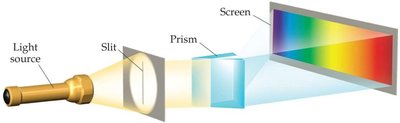
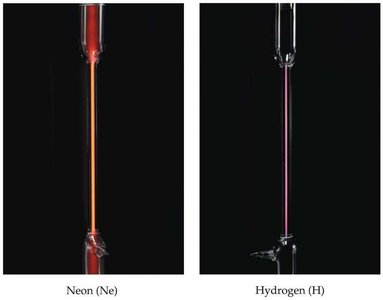
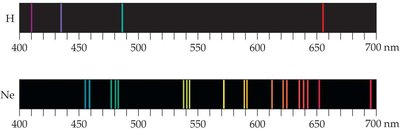
When elements are excited, they emit light at specific wavelengths, producing a line spectrum rather than a continuous spectrum. This observation supports the idea of quantized energy states in atoms.
Line Spectrum: Each element has a unique line spectrum, which can be used for identification.
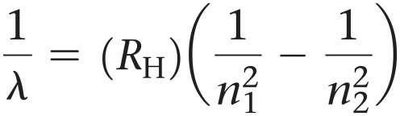
Rydberg Formula: The wavelengths of hydrogen’s spectral lines are given by: where m-1.
The Bohr Model of the Atom
Niels Bohr explained the quantized nature of atomic energy levels by proposing that electrons occupy specific orbits with fixed energies. Transitions between these orbits involve absorption or emission of energy as photons.
Energy Levels: Electrons can only occupy certain allowed orbits (energy levels).
Energy Transitions: Energy is absorbed or emitted when an electron moves between energy levels:

The Wave Nature of Matter and the Uncertainty Principle
Louis de Broglie proposed that particles such as electrons have wave properties, with a wavelength given by:
de Broglie Wavelength: where is mass and is velocity.
Heisenberg Uncertainty Principle: It is impossible to simultaneously know both the exact position and momentum of a subatomic particle:
Quantum Mechanics and Atomic Orbitals
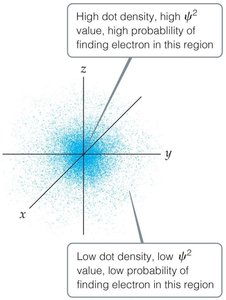
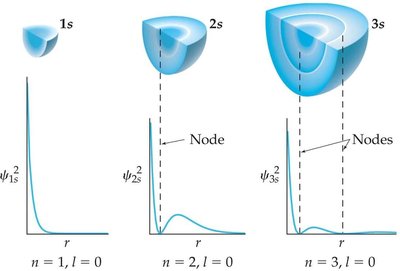
Erwin Schrödinger developed quantum mechanics, describing electrons as wavefunctions (\(\Psi\)), whose square gives the probability density of finding an electron in a region of space. Atomic orbitals are defined by quantum numbers:
Principal Quantum Number (n): Indicates the energy level (n = 1, 2, 3, ...).
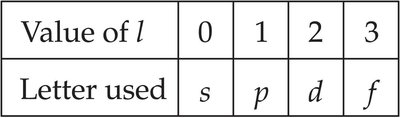
Angular Momentum Quantum Number (l): Defines the shape of the orbital (l = 0 to n-1).
Magnetic Quantum Number (m_l): Specifies the orientation of the orbital (-l to +l).
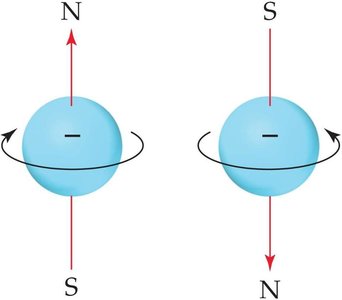
Spin Quantum Number (m_s): Describes the spin of the electron (+1/2 or -1/2).
Shapes and Energies of Atomic Orbitals
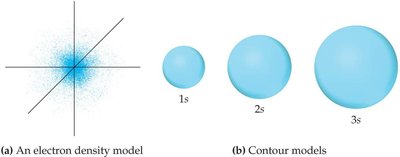
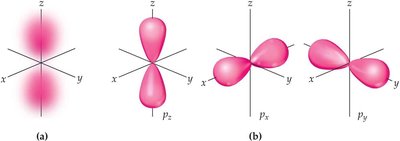
Orbitals have characteristic shapes and energies, which are determined by their quantum numbers. The s orbitals are spherical, p orbitals are dumbbell-shaped, and d orbitals have more complex shapes.
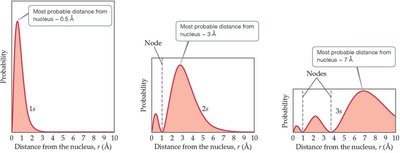
s Orbitals (l = 0): Spherical, with increasing size for higher n values.
p Orbitals (l = 1): Two lobes with a node at the nucleus.
d Orbitals (l = 2): Four have cloverleaf shapes; one has a unique shape with a torus.
Nodes: Regions where the probability of finding an electron is zero.
Electron Configuration and Orbital Diagrams
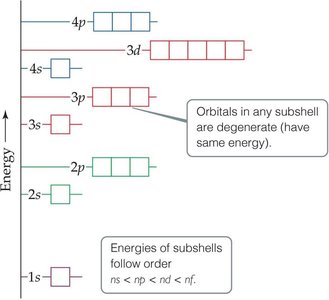
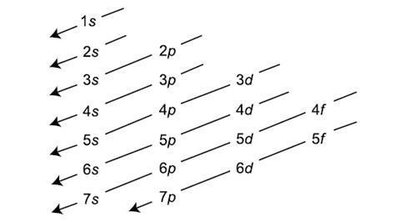
Electrons fill orbitals in order of increasing energy, following the Aufbau principle, Pauli exclusion principle, and Hund’s rule. Orbital diagrams visually represent electron configurations and spins.
Aufbau Principle: Electrons occupy the lowest energy orbitals first.
Pauli Exclusion Principle: No two electrons in an atom can have the same set of four quantum numbers.
Hund’s Rule: Electrons fill degenerate orbitals singly before pairing.
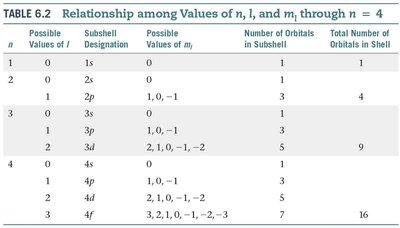
Summary Table: Quantum Numbers and Orbitals
n | l | ml | Orbital Notation | Number of Orbitals in Subshell | Number of Orbitals in Shell |
|---|---|---|---|---|---|
1 | 0 | 0 | 1s | 1 | 1 |
2 | 0 | 0 | 2s | 1 | 4 |
2 | 1 | -1, 0, +1 | 2p | 3 | 4 |
3 | 0 | 0 | 3s | 1 | 9 |
3 | 1 | -1, 0, +1 | 3p | 3 | 9 |
3 | 2 | -2, -1, 0, +1, +2 | 3d | 5 | 9 |
4 | 0 | 0 | 4s | 1 | 16 |
4 | 1 | -1, 0, +1 | 4p | 3 | 16 |
4 | 2 | -2, -1, 0, +1, +2 | 4d | 5 | 16 |
4 | 3 | -3, -2, -1, 0, +1, +2, +3 | 4f | 7 | 16 |
Additional info: These notes provide a comprehensive overview of the quantum-mechanical model of the atom, including the nature of electromagnetic radiation, quantization of energy, atomic orbitals, and electron configurations, as required for a General Chemistry college course.
