 Indietro
Empirical and Molecular Formulas & Chemical Reactions: Study Guide
Guida di studio - Note intelligenti
 Appunti personalizzati basati sui tuoi materiali, ampliati con definizioni chiave, esempi e contesto.
Empirical and Molecular Formulas
Definitions and Differences
Understanding empirical and molecular formulas is fundamental in chemistry for describing the composition of compounds. The empirical formula represents the simplest whole-number ratio of elements in a compound, while the molecular formula shows the actual number of atoms of each element in a molecule and is often a multiple of the empirical formula.
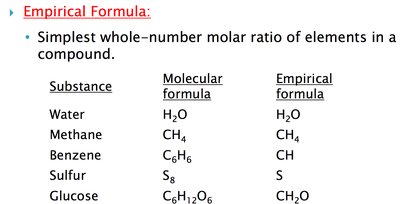
Empirical Formula: Simplest whole-number molar ratio of elements in a compound.
Molecular Formula: Actual molar ratio of elements in a compound; may be a multiple of the empirical formula.
Example: Acetylene has an empirical formula of CH and a molecular formula of C2H2.
Comparison Table: Molecular vs. Empirical Formulas
Substance | Molecular formula | Empirical formula |
|---|---|---|
Water | H2O | H2O |
Methane | CH4 | CH4 |
Benzene | C6H6 | CH |
Sulfur | S8 | S |
Glucose | C6H12O6 | CH2O |
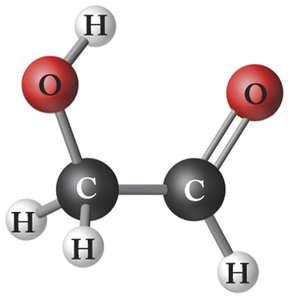
Key Point: Many compounds can share the same empirical formula but have different molecular formulas, such as glycolaldehyde (C2H4O2) and glucose (C6H12O6), both with the empirical formula CH2O.
Percentage Composition and Empirical Formula Determination
Percentage composition is used to determine the empirical formula of a compound. The mass percent of each element is calculated and converted to moles, then the simplest whole-number ratio is found.
Mass percent (%):
Example: Determining percent iron in iron(III) oxide (Fe2O3).
Combustion Analysis for Hydrocarbons
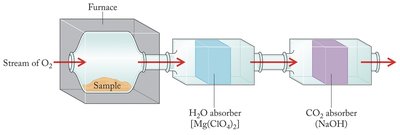
Combustion analysis is a technique used to determine the percent of carbon and hydrogen in organic substances by measuring the mass of H2O and CO2 produced.
Steps to Determine Empirical Formula from Mass Percent
To find the empirical formula from mass percent:
Assume 100 g of the sample, so the percent composition equals the number of grams of each element.
Convert grams of each element to moles using their molar mass.
Divide the smallest number of moles into the moles of each element present.
Convert fractional ratios to whole numbers by multiplying all ratios by the same number.
The resulting numbers are the subscripts for each element in the empirical formula.
Worked Example: MgCl2
Given: 25.6% Mg, 74.4% Cl
Assume 100 g sample: 25.6 g Mg, 74.4 g Cl
Convert to moles:
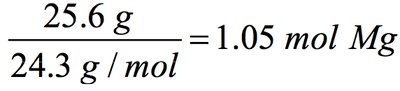
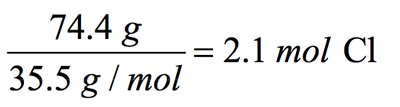
Find ratio: (Mg) (Cl)
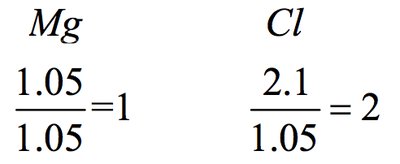
Empirical formula: MgCl2
Mass Spectrometry and Molecular Formula Determination
Mass spectrometry is used to determine the molar mass of substances, which helps in finding the molecular formula. The molecular formula is a simple multiple of the empirical formula.
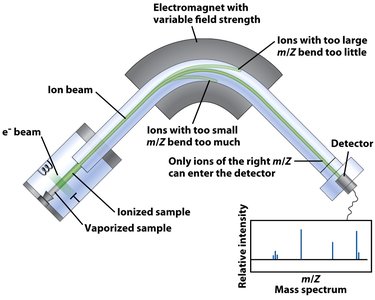
Formula:
Example: For a compound with 24.3% C, 4.1% H, 71.6% Cl, and molar mass 99.0 g:
Convert to moles:
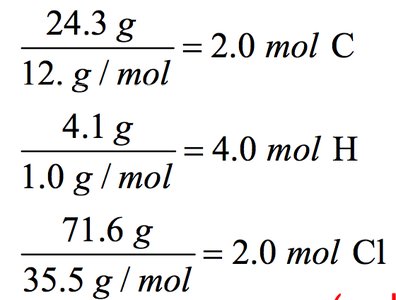
Find ratio: (C) (H) (Cl)
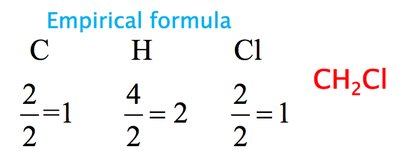
Empirical formula: CH2Cl
Molecular formula: (CH2Cl)2 = C2H4Cl2
Chemical Reactions and Balanced Equations
Law of Conservation of Mass and Charge
Balanced chemical equations are essential for representing chemical transformations. They follow the law of conservation of mass and charge, ensuring that the total mass and charge of reactants equals that of products.
Key Point: The total mass of each element and the total charge must be equal on both sides of the equation.
Example: Chemical reactions are written according to strict rules based on molecular structure.
Steps for Writing Balanced Chemical Equations
Write correct formulas for reactants and products, including physical states.
Balance an element that appears in only one reactant and product first.
Choose coefficients to balance other elements as needed.
Combustion Reactions
Combustion reactions involve oxygen and another element or compound. Hydrocarbon combustion produces CO2 and H2O.
Example: CH4(g) + 2O2(g) → CO2(g) + 2H2O(g)
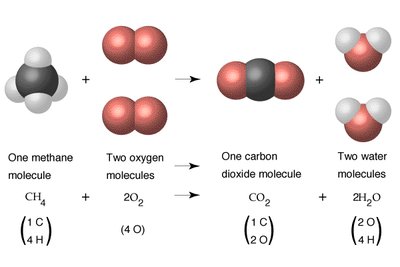
Balanced Combustion Reaction Example
Unbalanced: C4H10 + O2 → CO + H2O
Balanced: 2C4H10 + 9O2 → 8CO2 + 10H2O
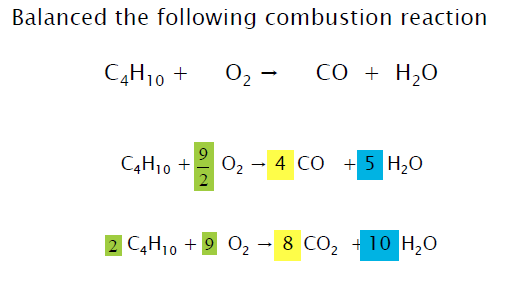
Practice: Balancing equations is a critical skill for representing chemical reactions accurately.
Summary Table: Steps for Empirical Formula Determination
Step | Description |
|---|---|
1 | Assume 100 g sample |
2 | Convert grams to moles |
3 | Divide by smallest number of moles |
4 | Convert ratios to whole numbers |
5 | Write empirical formula |
Additional info: The notes cover key concepts from General Chemistry chapters on chemical formulas and reactions, including lab techniques (combustion analysis) and mathematical operations (mole calculations).
