 Indietro
Energy and Chemical Processes: Study Notes for General Chemistry
Guida di studio - Note intelligenti
 Appunti personalizzati basati sui tuoi materiali, ampliati con definizioni chiave, esempi e contesto.
Energy and Chemical Processes
Energy Units
Energy is a fundamental concept in chemistry, playing a crucial role in chemical reactions and physical changes. The SI unit for energy, work, and heat is the joule (J). Because the joule is a relatively small unit, the kilojoule (kJ) is often used for larger energy changes. Another common unit is the calorie (cal), especially in health sciences and everyday life. The calorie was originally defined as the energy needed to raise the temperature of 1 gram of water by 1°C, but is now directly related to the joule:
1 cal = 4.184 J
Energy conversions are important for understanding nutrition and physical activity.
Example: Energy Conversion
If a serving of bread contains 70.0 Cal (food calories), this can be converted to calories and joules:
1 Cal (food calorie) = 1,000 cal (small calorie)
70.0 Cal = 70,000 cal
70,000 cal × 4.184 J/cal = 292,880 J
Common Energy Expenditures
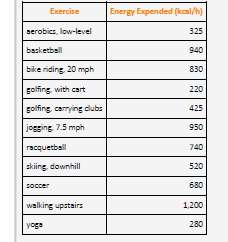
Different physical activities expend energy at varying rates, measured in kilocalories per hour (kcal/h). Understanding these values helps relate chemical energy to everyday life.
Exercise | Energy Expended (kcal/h) |
|---|---|
aerobics, low-level | 325 |
basketball | 940 |
bike riding, 20 mph | 830 |
golfing, with cart | 220 |
golfing, carrying clubs | 425 |
jogging, 7.5 mph | 950 |
racquetball | 740 |
skiing, downhill | 520 |
soccer | 680 |
walking upstairs | 1,200 |
yoga | 280 |
Heat and Temperature Change (ΔT)
Heat is a form of energy transfer that occurs due to a difference in temperature between two objects. When you touch a hot object, energy flows into your hand; when you touch something cold, energy flows out. The change in temperature, denoted as ΔT, is calculated as:
The greater the mass (m) of an object, the more heat is required to change its temperature.
Calculating Heat: The q = mcΔT Equation
Every substance has a characteristic specific heat (c), which is the amount of energy required to change the temperature of 1 gram of the substance by 1°C. The formula for calculating heat transfer is:
Where q is the heat transferred, m is mass in grams, c is specific heat, and ΔT is the change in temperature.
Example: Calculating Heat Transfer
To find the heat transferred when a 150.0 g block of iron is heated from 25.0°C to 73.3°C:
Specific heat of iron: c = 0.108 cal/g°C
ΔT = 73.3°C - 25.0°C = 48.3°C
cal
Heat flows into the iron (from surroundings) as it is heated.
Specific Heats of Substances
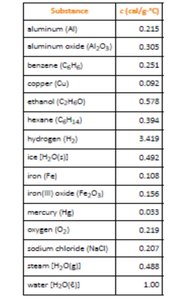
The specific heat varies for different substances. This property is important for understanding how materials respond to heat.
Substance | c (cal/g°C) |
|---|---|
aluminum (Al) | 0.215 |
aluminum oxide (Al2O3) | 0.305 |
benzene (C6H6) | 0.251 |
copper (Cu) | 0.092 |
ethanol (C2H5OH) | 0.578 |
hexane (C6H14) | 0.394 |
hydrogen (H2) | 3.419 |
ice (H2O(s)) | 0.492 |
iron (Fe) | 0.108 |
iron(III) oxide (Fe2O3) | 0.155 |
mercury (Hg) | 0.033 |
oxygen (O2) | 0.219 |
sodium chloride (NaCl) | 0.207 |
steam (H2O(g)) | 0.488 |
water (H2O(l)) | 1.00 |
Application Example
Water has a high specific heat (1.00 cal/g°C), which is why it is effective for temperature regulation in biological and environmental systems.
Summary Table: Key Equations
Additional info:
These concepts are foundational for understanding thermochemistry, calorimetry, and energy changes in chemical reactions.
