 Indietro
Essentials of Units, Measurement, and Problem Solving in General Chemistry
Guida di studio - Note intelligenti
 Appunti personalizzati basati sui tuoi materiali, ampliati con definizioni chiave, esempi e contesto.
Essentials: Units, Measurement, and Problem Solving
Introduction to Measurements in Chemistry
All scientific measurements consist of two essential components: a numerical value and a dimensional or scalar unit. Chemists use the International System of Units (SI), which is based on the metric system, to ensure consistency and clarity in reporting measurements.
SI Base Units
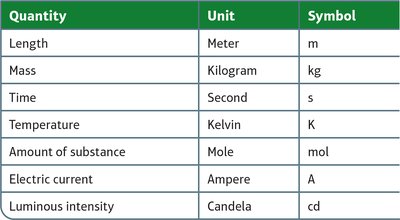
The SI system defines seven base units from which all other units are derived. These base units are fundamental to all scientific measurements in chemistry.
Quantity | Unit | Symbol |
|---|---|---|
Length | Meter | m |
Mass | Kilogram | kg |
Time | Second | s |
Temperature | Kelvin | K |
Amount of substance | Mole | mol |
Electric current | Ampere | A |
Luminous intensity | Candela | cd |
Scientific Notation and SI Prefixes
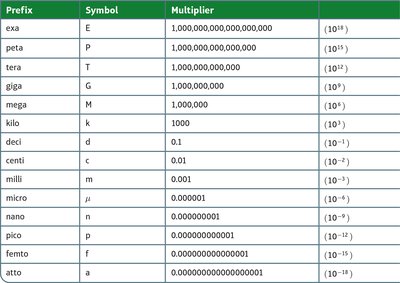
Scientific notation is used to express very large or very small numbers compactly, using powers of ten. SI prefixes are used to denote multiples or fractions of units, making it easier to communicate measurements without excessive zeros.
Prefix | Symbol | Multiplier |
|---|---|---|
exa | E | 1,000,000,000,000,000,000 (1018) |
peta | P | 1,000,000,000,000,000 (1015) |
tera | T | 1,000,000,000,000 (1012) |
giga | G | 1,000,000,000 (109) |
mega | M | 1,000,000 (106) |
kilo | k | 1,000 (103) |
deci | d | 0.1 (10-1) |
centi | c | 0.01 (10-2) |
milli | m | 0.001 (10-3) |
micro | μ | 0.000001 (10-6) |
nano | n | 0.000000001 (10-9) |
pico | p | 0.000000000001 (10-12) |
femto | f | 0.000000000000001 (10-15) |
atto | a | 0.000000000000000001 (10-18) |
Example: Expressing Measurements with Prefixes
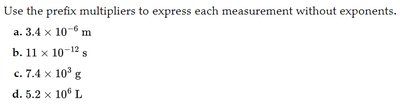
3.4 × 10⁻⁶ m = 3.4 μm (micrometers)
11 × 10-12 s = 11 ps (picoseconds)
7.4 × 10³ g = 7.4 kg (kilograms)
5.2 × 10⁶ L = 5.2 ML (megaliters)
Derived Units and Volume Relationships
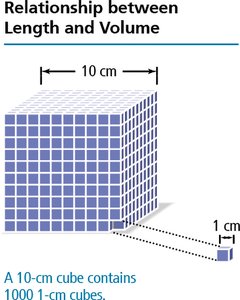
Many scientific measurements require combinations of base units, known as derived units. For example, velocity is measured in meters per second (m/s), and density in grams per cubic centimeter (g/cm3). Volume is an important derived unit in chemistry, commonly measured in cubic meters (m3), liters (L), or milliliters (mL). One milliliter (1 mL) is equal to 1 cm3.
Common Unit Conversions
Unit conversions are essential for solving chemistry problems. Some conversions are exact (defined by definition), while others are measured and thus inexact. The following table summarizes common conversions for length, mass, and volume:
Length | Mass | Volume |
|---|---|---|
1 kilometer (km) = 0.6214 mile (mi) | 1 kilogram (kg) = 2.205 pounds (lb) | 1 liter (L) = 1000 mL = 1000 cm3 |
1 meter (m) = 39.37 inches (in) = 1.094 yards (yd) | 1 pound (lb) = 453.6 grams (g) | 1 liter (L) = 1.057 quarts (qt) |
1 foot (ft) = 30.48 centimeters (cm) (exact) | 1 ounce (oz) = 28.35 grams (g) | 1 U.S. gallon (gal) = 3.785 liters (L) |
1 inch (in) = 2.54 centimeters (cm) (exact) |

Uncertainty in Measurement and Significant Figures
All measurements have some degree of uncertainty, which depends on the precision of the measuring instrument. The uncertainty is often reported as ± a certain value, indicating the range within which the true value lies. Significant figures are used to communicate the reliability of a measurement.
The last digit in a measurement is always uncertain.
Significant figures include all certain digits plus one uncertain digit.
Example: 23.46 ± 0.04 mg means the true value is between 23.42 and 23.50 mg.
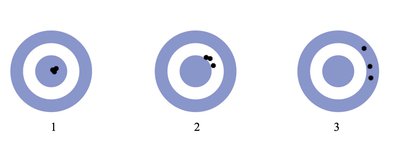
Precision vs. Accuracy
Precision refers to how closely repeated measurements agree with each other, while accuracy refers to how close a measurement is to the true or accepted value.
High precision: Measurements are close to each other.
High accuracy: Measurements are close to the true value.
Rules for Significant Figures
All nonzero digits are significant (e.g., 536 has 3 significant figures).
Zeroes between nonzero digits are significant (e.g., 6703 has 4 significant figures).
Leading zeroes are not significant (e.g., 0.0043 has 2 significant figures).
Trailing zeroes after a decimal point are significant (e.g., 50.0 has 3 significant figures; 0.0600 has 3 significant figures).
Trailing zeroes in a whole number without a decimal point are not significant (e.g., 7000 has 1 significant figure).
Exact numbers (counted or defined quantities) have infinite significant figures and do not limit the number of significant figures in calculations.
Significant Figures in Calculations
Addition/Subtraction: The result should have the same number of decimal places as the measurement with the fewest decimal places.
Multiplication/Division: The result should have the same number of significant figures as the measurement with the fewest significant figures.
Rounding Rules
Round down if the digit to be dropped is less than 5.
Round up if the digit to be dropped is 5 or greater.
Do not round intermediate steps; round only the final answer.
Combined Operations
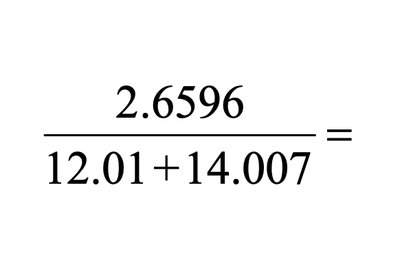
When calculations involve both addition/subtraction and multiplication/division, follow the order of operations and apply significant figure rules at each step. For example:
\frac{2.6596}{12.01 + 14.007} \$
Practice Problems and Applications
Unit conversions (e.g., converting feet to centimeters, kilograms to ounces, meters per second to miles per hour).
Expressing measurements in scientific notation and with appropriate SI prefixes.
Determining the best unit or prefix for very large or small quantities (e.g., mass of a DNA base pair, mass of a black hole).
Summary Table: Key Concepts
Concept | Description |
|---|---|
SI Base Units | Fundamental units for all measurements in chemistry |
Derived Units | Combinations of base units (e.g., m3, g/cm3) |
Scientific Notation | Compact way to express very large or small numbers |
SI Prefixes | Multipliers for units (e.g., kilo-, milli-, micro-) |
Significant Figures | Indicate the precision and reliability of measurements |
Precision vs. Accuracy | Precision: repeatability; Accuracy: closeness to true value |
Unit Conversions | Changing from one unit to another using conversion factors |
