Indietro
Essentials: Units, Measurement, and Problem Solving – Study Guide
Guida di studio - Note intelligenti
 Appunti personalizzati basati sui tuoi materiali, ampliati con definizioni chiave, esempi e contesto.
Essentials: Units, Measurement, and Problem Solving
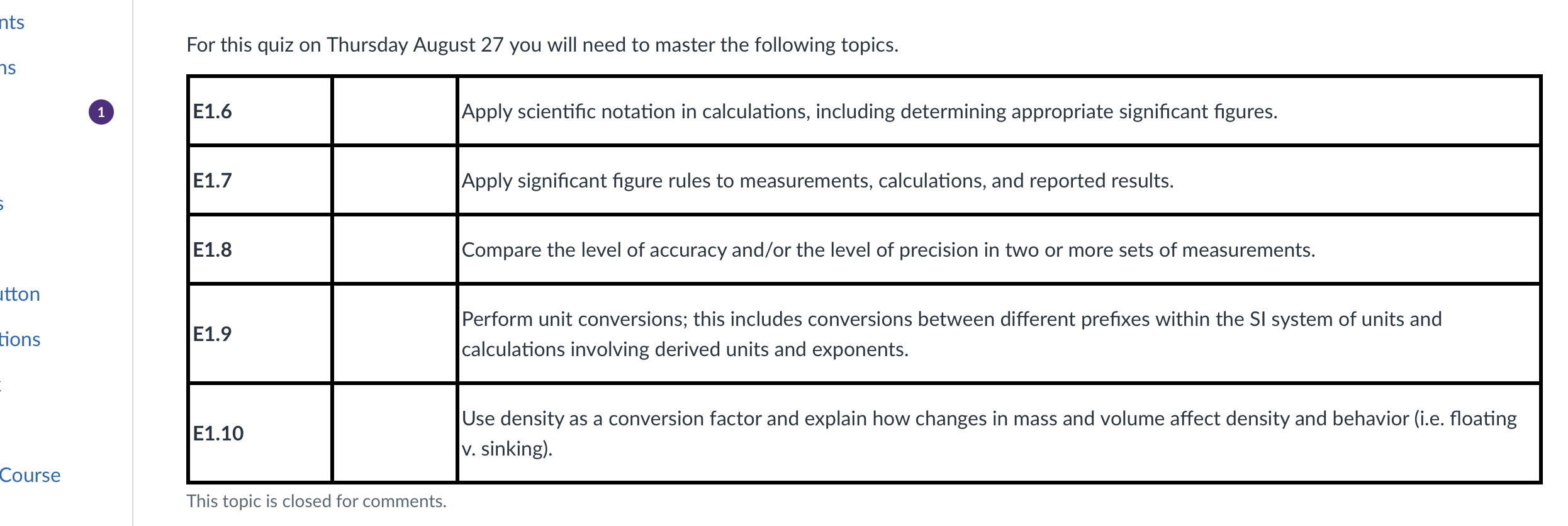
Scientific Notation and Significant Figures
Scientific notation is a method used to express very large or very small numbers in a concise form. Significant figures reflect the precision of a measured or calculated quantity.
Scientific Notation: Numbers are written as a × 10n, where 1 ≤ a < 10 and n is an integer.
Significant Figures: The digits in a measurement that are known with certainty plus one estimated digit.
Rules for Significant Figures:
All nonzero digits are significant.
Zeros between nonzero digits are significant.
Leading zeros are not significant.
Trailing zeros are significant only if there is a decimal point.
Calculations:
Multiplication/Division: The result should have as many significant figures as the measurement with the fewest significant figures.
Addition/Subtraction: The result should have as many decimal places as the measurement with the fewest decimal places.
Example: (Avogadro's number) has three significant figures.
Accuracy and Precision
Accuracy and precision are terms used to describe the quality of measurements.
Accuracy: How close a measurement is to the true or accepted value.
Precision: How close repeated measurements are to each other, regardless of their accuracy.
Comparison:
High accuracy, high precision: Measurements are close to each other and to the true value.
High accuracy, low precision: Measurements are close to the true value but not to each other.
Low accuracy, high precision: Measurements are close to each other but not to the true value.
Low accuracy, low precision: Measurements are neither close to each other nor to the true value.
Example: If a scale consistently reads 1.0 g too high, it is precise but not accurate.
Unit Conversions and SI Prefixes
Unit conversions are essential for expressing measurements in different units, especially within the SI system. Derived units are combinations of base SI units.
SI Prefixes: Used to indicate multiples or fractions of base units (e.g., kilo-, centi-, milli-).
Conversion Factors: Ratios used to convert from one unit to another (e.g., ).
Steps for Unit Conversion:
Identify the starting and desired units.
Write the appropriate conversion factor(s).
Multiply the original value by the conversion factor(s), canceling units as needed.
Derived Units: Units such as m2 (area), m3 (volume), and kg/m3 (density).
Example: Convert 5.0 km to meters:
Density as a Conversion Factor
Density is defined as mass per unit volume and is a useful conversion factor in chemistry. It also determines whether an object will float or sink in a fluid.
Formula:
Units: Commonly g/cm3 or kg/m3.
Using Density: Can convert between mass and volume using density as a conversion factor.
Floating vs. Sinking: An object will float if its density is less than the fluid's density; it will sink if its density is greater.
Example: If a block has a mass of 10 g and a volume of 2 cm3, its density is .