 Indietro
Essentials: Units, Measurement, and Problem Solving (General Chemistry Chapter E)
Guida di studio - Note intelligenti
 Appunti personalizzati basati sui tuoi materiali, ampliati con definizioni chiave, esempi e contesto.
Essentials: Units, Measurement, and Problem Solving
Introduction
This chapter introduces the foundational concepts of measurement in chemistry, including the International System of Units (SI), unit conversions, significant figures, and the principles of energy. Mastery of these topics is essential for accurate scientific communication and problem solving in chemistry.
Units of Measurement
International System of Units (SI)
The International System of Units (SI) is the standard system used by scientists worldwide, based on the metric system. It ensures consistency and clarity in scientific measurements.
Metric system: Used globally, based on powers of ten.
English system: Used primarily in the United States.
SI Units: Seven base units for fundamental quantities.
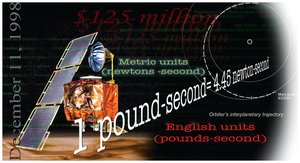
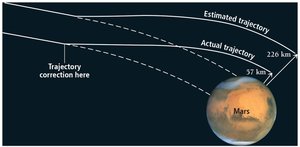
Example: The Mars Climate Orbiter was lost due to a failure to convert between English and metric units, highlighting the importance of using SI units in science.
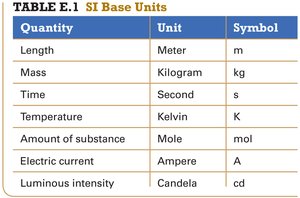
SI Base Units
Quantity | Unit | Symbol |
|---|---|---|
Length | Meter | m |
Mass | Kilogram | kg |
Time | Second | s |
Temperature | Kelvin | K |
Amount of substance | Mole | mol |
Electric current | Ampere | A |
Luminous intensity | Candela | cd |
Mass vs. Weight
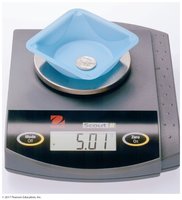
Mass is the quantity of matter in an object, measured in kilograms (kg) or grams (g). Weight is the force of gravity acting on that mass, which varies with location.
1 kg = 2.205 lb
1 g = 1/1000 kg
Temperature
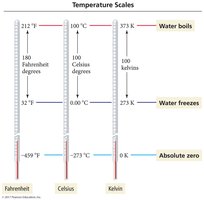
Temperature measures the average kinetic energy of particles in a substance. The SI unit is the kelvin (K). Temperature determines the direction of heat flow (from hot to cold).
Fahrenheit (°F): Used in the US
Celsius (°C): Used worldwide
Kelvin (K): SI unit, absolute scale
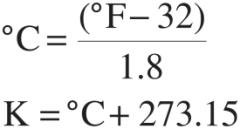
Temperature Conversions:
Prefix Multipliers
SI units use prefix multipliers to represent very large or small numbers efficiently. Each prefix corresponds to a power of ten.
Prefix | Symbol | Multiplier |
|---|---|---|
kilo | k | 1,000 (103) |
centi | c | 0.01 (10-2) |
milli | m | 0.001 (10-3) |
micro | μ | 0.000001 (10-6) |
nano | n | 0.000000001 (10-9) |
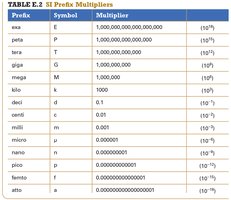
Example: 1 cm = m; 1 kg = g
Derived Units: Volume and Density
Volume
Volume is the amount of space an object occupies. Common units include cubic centimeters (cm3) and liters (L).
1 L = 1,000 mL = 1,000 cm3
Density
Density is the ratio of mass to volume, indicating how much matter is packed into a given space.
Formula:
Units: g/mL, g/cm3, kg/L
Density determines whether a substance will sink or float in another substance.
Properties of Matter
Intensive vs. Extensive Properties
Intensive properties do not depend on the amount of substance (e.g., density, temperature). Extensive properties depend on the amount of substance (e.g., mass, volume).
Measurement Reliability
Reading Measurements
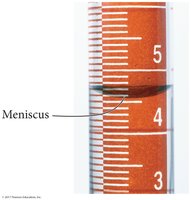
Measurements should be recorded so that all digits are certain except the last, which is estimated. Always read the bottom of the meniscus in a graduated cylinder.
Precision vs. Accuracy
Precision refers to how close repeated measurements are to each other. Accuracy refers to how close a measurement is to the true value.
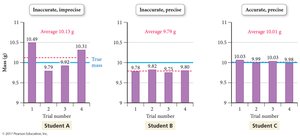
High precision, low accuracy: Consistent but wrong value (systematic error).
Low precision, high accuracy: Scattered but average is correct (random error).
High precision, high accuracy: Consistent and correct.
Types of Error
Random error: Equal probability of being too high or too low; can be reduced by repeated trials.
Systematic error: Consistently too high or too low; caused by faulty equipment or technique.
Significant Figures
Counting Significant Figures
Significant figures reflect the precision of a measurement. The more significant figures, the greater the certainty.
All nonzero digits are significant.
Zeros between nonzero digits are significant.
Leading zeros are not significant.
Trailing zeros are significant if there is a decimal point.
Exact numbers (counted or defined quantities) have an unlimited number of significant figures.
Significant Figures in Calculations
Multiplication/Division: Result has the same number of significant figures as the factor with the fewest significant figures.
Addition/Subtraction: Result has the same number of decimal places as the quantity with the fewest decimal places.
Rounding Rules
Round down if the digit dropped is less than 5.
Round up if the digit dropped is 5 or more.
Only round the final answer in multistep calculations.
Scientific Notation
Scientific notation is used to express very large or small numbers. Place a single nonzero digit to the left of the decimal and multiply by a power of ten.
Example: atoms
Example: g
Energy and Its Units
Types of Energy
Energy is the capacity to do work. Work is the action of a force through a distance.
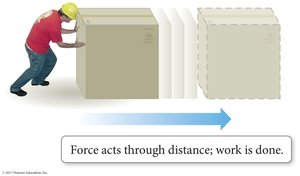
Kinetic energy (KE): Energy of motion.
Potential energy (PE): Energy due to position or composition.
Thermal energy: Energy associated with temperature (a form of kinetic energy).
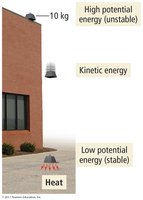
Law of Conservation of Energy
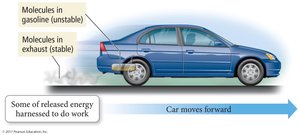
Energy cannot be created or destroyed, only transformed. The total energy of a system is the sum of kinetic and potential energy.
Systems with high potential energy tend to change to lower potential energy, releasing energy to the surroundings.
Problem Solving in Chemistry
Dimensional Analysis and Unit Conversions
Dimensional analysis uses units as a guide to solving problems. Units are treated algebraically and can be multiplied, divided, or canceled.
Always include units in calculations.
When raising a unit to a power, raise both the number and the unit.

General formula for conversions:
Example: To convert 1 km2 to in2, square both the number and the unit in the conversion factor.
Conceptual Plan Approach
For complex problems, sort data into given and needed information, strategize the steps, solve, and check your answer. Work backwards if stuck.
Summary Table: Key Concepts
Concept | Key Points |
|---|---|
SI Units | Standardized, based on metric system |
Significant Figures | Reflect measurement precision |
Energy | Kinetic, potential, thermal; conserved in transformations |
Dimensional Analysis | Systematic approach to unit conversions |
