 Indietro
Exam 1 Review: General Chemistry Concepts and Practice Problems
Guida di studio - Note intelligenti
 Appunti personalizzati basati sui tuoi materiali, ampliati con definizioni chiave, esempi e contesto.
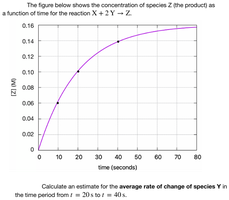
Q1. The figure below shows the concentration of species Z (the product) as a function of time for the reaction X + 2Y → Z. Calculate an estimate for the average rate of change of species Y in the time period from t = 20 s to t = 40 s.
Background
Topic: Chemical Kinetics – Rate of Reaction
This question tests your understanding of how to calculate the average rate of change of a reactant or product using concentration vs. time data, and how to relate the rate of change of one species to another using stoichiometry.
Key Terms and Formulas:
Average rate:
Stoichiometry: Use the coefficients from the balanced equation to relate the rates of change of different species.
Step-by-Step Guidance
Identify the concentrations of Z at t = 20 s and t = 40 s from the graph.
Calculate by subtracting the concentration at 20 s from that at 40 s.
Calculate the average rate of formation of Z using .
Use the stoichiometry of the reaction (X + 2Y → Z) to relate the rate of change of Y to the rate of formation of Z. Remember, for every 1 Z formed, 2 Y are consumed.
Set up the expression for the average rate of change of Y based on the stoichiometric relationship, but do not solve for the final value yet.
Try solving on your own before revealing the answer!
Final Answer:
The average rate of change of Y is , where is the change in concentration of Z between 20 s and 40 s.
From the graph, M and M, so M.
s.
Average rate of formation of Z: M/s.
Average rate of change of Y: M/s.
The negative sign indicates Y is being consumed.
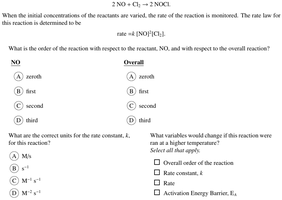
Q2. When the initial concentrations of the reactants are varied, the rate of the reaction is monitored. The rate law for this reaction is determined to be rate = k[NO][Cl2]. What is the order of the reaction with respect to the reactant NO, and with respect to the overall reaction?
Background
Topic: Rate Laws and Reaction Order
This question tests your ability to interpret a rate law and determine the order of reaction for each reactant and the overall order.
Key Terms and Formulas:
Rate law:
Order with respect to a reactant: The exponent of the concentration in the rate law.
Overall order: Sum of the exponents in the rate law.
Step-by-Step Guidance
Identify the exponent for NO in the rate law.
Identify the exponent for Cl2 in the rate law.
Add the exponents to determine the overall order of the reaction.
Review the multiple choice options and match your findings to the correct answers, but do not select the final answer yet.
Try solving on your own before revealing the answer!
Final Answer:
The order with respect to NO is first order (exponent = 1), and the overall order is second order (sum of exponents = 1 + 1 = 2).
Correct answers: NO = first, Overall = second.
Q3. What are the correct units for the rate constant, k, for this reaction?
Background
Topic: Rate Constant Units
This question tests your understanding of how to determine the units of the rate constant based on the overall order of the reaction.
Key Terms and Formulas:
General formula:
Units of rate: M/s
Units of concentration: M
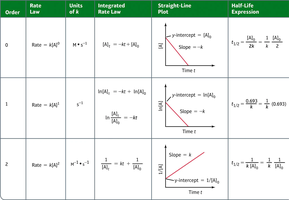
For a second order reaction: units =
Step-by-Step Guidance
Write the rate law and identify the overall order (second order).
Recall that rate has units of M/s.
Set up the equation for units:
Solve for the units of k, but do not state the final units yet.
Try solving on your own before revealing the answer!
Final Answer:
The units for the rate constant k in a second order reaction are .
Q4. What variables would change if this reaction were run at a higher temperature? Select all that apply.
Background
Topic: Temperature Effects on Reaction Rate
This question tests your understanding of how temperature affects reaction rate, rate constant, activation energy, and reaction order.
Key Terms and Formulas:
Arrhenius Equation:
Rate constant (k) increases with temperature.
Activation energy (Ea) is a property of the reaction and does not change with temperature.
Overall order is determined by the mechanism and does not change with temperature.
Step-by-Step Guidance
Recall which variables are affected by temperature (rate and rate constant).
Consider which variables are intrinsic to the reaction and do not change (activation energy, overall order).
Review the options and identify which ones are correct, but do not select the final answer yet.
Try solving on your own before revealing the answer!
Final Answer:
Rate and rate constant (k) would change with temperature. Overall order and activation energy barrier (Ea) would not change.
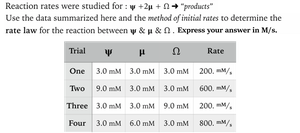
Q5. Reaction rates were studied for: ψ + 2μ + Ω → products. Use the data summarized here and the method of initial rates to determine the rate law for the reaction between ψ & μ & Ω. Express your answer in M/s.
Background
Topic: Method of Initial Rates
This question tests your ability to use experimental data to determine the rate law for a reaction by comparing how changes in reactant concentrations affect the rate.
Key Terms and Formulas:
Rate law:
Method of initial rates: Compare trials where only one reactant concentration changes.
Step-by-Step Guidance
Identify pairs of trials where only one reactant concentration changes.
Calculate the effect of changing ψ, μ, or Ω on the rate by comparing rates and concentrations.
Determine the order with respect to each reactant by analyzing how the rate changes.
Write the rate law based on your findings, but do not state the final rate law yet.
Try solving on your own before revealing the answer!
Final Answer:
The rate law is .
Each reactant's order was determined by comparing trials where only its concentration changed.
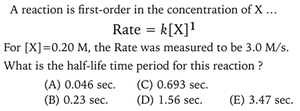
Q6. A reaction is first-order in the concentration of X. For [X] = 0.20 M, the Rate was measured to be 3.0 M/s. What is the half-life time period for this reaction?
Background
Topic: First-Order Kinetics and Half-Life
This question tests your ability to calculate the half-life of a first-order reaction using the rate law and the measured rate.
Key Terms and Formulas:
First-order rate law:
Half-life for first-order:
Step-by-Step Guidance
Use the rate law to solve for k:
Plug in the values for rate and [X] to find k.
Use the half-life formula for first-order reactions:
Set up the calculation for half-life, but do not solve for the final value yet.
Try solving on your own before revealing the answer!
Final Answer:
s
s
The correct answer is (A) 0.046 sec.
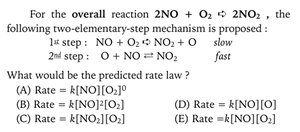
Q7. For the overall reaction 2NO + O2 → 2NO2, the following two-elementary-step mechanism is proposed: 1st step: NO + O2 → NO2 + O (slow), 2nd step: O + NO → NO2 (fast). What would be the predicted rate law?
Background
Topic: Reaction Mechanisms and Rate Laws
This question tests your ability to use a proposed mechanism to predict the rate law, focusing on the slow (rate-determining) step.
Key Terms and Formulas:
Rate-determining step: The slowest step in the mechanism determines the rate law.
Rate law for elementary step: Use the reactants in the slow step.
Step-by-Step Guidance
Identify the slow step in the mechanism.
Write the rate law using the reactants in the slow step.
Review the multiple choice options and match your findings, but do not select the final answer yet.
Try solving on your own before revealing the answer!
Final Answer:
The predicted rate law is .
This is because the slow step involves NO and O2 as reactants.
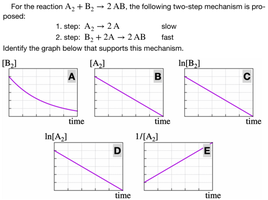
Q8. For the reaction A2 + B2 → 2 AB, a two-step mechanism is proposed: 1st step: A2 → 2A (slow), 2nd step: B2 + 2A → 2 AB (fast). Identify the graph below that supports this mechanism.
Background
Topic: Reaction Mechanisms and Integrated Rate Laws
This question tests your ability to interpret kinetic data and match it to a proposed mechanism, focusing on the slow step and its effect on reactant concentration over time.
Key Terms and Formulas:
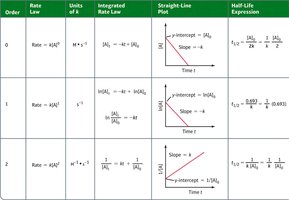
Integrated rate laws: Zero, first, and second order reactions have characteristic concentration vs. time plots.
Slow step determines the rate law and the shape of the concentration-time graph.
Step-by-Step Guidance
Identify which reactant is involved in the slow step (A2).
Determine the expected concentration vs. time plot for A2 based on the slow step's order.
Compare the provided graphs to the expected plot, but do not select the final answer yet.
Try solving on your own before revealing the answer!
Final Answer:
The graph that supports the mechanism is the one showing a straight line for ln[A2] vs. time, indicating a first-order reaction for A2 in the slow step.
Correct graph: D (ln[A2] vs. time is linear).
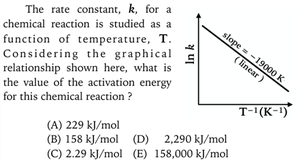
Q9. The rate constant, k, for a chemical reaction is studied as a function of temperature, T. Considering the graphical relationship shown here, what is the value of the activation energy for this chemical reaction?
Background
Topic: Arrhenius Equation and Activation Energy
This question tests your ability to use the Arrhenius equation and interpret a plot of ln k vs. 1/T to determine activation energy.
Key Terms and Formulas:
Arrhenius Equation:
Slope of the plot:
R = 8.314 J/(mol·K)
Step-by-Step Guidance
Identify the slope of the plot (given as -19,000 K).
Set up the equation and solve for .
Plug in the value for R and calculate , but do not state the final value yet.
Try solving on your own before revealing the answer!
Final Answer:
J/mol = 158 kJ/mol
The correct answer is (B) 158 kJ/mol.
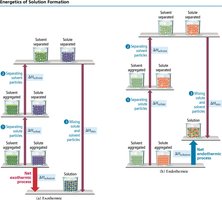
Q10. Energetics of Solution Formation: What are the steps and energy changes involved in forming a solution?
Background
Topic: Solution Formation and Enthalpy Changes
This question tests your understanding of the process of solution formation and the associated energy changes (endothermic and exothermic steps).
Key Terms and Formulas:
Enthalpy of solution (): Sum of the enthalpy changes for separating solute, separating solvent, and mixing.
Endothermic: Energy absorbed (breaking bonds).
Exothermic: Energy released (forming new interactions).
Step-by-Step Guidance
Identify the three steps: separating solute, separating solvent, and mixing.
Determine which steps are endothermic and which are exothermic.
Sum the enthalpy changes to find the net enthalpy of solution, but do not state the final value yet.
Try solving on your own before revealing the answer!
Final Answer:
Solution formation involves three steps: (1) separating solute (endothermic), (2) separating solvent (endothermic), and (3) mixing solute and solvent (exothermic). The net enthalpy change () is the sum of these steps.
Q11. Osmosis is the flow of solvent from a solution of lower solute concentration to one of higher solute concentration. Why does this occur?
Background
Topic: Osmosis and Colligative Properties
This question tests your understanding of osmosis and the tendency of nature to mix substances, driven by differences in solute concentration.
Key Terms and Formulas:
Osmosis: Movement of solvent across a semipermeable membrane.
Colligative properties: Depend on the number of solute particles.
Osmotic pressure formula:
Step-by-Step Guidance
Recall that osmosis is driven by differences in solute concentration.
Understand that solvent moves to equalize concentrations due to nature's tendency to mix.
Relate this to the concept of osmotic pressure, but do not state the final explanation yet.
Try solving on your own before revealing the answer!
Final Answer:
Osmosis occurs because solvent naturally moves from areas of lower solute concentration to higher solute concentration to equalize concentrations, driven by the tendency to mix and maximize entropy.
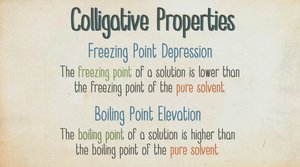
Q12. Colligative Properties of Strong Electrolyte Solutions: To calculate freezing point depression, boiling point elevation, and osmotic pressure of ionic solutions, we use the van’t Hoff factor in each equation as follows:
Background
Topic: Colligative Properties and van’t Hoff Factor
This question tests your understanding of colligative properties and how the van’t Hoff factor (i) is used in calculations for ionic solutions.
Key Terms and Formulas:
van’t Hoff factor (i): Number of particles produced per formula unit.
Freezing point depression:
Boiling point elevation:
Osmotic pressure:
Step-by-Step Guidance
Identify the relevant equations for freezing point depression, boiling point elevation, and osmotic pressure.
Understand how the van’t Hoff factor (i) modifies each equation for ionic solutions.
Set up the calculation for a sample ionic solution, but do not solve for the final value yet.
Try solving on your own before revealing the answer!
Final Answer:
For strong electrolytes, use the van’t Hoff factor (i) in each colligative property equation: , , . The value of i depends on the number of ions produced per formula unit.
