 Indietro
Foundations of General Chemistry: Matter, Measurement, and Atomic Structure
Guida di studio - Note intelligenti
 Appunti personalizzati basati sui tuoi materiali, ampliati con definizioni chiave, esempi e contesto.
Introduction to Chemistry
What is Chemistry?
Chemistry is the experimental science that studies the interactions of matter and energy, as well as the changes that matter undergoes. All matter has mass and occupies space, and it can neither be created nor destroyed according to the law of conservation of energy.
Matter exists in three primary states: solid (fixed volume and shape), liquid (fixed volume, shape of container), and gas (shape and volume of container).
There are about 90 naturally occurring elements that make up all matter.
Classification of Matter
Elements, Compounds, and Mixtures
Elements are the simplest stable forms of matter and are considered pure substances. Elements can combine to form compounds, which are also pure substances. Both elements and compounds can exist as mixtures.
Pure Substance: Cannot be separated into other kinds of matter by physical means (e.g., pure gold bar).
Mixture: Can be separated by physical means (e.g., salt water).
Conservation of Energy
Energy in Chemistry
Energy is the capacity to do work. According to the law of conservation of energy, energy cannot be created or destroyed, only transformed.
Measurement in Chemistry
SI Units and Measurement Systems
To ensure reproducibility in science, the International System of Units (SI Units) is used. Every measurement must include a unit to indicate the reference standard.
Quantity | SI Unit | Other Units |
|---|---|---|
Mass | Gram (g) | Pound (lb), Ounce (oz) |
Length | Meter (m) | Yard, Inch, Foot |
Time | Second (s) | Minute, Hour |
Temperature | Kelvin (K) | Celsius (°C), Fahrenheit (°F) |
Volume | Liter (L) | Quart, Gallon |
Amount of Substance | Mole (mol) | Dozen, etc. |
Metric Prefixes and Orders of Magnitude
Metric prefixes indicate the order of magnitude for units, making it easier to express very large or small numbers.
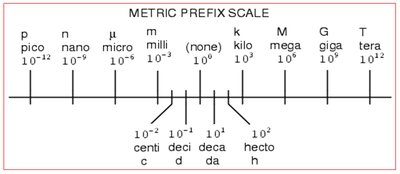
Scientific Notation
Scientific notation is used to conveniently express very large or small numbers. For example, atoms is Avogadro's number.
Temperature Scales
Fahrenheit, Celsius, and Kelvin
There are three main temperature scales used in chemistry: Fahrenheit (°F), Celsius (°C), and Kelvin (K). Kelvin is the SI unit and is based on absolute zero, the lowest possible temperature where all kinetic energy is removed.
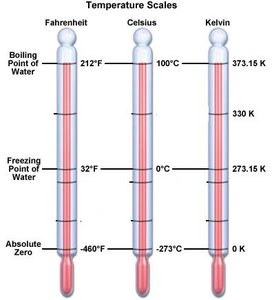
Conversion formulas:
Significant Figures and Measurement
Precision and Accuracy
Significant figures reflect the precision of a measurement. All certain digits plus the first uncertain digit are considered significant.
Non-zero digits are always significant.
Zeros between non-zeros are significant (e.g., 903).
Trailing zeros with a decimal are significant (e.g., 70.00).
Leading zeros are not significant (e.g., 0.03).
Rules for Calculations
Addition/Subtraction: The answer should have the same number of decimal places as the measurement with the fewest decimal places.
Multiplication/Division: The answer should have the same number of significant figures as the measurement with the fewest significant figures.
Dimensional Analysis
Unit Conversions
Dimensional analysis is a systematic approach to converting between units using conversion factors. For squared or cubed units, the conversion factor must also be squared or cubed.
Density
Definition and Calculation
Density is defined as mass per unit volume:
For water, .
Atomic Theory and Structure
Dalton's Atomic Theory
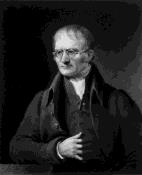
Dalton proposed that elements are made of atoms, all atoms of an element are identical, and atoms combine in fixed ratios to form compounds. Atoms are not created or destroyed in chemical reactions.
Structure of the Atom
Atoms are composed of protons, neutrons, and electrons. Protons and neutrons are located in the nucleus, while electrons occupy the surrounding cloud. The number of protons defines the element (atomic number).
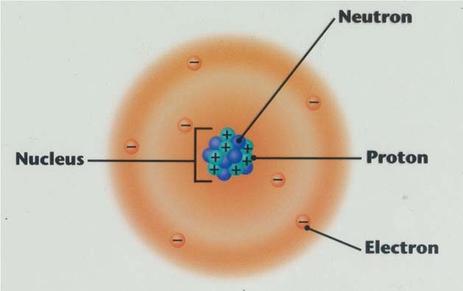
Discovery of Subatomic Particles
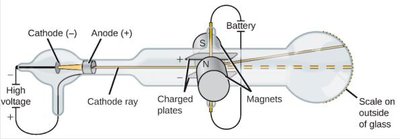
Electron: Discovered using the cathode ray tube experiment, which showed that electrons are negatively charged particles with a specific charge-to-mass ratio.
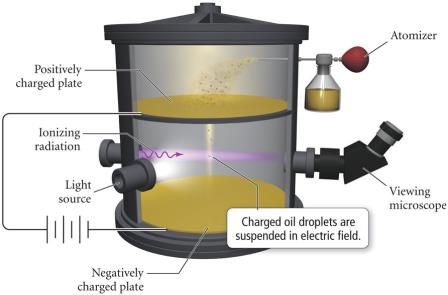
Millikan Oil Drop Experiment: Determined the charge of the electron and, using the charge-to-mass ratio, its mass.
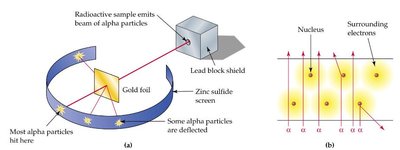
Rutherford Gold Foil Experiment: Demonstrated that atoms have a small, dense nucleus.
Properties of Subatomic Particles
Proton (p+): Charge = +1, Mass = 1 amu ( g)
Electron (e-): Charge = -1, Mass = g
Neutron (n): Charge = 0, Mass = 1 amu
Isotopes and Atomic Mass
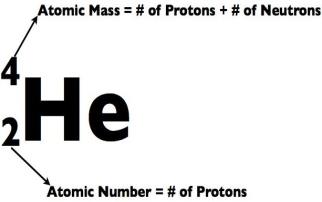
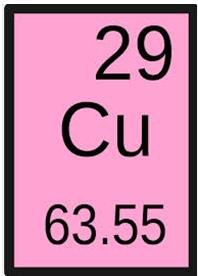
Isotopes are atoms of the same element with different numbers of neutrons. The atomic mass listed on the periodic table is a weighted average of all naturally occurring isotopes.
The Mole and Avogadro's Number
Definition of the Mole
The mole (mol) is the SI unit for the amount of substance. One mole contains entities (Avogadro's number). The molar mass (g/mol) of an element is numerically equal to its atomic mass in amu.
The Periodic Table
Organization and Groups
The periodic table is organized by increasing atomic number, with metals on the left and nonmetals on the right. Elements with similar properties are grouped in vertical columns called groups or families.
Group 1: Alkali metals (+1 charge)
Group 2: Alkaline earth metals (+2 charge)
Group 7: Halogens (-1 charge)
Group 8: Noble gases (0 charge, unreactive)
Ions and Ionic Compounds
Formation of Ions
Atoms gain or lose electrons to achieve the same number of electrons as the nearest noble gas, forming ions. Metals lose electrons to form cations, while nonmetals gain electrons to form anions.
Cation: Positively charged ion (e.g., Na+)
Anion: Negatively charged ion (e.g., Cl-)
Binary Ionic Compounds
Binary ionic compounds consist of two elements: a metal and a nonmetal. The compound is electrically neutral, with the total positive charge balancing the total negative charge.
Examples:
Na+ + Cl- → NaCl
Ca2+ + O2- → CaO
The force holding the ions together is the Coulombic force:
Polyatomic Ions
Polyatomic ions are ions composed of more than one atom. They can form ionic compounds in the same way as binary ions.
Ion | Formula |
|---|---|
Cyanide | CN- |
Bicarbonate | HCO3- |
Hydroxide | OH- |
Chromate | CrO42- |
Phosphate | PO43- |
Ammonium | NH4+ |
Molecular Compounds
Covalent Bonding
Molecular compounds are typically composed of nonmetals bonded together by covalent bonds, where electrons are shared. The electronegativity difference is less than 2.0.
Examples:
H2O
CH4
PF3
Mixtures
Types of Mixtures
Homogeneous Mixture: Uniform composition throughout (e.g., air, salt water).
Heterogeneous Mixture: Non-uniform composition, visible differences (e.g., granite, blood).
Colloid: Intermediate between homogeneous and heterogeneous; particles are not visible to the naked eye (e.g., milk, fog).
Naming Compounds
Nomenclature Flow Chart
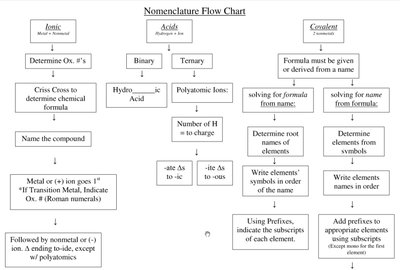
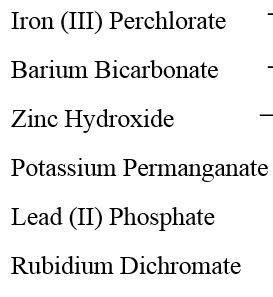
Ionic Compounds: Name the cation first, then the anion (with -ide suffix). For transition metals, include the oxidation state in Roman numerals.
Molecular Compounds: Name the element with the lowest group number first, then the second element as an anion with -ide. Use Greek prefixes to indicate the number of atoms.
Hydrates: Add the Greek prefix and 'hydrate' to indicate water molecules (e.g., Copper(II) sulfate pentahydrate).
Naming Ionic Compounds with Polyatomic Ions
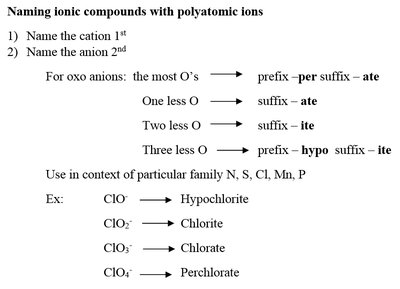
For oxoanions, use prefixes and suffixes to indicate the number of oxygen atoms (e.g., hypochlorite, chlorite, chlorate, perchlorate).
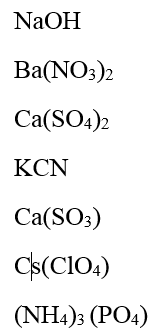
Examples of Compound Names and Formulas
Additional info: This guide covers foundational topics in general chemistry, including matter, measurement, atomic structure, the periodic table, ions, compounds, mixtures, and nomenclature. It is suitable for exam preparation and as a reference for introductory college chemistry.
