 Indietro
General Chemistry Essentials: Units, Atomic Structure, Quantum Theory, and Electron Configuration
Guida di studio - Note intelligenti
 Appunti personalizzati basati sui tuoi materiali, ampliati con definizioni chiave, esempi e contesto.
Essentials: Units, Measurement, and Problem Solving
SI Prefix Multipliers
Understanding SI prefixes is crucial for converting between units in chemistry. The most commonly used prefixes between kilo and nano are:
Kilo- (k): or 1,000
Centi- (c): or 0.01
Milli- (m): or 0.001
Micro- (\mu):
Nano- (n):
Be able to convert between units with different prefixes, including squared or cubed units (e.g., ).
Significant Figures
Significant figures reflect the precision of a measurement. Rules for determining significant figures:
All nonzero digits are significant.
Zeros between nonzero digits are significant.
Leading zeros are not significant.
Trailing zeros are significant only if there is a decimal point.
When performing calculations:
Addition/Subtraction: The result should have the same number of decimal places as the measurement with the fewest decimal places.
Multiplication/Division: The result should have the same number of significant figures as the measurement with the fewest significant figures.
Multiple Operations: Apply the rules stepwise, rounding at the end.
Dimensional Analysis
Dimensional analysis uses conversion factors to solve problems involving unit changes. Always include units in calculations to ensure accuracy.
Classification of Matter
Elements, Compounds, and Mixtures
Pure Substance: Matter with a fixed composition (element or compound).
Element: Consists of only one type of atom.
Compound: Contains two or more elements chemically combined.
Mixture: Physical combination of substances.
Homogeneous Mixture: Uniform composition throughout (e.g., saltwater).
Heterogeneous Mixture: Non-uniform composition (e.g., salad).
Physical Properties of Solids, Liquids, and Gases
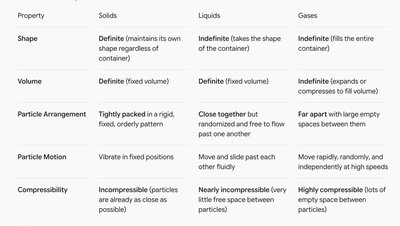
The three states of matter differ in shape, volume, particle arrangement, motion, and compressibility.
Property | Solids | Liquids | Gases |
|---|---|---|---|
Shape | Definite (maintains its own shape) | Indefinite (takes shape of container) | Indefinite (fills container) |
Volume | Definite | Definite | Indefinite |
Particle Arrangement | Tightly packed, orderly | Close together, random | Far apart, large empty spaces |
Particle Motion | Vibrate in fixed positions | Move/slide past each other | Move rapidly, independently |
Compressibility | Incompressible | Nearly incompressible | Highly compressible |
Physical vs. Chemical Properties
Physical Properties: Can be observed without changing the substance (e.g., melting point, density).
Chemical Properties: Describe how a substance reacts (e.g., flammability, reactivity).
Atomic Structure
Nuclear Atom Model
Electrical Neutrality: In a neutral atom, number of protons = number of electrons.
Atomic Number (Z): Number of protons; defines the element.
Mass Number (A): Total number of protons and neutrons.
Subatomic Particles
Proton: Charge +1, mass ≈ 1 amu
Neutron: Charge 0, mass ≈ 1 amu
Electron: Charge -1, mass ≈ 0.0005 amu
Atomic Mass Unit (amu): Defined as 1/12 the mass of a carbon-12 atom ().
Nuclide Symbol and Isotopes
The nuclide symbol is written as , where X is the element symbol, A is the mass number, and Z is the atomic number.
Isotopes: Atoms of the same element (same Z) with different numbers of neutrons (different A).
Ions: Atoms or molecules with a net charge due to loss/gain of electrons.
Cation: Positively charged (loss of electrons).
Anion: Negatively charged (gain of electrons).
Given a nuclide symbol, you can determine the number of protons, neutrons, and electrons.
Average Atomic Mass
Calculated using isotopic masses and abundances:
The most abundant isotope is the one whose mass is closest to the average atomic mass.
The Mole and Avogadro's Number
Mole: The amount of substance containing particles (Avogadro's number).
Significance: Links atomic scale to laboratory scale; 1 mole of atoms has a mass in grams equal to its atomic mass in amu.
Conversions: mass ↔ moles ↔ number of particles.
Quantum-Mechanical Model of the Atom
Electromagnetic Radiation
Electromagnetic radiation: Energy traveling as oscillating electric and magnetic fields (waves).
Frequency (\nu): Number of cycles per second (Hz).
Wavelength (\lambda): Distance between wave crests (m, nm, etc.).
Photon: Quantum of electromagnetic energy; .
Key equations:
Units: Frequency (Hz), Wavelength (m, nm), Energy (J, kJ/mol).
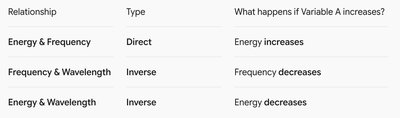
Relationships Among Energy, Frequency, and Wavelength
Relationship | Type | What happens if Variable A increases? |
|---|---|---|
Energy & Frequency | Direct | Energy increases |
Frequency & Wavelength | Inverse | Frequency decreases |
Energy & Wavelength | Inverse | Energy decreases |
Electromagnetic Spectrum
Order (increasing energy/frequency, decreasing wavelength): Radio → Microwave → Infrared → Visible → Ultraviolet → X-ray → Gamma
Visible light: Red (longest wavelength, lowest energy) to violet (shortest wavelength, highest energy)
Photoelectric Effect
Light can eject electrons from a metal only if its frequency is above a threshold. This demonstrated that light behaves as particles (photons), not just waves.
Bohr Model of the Atom
Electrons orbit in fixed, quantized energy levels.
Energy is absorbed/emitted as electrons change levels ().
Explains hydrogen's line spectrum but violates classical physics (should radiate energy continuously).
Wave-Particle Duality
Light and matter exhibit both wave and particle properties. de Broglie equation: .
Heisenberg Uncertainty Principle
It is impossible to know both the exact position and momentum of a particle simultaneously:
Wavefunction and Probability Density
The square of the wavefunction () gives the probability density of finding an electron at a point in space.
Quantum Numbers
Principal Quantum Number (n): Main energy level (n = 1, 2, 3, ...)
Angular Momentum Quantum Number (l): Shape of orbital (l = 0 to n-1; s, p, d, f)
Magnetic Quantum Number (m_l): Orientation (-l to +l)
Spin Quantum Number (m_s): Direction of spin (+1/2 or -1/2)
Selection rules: n is a positive integer; l is 0 to n-1; m_l is -l to +l; m_s is +1/2 or -1/2.
Electron Transitions: Absorption and Emission
Absorption: Electron absorbs a photon and moves to a higher energy level.
Emission: Electron drops to a lower energy level, emitting a photon.
Electron Configuration and the Periodic Table
Orbital Diagrams and Electron Configurations
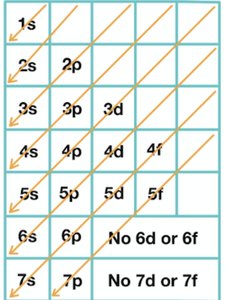
Electrons fill orbitals in order of increasing energy (Aufbau principle).
Pauli Exclusion Principle: No two electrons in an atom can have the same set of four quantum numbers.
Hund's Rule: Electrons fill degenerate orbitals singly before pairing.
Some elements (e.g., Cr, Cu) have exceptions to the general filling order for increased stability.
Electron configurations can be written in full or using noble gas shorthand.
Core vs. Valence Electrons
Core electrons: Inner electrons, not involved in bonding.
Valence electrons: Outermost electrons, determine chemical properties.
The periodic table's shape reflects the filling of s, p, d, and f orbitals (blocks).
Additional info: Some explanations and examples have been expanded for clarity and completeness based on standard general chemistry textbooks.
