 Indietro
General Chemistry Exam 1 Review – Kinetics and Equilibrium Guidance
Guida di studio - Note intelligenti
 Appunti personalizzati basati sui tuoi materiali, ampliati con definizioni chiave, esempi e contesto.
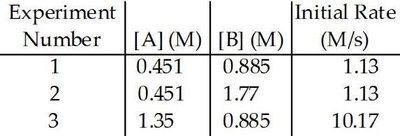
Q26. The rate law for the reaction A + B → C is rate = ________.
Background
Topic: Chemical Kinetics – Rate Laws
This question tests your ability to determine the rate law for a reaction using experimental data. The rate law expresses how the rate depends on the concentrations of reactants.
Key Terms and Formulas:
Rate Law:
k = rate constant
m, n = reaction orders with respect to A and B
Step-by-Step Guidance
Examine the table to see how changing [A] or [B] affects the initial rate.
Compare experiments where only [B] changes (Experiments 1 and 2) to determine the order with respect to B.
Compare experiments where only [A] changes (Experiments 1 and 3) to determine the order with respect to A.
Set up ratios of rates and concentrations to solve for the exponents m and n in the rate law.
Write the general form of the rate law based on your findings, but do not plug in the final exponents yet.
Try solving on your own before revealing the answer!
Final Answer: rate = k[A]^2[B]
By comparing the experiments, you find that the rate is independent of [B] (order 0), and the rate increases by a factor of about 9 when [A] increases by a factor of 3 (order 2). Thus, the rate law is .
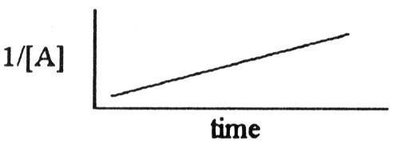
Q27. Which graph shows the correct relationship between concentration and time for a reaction that is second order in [A]?
Background
Topic: Chemical Kinetics – Integrated Rate Laws
This question tests your understanding of how concentration changes over time for different reaction orders. For second-order reactions, the integrated rate law has a specific form.
Key Terms and Formulas:
Second-order integrated rate law:
For a second-order reaction, a plot of vs. time is linear.
Step-by-Step Guidance
Recall the integrated rate law for second-order reactions.
Identify which variable (concentration, ln(concentration), 1/concentration) should be plotted against time to yield a straight line.
Examine the provided graphs and match the correct plot to the second-order behavior.
Look for a graph where increases linearly with time.
Try solving on your own before revealing the answer!
Final Answer: Graph C (1/[A] vs. time is linear)
The correct graph for a second-order reaction is the one where increases linearly with time, which matches the integrated rate law for second order.
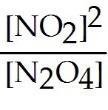
Q37. Which of the following expressions is the correct equilibrium-constant expression for the equilibrium between dinitrogen tetroxide and nitrogen dioxide?
Background
Topic: Chemical Equilibrium – Equilibrium Constant Expressions
This question tests your ability to write the equilibrium constant expression for a given chemical equation.
Key Terms and Formulas:
For the reaction , the equilibrium constant expression is:
Step-by-Step Guidance
Write the balanced chemical equation: .
Recall that the equilibrium constant expression is the product of concentrations of products raised to their stoichiometric coefficients divided by the product of concentrations of reactants raised to their coefficients.
Apply this rule to the equation above.
Identify the correct mathematical form from the provided options.
Try solving on your own before revealing the answer!
Final Answer:
The correct equilibrium constant expression for is .
