 Indietro
General Chemistry Exam 1 Study Guidance
Guida di studio - Note intelligenti
 Appunti personalizzati basati sui tuoi materiali, ampliati con definizioni chiave, esempi e contesto.
Q1. Chemistry studies the matter in the world on the level of:
Background
Topic: Scope of Chemistry
This question tests your understanding of what chemistry focuses on compared to other sciences. Chemistry is concerned with the composition, structure, properties, and changes of matter, especially at the atomic and molecular level.
Key Terms:
Atoms: The smallest unit of an element that retains the properties of that element.
Molecules: Groups of two or more atoms bonded together.
Step-by-Step Guidance
Review the definitions of subatomic particles, atoms, molecules, cells, planets, and galaxies.
Consider which of these levels is the primary focus of chemistry, as opposed to physics, biology, or astronomy.
Recall that chemistry is often called the "central science" because it connects physical sciences with life and applied sciences, but its main focus is on the structure and behavior of atoms and molecules.
Try solving on your own before revealing the answer!
Final Answer: B) Atoms and Molecules
Chemistry primarily studies matter at the atomic and molecular level, not at the level of cells, planets, or galaxies.
Q2. How many significant figures are in the measurement, 0.005890 g?
Background
Topic: Significant Figures
This question tests your ability to count significant figures in a measured value, which is important for reporting scientific data accurately.
Key Terms:
Significant Figures: All the digits in a measurement that are known with certainty plus one final digit, which is somewhat uncertain or estimated.
Step-by-Step Guidance
Identify all nonzero digits in the number; these are always significant.
Count any zeros between nonzero digits; these are also significant.
Leading zeros (zeros before the first nonzero digit) are not significant.
Trailing zeros in a decimal number are significant.
Try solving on your own before revealing the answer!
Final Answer: C) 4
The significant figures in 0.005890 are 5, 8, 9, and the final 0 (because it is after the decimal and after a nonzero digit).
Q3. What answer should be reported, with the correct number of significant figures, for the following calculation? 965.43 × 3.911 + 9413.4136
Background
Topic: Significant Figures in Calculations
This question tests your ability to apply the rules for significant figures in multiplication and addition.
Key Terms and Formulas:
Multiplication/Division: The result should have as many significant figures as the measurement with the fewest significant figures.
Addition/Subtraction: The result should have as many decimal places as the measurement with the fewest decimal places.
Step-by-Step Guidance
First, multiply 965.43 by 3.911. Determine the number of significant figures in each value.
Round the result of the multiplication to the correct number of significant figures.
Add the rounded multiplication result to 9413.4136. Consider the number of decimal places in each value for the final rounding.
Try solving on your own before revealing the answer!
Final Answer: D) 13189
The multiplication is rounded to four significant figures, and the final sum is rounded to the correct decimal place.
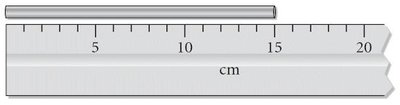
Q4. Read the length of the metal bar with the correct number of significant figures.
Background
Topic: Measurement and Significant Figures
This question tests your ability to read a measurement from a ruler and report it with the correct number of significant figures, including estimation of the last digit.
Key Terms:
Significant Figures in Measurement: All certain digits plus one estimated digit.
Step-by-Step Guidance
Align the left end of the bar with the zero mark on the ruler.
Read the value at the right end of the bar, noting the smallest division on the ruler (usually 0.1 cm).
Estimate one digit beyond the smallest marked division for the most precise measurement.
Try solving on your own before revealing the answer!
Final Answer: B) 15.0 cm
The correct measurement includes all certain digits plus one estimated digit, reflecting the precision of the ruler.
Q5. Convert 690 m2 to cm2.
Background
Topic: Unit Conversion (Metric System)
This question tests your ability to convert between units of area in the metric system, remembering to square the conversion factor.
Key Formula:
So,
Step-by-Step Guidance
Write the given value: .
Set up the conversion factor: .
Multiply the given value by the conversion factor to convert to cm2.
Try solving on your own before revealing the answer!
Final Answer: A) cm2
Multiplying 690 by 10,000 gives cm2, or cm2.
Q6. A recipe requires 1.66 liters of milk for a soup base. How many quarts are needed? (1 L = 1.057 qts.)
Background
Topic: Unit Conversion (Volume)
This question tests your ability to convert between metric and English units for volume.
Key Formula:
Step-by-Step Guidance
Write the given value: .
Set up the conversion factor to convert liters to quarts.
Multiply the given value by the conversion factor.
Try solving on your own before revealing the answer!
Final Answer: C) 1.75 qts
Multiplying 1.66 by 1.057 gives approximately 1.75 quarts.
Q7. Determine the mass of an object that has a volume of 88.6 mL and a density of 9.77 g/mL.
Background
Topic: Density Calculations
This question tests your ability to use the density formula to find mass when given volume and density.
Key Formula:
Rearranged:
Step-by-Step Guidance
Write the given values: , .
Set up the formula to solve for mass.
Multiply the density by the volume to find the mass.
Try solving on your own before revealing the answer!
Final Answer: E) 866 g
Multiplying 88.6 mL by 9.77 g/mL gives 866 g (rounded to three significant figures).
Q8. Identify a solid.
Background
Topic: States of Matter
This question tests your understanding of the properties of solids, liquids, and gases.
Key Terms:
Solid: A state of matter that is rigid and not compressible.
Liquid: Not rigid, not compressible.
Gas: Compressible, not rigid.
Step-by-Step Guidance
Recall the defining properties of solids: rigidity and incompressibility.
Compare each answer choice to these properties.
Try solving on your own before revealing the answer!
Final Answer: C) Not compressible but rigid
Solids are rigid and not compressible, distinguishing them from liquids and gases.
Q9. Which one is a pure substance?
Background
Topic: Classification of Matter
This question tests your ability to distinguish between pure substances and mixtures.
Key Terms:
Pure Substance: Matter with a fixed composition and distinct properties (elements and compounds).
Mixture: A combination of two or more substances that retain their individual properties.
Step-by-Step Guidance
Identify which options are mixtures (contain more than one component).
Recall that elements and compounds are pure substances.
Determine which option is an element or compound.
Try solving on your own before revealing the answer!
Final Answer: D) gold
Gold is an element, which is a pure substance. The other options are mixtures.
Q10. Which one of the following is a homogeneous mixture?
Background
Topic: Homogeneous vs. Heterogeneous Mixtures
This question tests your ability to distinguish between mixtures that are uniform throughout (homogeneous) and those that are not (heterogeneous).
Key Terms:
Homogeneous Mixture: A mixture with uniform composition throughout (also called a solution).
Heterogeneous Mixture: A mixture with non-uniform composition.
Step-by-Step Guidance
Review the definitions of homogeneous and heterogeneous mixtures.
Consider each option and decide if its composition is uniform throughout.
Try solving on your own before revealing the answer!
Final Answer: A) pure air
Pure air is a homogeneous mixture because its composition is uniform throughout.
Q11. Which of the following is a chemical change?
Background
Topic: Physical vs. Chemical Changes
This question tests your ability to distinguish between physical changes (which do not alter the chemical identity) and chemical changes (which do).
Key Terms:
Chemical Change: A process in which one or more substances are converted into new substances with different properties.
Physical Change: A change in state or appearance without changing composition.
Step-by-Step Guidance
Identify which processes involve a change in chemical composition.
Recall that digestion involves breaking down food into new substances, while grinding, melting, and dissolving do not change the chemical identity.
Try solving on your own before revealing the answer!
Final Answer: B) Digesting pizza
Digestion is a chemical change because it produces new substances from the original food.
Q12. Determine the number of protons, neutrons, and electrons in the following:
Background
Topic: Atomic Structure
This question tests your ability to interpret atomic symbols and determine the number of subatomic particles.
Key Terms and Formulas:
Atomic Number (Z): Number of protons
Mass Number (A): Number of protons + neutrons
Number of Neutrons:
Number of Electrons: For a neutral atom, equals the number of protons; for ions, adjust for charge.
Step-by-Step Guidance
Identify the atomic number (Z) and mass number (A) from the symbol.
Calculate the number of protons (equals Z).
Calculate the number of neutrons ().
Determine the number of electrons (considering the charge, if any).
Try solving on your own before revealing the answer!
Final Answer: E) p+ = 12, n0 = 13, e- = 12
For , protons = 12, neutrons = 25 - 12 = 13, electrons = 12 (neutral atom).
Q13. Br has ________ protons.
Background
Topic: Atomic Number and Isotopes
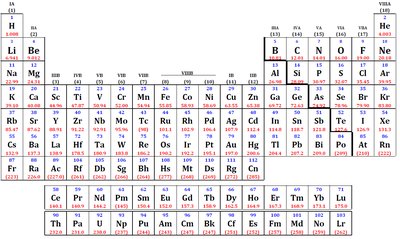
This question tests your ability to identify the number of protons in an isotope using the periodic table.
Key Terms:
Atomic Number (Z): Number of protons in the nucleus; unique for each element.
Isotope: Atoms of the same element with different numbers of neutrons.
Step-by-Step Guidance
Find bromine (Br) on the periodic table and note its atomic number.
Recall that the atomic number equals the number of protons.
The mass number (80) is not the number of protons, but the sum of protons and neutrons.
Try solving on your own before revealing the answer!
Final Answer: D) 35
Bromine has atomic number 35, so every Br atom has 35 protons.
Q14. Please fill the blanks in the following table.
Background
Topic: Atomic Structure and Ions
This question tests your understanding of how to determine the number of protons, neutrons, electrons, and the charge for various atoms and ions.
Key Terms and Formulas:
Atomic Number (Z): Number of protons
Mass Number (A): Number of protons + neutrons
Number of Neutrons:
Number of Electrons: For ions, adjust for the charge (add electrons for negative charge, subtract for positive charge).
Step-by-Step Guidance
For each row, use the given information to fill in the missing values using the relationships above.
For ions, remember to adjust the number of electrons according to the charge.
Check your answers for consistency (e.g., protons + neutrons = mass number).
Try solving on your own before revealing the answer!
Final Answer:
Symbol | Z | A | # proton | # neutron | # electron | Charge |
|---|---|---|---|---|---|---|
Li+ | 3 | 7 | 3 | 4 | 2 | +1 |
S2− | 16 | 32 | 16 | 16 | 18 | −2 |
Al | 13 | 27 | 13 | 14 | 13 | 0 |
Each value is determined using the relationships between atomic number, mass number, and charge.
Q15. Please demonstrate the Law of Multiple Proportions with the numbers provided for cuprous chloride and cupric chloride.
Background
Topic: Law of Multiple Proportions
This question tests your understanding of how to use experimental data to demonstrate the law of multiple proportions, which states that when two elements form more than one compound, the ratios of the masses of one element that combine with a fixed mass of the other are simple whole numbers.
Key Formula:
For two compounds of the same elements:
Step-by-Step Guidance
Calculate the mass ratio of copper to chlorine in cuprous chloride: .
Calculate the mass ratio of copper to chlorine in cupric chloride: .
Divide the two ratios to find the ratio between the compounds.
Simplify the result to the smallest whole numbers to demonstrate the law.
Try solving on your own before revealing the answer!
Final Answer:
Cuprous chloride:
Cupric chloride:
Ratio:
This shows that the ratio of copper that combines with a fixed mass of chlorine in the two compounds is a simple whole number (2:1), demonstrating the law of multiple proportions.
