 Indietro
General Chemistry Exam 1 Study Guide: Matter, Measurement, Atoms, Molecules, and Reaction Stoichiometry
Guida di studio - Note intelligenti
 Appunti personalizzati basati sui tuoi materiali, ampliati con definizioni chiave, esempi e contesto.
Introduction: Matter, Energy, and Measurement
Definitions and Classification of Matter
Understanding the fundamental concepts of matter is essential in chemistry. Matter is anything that has mass and occupies space. It can be classified based on its physical and chemical properties.
Atoms: The smallest unit of an element that retains its chemical properties.
Molecules: Groups of two or more atoms bonded together.
Properties of Matter: Includes physical properties (e.g., color, density, melting point) and chemical properties (e.g., reactivity, flammability).
Heterogeneous vs. Homogeneous: Heterogeneous mixtures have visibly different components; homogeneous mixtures are uniform throughout.
Chemical vs. Physical Changes: Physical changes do not alter the chemical composition; chemical changes result in new substances.
Metals, Nonmetals, Metalloids: Metals are typically shiny, conductive, and malleable; nonmetals are varied in appearance and generally non-conductive; metalloids have properties intermediate between metals and nonmetals.
Isotopes: Atoms of the same element with different numbers of neutrons.
Phases and Classification of Matter
Matter exists in three primary phases: gas, liquid, and solid. It can also be classified as pure substances (elements and compounds) or mixtures (homogeneous and heterogeneous).
Gas: No fixed shape or volume; particles move freely.
Liquid: Fixed volume, no fixed shape; particles move past each other.
Solid: Fixed shape and volume; particles are closely packed.
Pure Substances: Elements and compounds with uniform composition.
Mixtures: Combination of two or more substances; can be separated by physical means.
Measurement and Mathematical Operations
SI Units and Metric Prefixes
Chemistry relies on the International System of Units (SI) for measurement. Understanding metric prefixes is crucial for unit conversions.
SI Base Units: Length (meter, m), Mass (kilogram, kg), Time (second, s), Temperature (kelvin, K), Amount of substance (mole, mol).
Derived Units: Volume (liter, L), Density (g/cm3 or kg/m3).
Metric Prefixes: Examples include kilo- (), centi- (), milli- (), micro- (), nano- (), pico- (), femto- (), mega- (), giga- (), tera- (), deci- ().
Unit Conversions and Dimensional Analysis
Dimensional analysis is a systematic method for converting between units using conversion factors.
Conversion Factors: Ratios used to convert from one unit to another.
Example: To convert 5.0 cm to meters:
Temperature Conversions
Temperature can be measured in Celsius, Fahrenheit, and Kelvin. The following equations are used for conversions:
Celsius to Fahrenheit:
Fahrenheit to Celsius:
Celsius to Kelvin:
Density Calculations
Density is a physical property defined as mass per unit volume.
Density Equation:
Units: Commonly g/cm3 or kg/m3.
Scientific Notation and Significant Figures
Scientific notation is used to express very large or small numbers. Significant figures reflect the precision of a measurement.
Example: in scientific notation is .
Reporting Significant Figures: The number of digits reported should reflect the certainty of the measurement.
Atoms, Molecules, and Ions
Periodic Table and Element Classification
The periodic table organizes elements by increasing atomic number and groups elements with similar properties.
First 36 Elements: Know their symbols and names.
Column Names: Alkali metals, alkaline earth metals, halogens, noble gases, etc.
Metals, Nonmetals, Metalloids: Location and properties on the periodic table.
Structure of the Atom
An atom consists of protons, neutrons, and electrons. The atomic number is the number of protons; the mass number is the sum of protons and neutrons.
Atomic Number (): Number of protons in the nucleus.
Atomic Mass (): Number of protons plus neutrons.
Isotopes: Atoms of the same element with different numbers of neutrons.
Isotopic Calculations
The average atomic mass of an element is calculated based on the masses and abundances of its isotopes.
Average Atomic Mass Equation:
Example: If an element has two isotopes, A and B, with masses 10.0 and 11.0 amu and abundances 20% and 80%, the average mass is amu.
Ions and Polyatomic Ions
Ions are atoms or molecules with a net charge due to loss or gain of electrons. Polyatomic ions are charged groups of covalently bonded atoms.
Cations: Positively charged ions (e.g., Na+, NH4+).
Anions: Negatively charged ions (e.g., Cl-, SO42-).
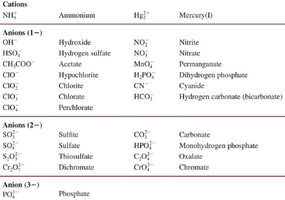
Polyatomic Ions: Know names, formulas, and charges.
Periodic Trends and Ion Formation
Elements form ions based on their position in the periodic table. Metals tend to form cations, nonmetals form anions.
Cations: Formed by loss of electrons (e.g., Na+).
Anions: Formed by gain of electrons (e.g., Cl-).
Transition Metals: Can form multiple charges; charge is determined from the compound's formula.
Naming Compounds
Chemical compounds are named according to systematic rules. Ionic compounds use cation and anion names; molecular compounds use prefixes.
Ionic Compounds: Name cation first, then anion (e.g., sodium chloride).
Molecular Compounds: Use prefixes (mono-, di-, tri-, tetra-, etc.) to indicate number of atoms (e.g., carbon dioxide).
Binary Acids: Named as "hydro-" + base name + "-ic acid" (e.g., hydrochloric acid).
Oxyacids: Named based on polyatomic ion (e.g., sulfuric acid from sulfate).
Chemical Reactions and Reaction Stoichiometry
Balancing Chemical Equations
Balancing equations ensures the Law of Conservation of Mass is obeyed. The number of atoms of each element must be the same on both sides.
Steps: Write the unbalanced equation, count atoms, adjust coefficients, check balance.
Example: becomes .
Types of Chemical Reactions
Chemical reactions can be classified by their patterns of reactivity.
Combination: Two or more substances form one product.
Decomposition: One substance breaks into two or more products.
Combustion: Substance reacts with oxygen, producing energy, CO2, and H2O.
Molecular and Formula Mass
The molecular mass is the sum of atomic masses in a molecule; formula mass is used for ionic compounds.
Calculation: Add atomic masses for each atom in the formula.
Example: Water (H2O): amu.
Molar Mass and Percent Composition
Molar mass is the mass of one mole of a substance. Percent composition is the mass percent of each element in a compound.
Molar Mass: (g/mol)
Percent Composition:
The Mole and Avogadro's Number
The mole is a counting unit in chemistry. Avogadro's number () is the number of particles in one mole.
Conversions: Use molar mass and Avogadro's number to convert between grams, moles, and particles.
Example:
Stoichiometry and Limiting Reactants
Stoichiometry involves calculations based on balanced equations. The limiting reactant determines the maximum amount of product formed.
Limiting Reactant: The reactant that is completely consumed first.
Percent Yield:
Empirical and Molecular Formulas
The empirical formula shows the simplest ratio of elements; the molecular formula shows the actual number of atoms.
Empirical Formula: Determined from percent composition or combustion analysis.
Molecular Formula: (where is a whole number)
Combustion Analysis
Combustion analysis is used to determine the empirical formula of a compound by measuring the amounts of CO2 and H2O produced.
Steps: Calculate moles of C and H from CO2 and H2O, determine O by difference, find simplest ratio.
Summary Table: Common Polyatomic Ions
The following table summarizes common polyatomic ions, their formulas, and charges.
Cations | Anions (1-) | Anions (2-) | Anion (3-) |
|---|---|---|---|
NH4+ (Ammonium) Hg22+ (Mercury(I)) | OH- (Hydroxide) HSO4- (Hydrogen sulfate) CH3COO- (Acetate) ClO- (Hypochlorite) ClO2- (Chlorite) ClO3- (Chlorate) ClO4- (Perchlorate) NO2- (Nitrite) NO3- (Nitrate) MnO4- (Permanganate) H2PO4- (Dihydrogen phosphate) CN- (Cyanide) HCO3- (Hydrogen carbonate) | SO32- (Sulfite) SO42- (Sulfate) S2O32- (Thiosulfate) Cr2O72- (Dichromate) CO32- (Carbonate) HPO42- (Monohydrogen phosphate) C2O42- (Oxalate) CrO42- (Chromate) | PO43- (Phosphate) |
Example: The sulfate ion is SO42-, and the ammonium ion is NH4+.
