 Indietro
General Chemistry Exam 1 Study Guide: Chapters E, 1, and 2
Guida di studio - Note intelligenti
 Appunti personalizzati basati sui tuoi materiali, ampliati con definizioni chiave, esempi e contesto.
Ch.E - Essentials: Units, Measurement, and Problem Solving
Conversions: Grams, Moles, and Number of Atoms
Understanding the relationships between grams, moles, and the number of atoms is fundamental in chemistry. These conversions rely on Avogadro's number and molar mass.
Grams to Moles: Divide the mass (in grams) by the molar mass (g/mol) of the substance.
Moles to Number of Atoms: Multiply the number of moles by Avogadro's number ( atoms/mol).
Grams to Number of Atoms: Convert grams to moles, then moles to atoms.
Example: How many atoms are in 10.0 g of carbon? 1. Find moles: 2. Atoms:
Conversion Factors and Multi-Step Conversions
Conversion factors are ratios used to express the same quantity in different units. Multi-step conversions may require chaining several conversion factors together.
Example: Convert 5.0 g of NaCl to number of formula units. 1. 2. formula units
Significant Figures
Significant figures reflect the precision of a measured or calculated quantity. The rules for significant figures ensure that results are not over-reported in precision.
Multiplication/Division: The result should have as many significant figures as the measurement with the fewest significant figures.
Addition/Subtraction: The result should have as many decimal places as the measurement with the fewest decimal places.
Ch.1 - Atoms
Atomic Theory and Laws
Several fundamental laws underpin atomic theory:
Law of Conservation of Mass: Mass is neither created nor destroyed in a chemical reaction.
Law of Definite Proportions: A given compound always contains the same proportion of elements by mass.
Law of Multiple Proportions: When two elements form more than one compound, the masses of one element that combine with a fixed mass of the other are in ratios of small whole numbers.
Example Calculation: If 8 g of O combine with 1 g of H to form water, and 16 g of O combine with 1 g of H to form hydrogen peroxide, the ratio is 2:1 (law of multiple proportions).
Atomic Number, Atomic Mass, and Molar Mass
The periodic table provides key information about each element:
Atomic Number (Z): Number of protons in the nucleus.
Atomic Mass: Weighted average mass of all isotopes of an element (in atomic mass units, amu).
Molar Mass: Mass of one mole of a substance (in grams per mole, g/mol).
Isotopes and Weighted Average Atomic Mass
Isotopes are atoms of the same element with different numbers of neutrons. The atomic mass on the periodic table is a weighted average based on the natural abundance of each isotope.
Weighted Average Formula:
Example: If (75.77%, 34.97 amu) and (24.23%, 36.97 amu): amu
Ch.2 - The Quantum-Mechanical Model of the Atom
Wave Properties and Criteria
Waves are characterized by several properties:
Wavelength (\( \lambda \)): Distance between successive crests (meters).
Frequency (\( \nu \)): Number of cycles per second (Hz).
Amplitude: Height of the wave crest (intensity).
De Broglie Equation
The De Broglie equation relates the wavelength of a particle to its mass and velocity, demonstrating the wave-particle duality of matter.
Equation:
Where: is Planck's constant (), is mass (kg), is velocity (m/s).
Example: Calculate the wavelength of an electron (mass kg) moving at m/s.
Bohr Model for the Hydrogen Atom
The Bohr model describes the energy levels of electrons in a hydrogen atom. The energy change associated with electron transitions is given by:
Energy Equation:
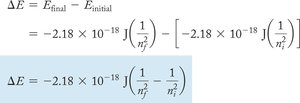
J
Where: is the initial energy level, is the final energy level.
Application: Used to calculate the energy absorbed or emitted when an electron changes energy levels.
Quantum Numbers
Quantum numbers describe the properties of atomic orbitals and the electrons in them:
Principal Quantum Number (n): Indicates energy level (n = 1, 2, 3, ...).
Angular Momentum Quantum Number (l): Indicates subshell (l = 0 to n-1).
Magnetic Quantum Number (m_l): Orientation of orbital (m_l = -l to +l).
Spin Quantum Number (m_s): Electron spin (+1/2 or -1/2).
Relationships: For a given n, l can be 0 to n-1; for a given l, m_l can be -l to +l.
Information Provided: n and l give energy and shape; m_l gives orientation; m_s gives spin direction.
Energy of a Photon
The energy of a photon is related to its frequency and wavelength:
Equations:
Where: is energy (J), is Planck's constant, is frequency (Hz), is speed of light ( m/s), is wavelength (m).
Applications: Calculate energy for one photon, multiple photons, or a mole of photons (multiply by Avogadro's number).
Photoelectric Effect and Einstein's Equation
Einstein explained the photoelectric effect using the concept of photons:
Equation:
Where: is the energy of the incoming photon, is the energy required to remove the electron.
Heisenberg Uncertainty Principle
The Heisenberg uncertainty principle states that it is impossible to simultaneously know both the exact position and momentum of a quantum particle:
Equation:
Significance: Sets a fundamental limit on measurement precision at the quantum scale.
