 Indietro
General Chemistry Exam 2 Study Guide: Atoms, Molecules, Compounds, and Chemical Reactions
Guida di studio - Note intelligenti
 Appunti personalizzati basati sui tuoi materiali, ampliati con definizioni chiave, esempi e contesto.
Atoms & Elements
Atomic Mass and Isotopes
The atomic mass of an element is the weighted average of the masses of its naturally occurring isotopes, based on their relative abundances. Isotopes are atoms of the same element with different numbers of neutrons.
Calculation: Multiply each isotope's mass by its fractional abundance, then sum the results.
Example: For element X with isotopes X-45 (44.8776 amu, 32.88%) and X-47 (46.9443 amu, 67.12%): amu
Mole Concept
The mole is a fundamental unit in chemistry representing 6.022 × 10²³ particles (Avogadro's number). It allows conversion between atoms/molecules and grams.
Formula:
Example: moles
Periodic Table
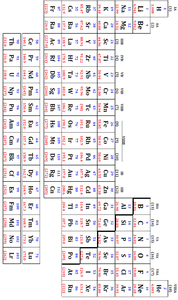
The periodic table organizes elements by increasing atomic number and groups elements with similar chemical properties.
Groups: Vertical columns; elements in the same group have similar valence electron configurations.
Periods: Horizontal rows; elements in the same period have the same number of electron shells.
Molecules and Compounds
Formulas and Naming
Chemical compounds are represented by formulas indicating the types and numbers of atoms present. Naming follows systematic rules based on the type of compound.
Ionic Compounds: Name the cation first, then the anion. For transition metals, indicate the charge with Roman numerals.
Covalent Compounds: Use prefixes to indicate the number of each atom (e.g., NO2 is nitrogen dioxide).
Acids: Naming depends on the anion present (e.g., H2SO4 is sulfuric acid).
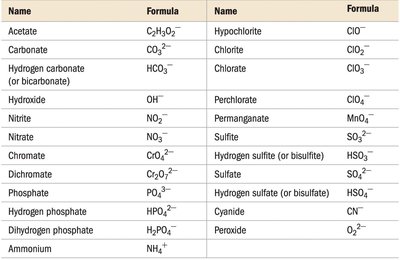
Common Polyatomic Ions
Polyatomic ions are charged species composed of multiple atoms. Knowing their names and formulas is essential for writing and naming compounds.
Chemical Reactions and Chemical Quantities
Stoichiometry
Stoichiometry involves calculating the quantities of reactants and products in a chemical reaction using balanced equations.
Balanced Equation: Ensures the same number of atoms of each element on both sides.
Example:
Limiting Reactant: The reactant that is completely consumed first, limiting the amount of product formed.
Excess Reactant: The reactant left over after the reaction is complete.
Calculating Masses in Reactions
To determine the mass of a product formed or reactant required, use molar masses and mole ratios from the balanced equation.
Example: For the reaction :
Calculate moles of reactant, use mole ratios to find moles of product, then convert to grams.
Limiting Reactant Calculation: Compare the amount of product each reactant can produce; the smaller amount indicates the limiting reactant.
Percent Composition and Empirical/Molecular Formulas
Percent composition is the mass percent of each element in a compound. The empirical formula is the simplest whole-number ratio of elements, while the molecular formula gives the actual number of atoms in a molecule.
Percent Composition Formula:
Empirical Formula: Convert mass percent to moles, divide by smallest number, round to nearest whole number.
Molecular Formula: , where
Lab Techniques and Procedures
Significant Figures and Units
Always pay attention to significant figures and units in calculations. The number of significant figures in the answer should reflect the precision of the measurements used.
Rules: Nonzero digits are always significant; zeros between nonzero digits are significant; trailing zeros in a decimal are significant.
Example: 50.0 g has three significant figures.
Additional info:
These notes cover key concepts from General Chemistry chapters on atoms, elements, molecules, compounds, chemical reactions, stoichiometry, and lab techniques, as reflected in the exam questions and provided tables/images.
