 Indietro
General Chemistry Exam I Study Guidance: Chapters 1 & 2
Guida di studio - Note intelligenti
 Appunti personalizzati basati sui tuoi materiali, ampliati con definizioni chiave, esempi e contesto.
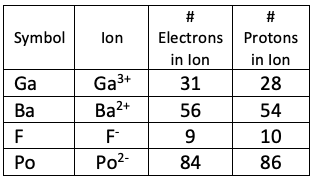
Q1. Complete the table for ions: Symbol, Ion, Number of Electrons, Number of Protons
Background
Topic: Ions and Subatomic Particles
This question tests your understanding of how ions are formed and how to determine the number of electrons and protons in ions based on their charge and atomic number.
Key Terms and Formulas:
Ion: An atom or molecule with a net electric charge due to the loss or gain of electrons.
Protons: Positively charged particles in the nucleus; the number of protons equals the atomic number.
Electrons: Negatively charged particles; the number of electrons changes when an atom forms an ion.
Charge of Ion:
For cations (positive ions): Electrons are lost, so
For anions (negative ions): Electrons are gained, so
Step-by-Step Guidance
Identify the atomic number for each element, which gives the number of protons in the neutral atom.
Determine the charge of the ion (e.g., means gallium has lost 3 electrons).
Calculate the number of electrons in the ion using the formulas above, depending on whether the ion is a cation or anion.
Fill in the missing values in the table for each element and ion.
Check your answers by confirming that the difference between protons and electrons matches the ion's charge.
Try solving on your own before revealing the answer!
Final Answer:
Ga: Ga3+, 28 electrons, 31 protons Ba: Ba2+, 54 electrons, 56 protons F: F-, 10 electrons, 9 protons Po: Po2-, 86 electrons, 84 protons
For cations, subtract the charge from the atomic number to get electrons. For anions, add the charge to the atomic number.
Q2. Which statement about atomic number and mass number is correct?
Background
Topic: Atomic Structure
This question tests your understanding of the definitions of atomic number and mass number, and their relationship to protons, neutrons, and electrons.
Key Terms:
Atomic Number (): Number of protons in the nucleus of an atom.
Mass Number (): Sum of protons and neutrons in the nucleus.
Neutrons:
Step-by-Step Guidance
Recall that the atomic number is always the number of protons in the atom.
Remember that the mass number is the sum of protons and neutrons.
Review each statement and check if it matches these definitions.
Eliminate any answer choices that confuse electrons with protons or neutrons.
Try solving on your own before revealing the answer!
Final Answer:
b. Atomic number is equivalent to the number of protons while the mass number is equivalent to the sum of the number of protons and number of neutrons.
This matches the standard definitions in chemistry.
Q3. Is the statement an observation, a law, or a theory?
Background
Topic: Scientific Method and Classification of Matter
This question tests your ability to distinguish between observations, laws, and theories in scientific reasoning.
Key Terms:
Observation: Directly recorded data or facts.
Law: A statement describing a consistent relationship or pattern in nature.
Theory: An explanation for why laws and observations occur.
Step-by-Step Guidance
Read each statement carefully and decide if it describes a fact, a pattern, or an explanation.
Identify which statements are direct observations (e.g., argon is inert).
Identify which statements describe a pattern or relationship (e.g., periodic reactivity).
Identify which statements attempt to explain why something happens (e.g., electron arrangement dictates reactivity).
Try solving on your own before revealing the answer!
Final Answer:
b. (a) Observation (b) Theory (c) Law (d) Observation
Observations are direct facts, laws are patterns, and theories explain why.
Q4. Using the law of multiple proportions, how much hydrogen reacts with 1.78 g of carbon to produce methane and ethylene?
Background
Topic: Law of Multiple Proportions
This question tests your understanding of how elements combine in fixed ratios to form different compounds.
Key Formula:
Law of Multiple Proportions: If two elements form more than one compound, the masses of one element that combine with a fixed mass of the other are in ratios of small whole numbers.
Set up ratios for hydrogen to carbon in CH4 and C2H2.
Step-by-Step Guidance
Write the formulas for methane (CH4) and ethylene (C2H2).
Calculate the mass ratio of hydrogen to carbon in each compound.
Set up a proportion using 1.78 g of carbon to find the mass of hydrogen needed for each compound.
Check that the ratio of hydrogen masses for the two compounds is a small whole number.
Try solving on your own before revealing the answer!
Final Answer:
a. for CH4: 0.299 g H for C2H2: 0.149 g H
The ratio of hydrogen masses matches the law of multiple proportions.
Q5. Which statements about changes in mass and appearance are true for materials exposed to acid rain?
Background
Topic: Physical and Chemical Changes
This question tests your ability to distinguish between physical and chemical changes based on observable properties.
Key Terms:
Physical Change: Change in appearance, state, or mass without altering chemical composition.
Chemical Change: Change that results in new substances, often indicated by color, texture, or mass changes.
Step-by-Step Guidance
Review what constitutes a physical change (e.g., mass, state, appearance).
Review what constitutes a chemical change (e.g., color, texture, formation of new substances).
Analyze each statement to see if it correctly identifies the type of change based on the evidence given.
Eliminate statements that incorrectly attribute changes to only one type.
Try solving on your own before revealing the answer!
Final Answer:
b. Changes in color and texture indicate that the material underwent a chemical change.
Color and texture changes are classic signs of chemical change.
Q6. How do chemical properties influence chemical reactions?
Background
Topic: Chemical Properties
This question tests your understanding of the role of chemical properties in determining the behavior of substances during reactions.
Key Terms:
Chemical Properties: Characteristics that determine how a substance reacts with others.
Chemical Reaction: Process where substances are transformed into new substances.
Step-by-Step Guidance
Recall that chemical properties are related to reactivity and the types of reactions a substance can undergo.
Consider how these properties affect the products formed in a reaction.
Eliminate answer choices that confuse chemical properties with physical properties or unrelated factors.
Try solving on your own before revealing the answer!
Final Answer:
c. They determine the types of reactions and products formed.
Chemical properties dictate how substances react and what products result.
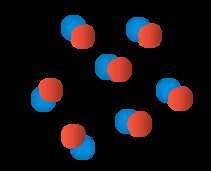
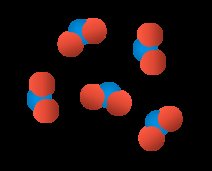
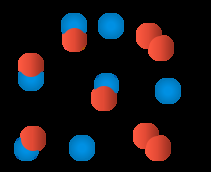
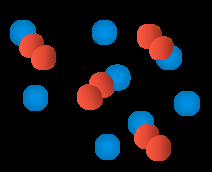
Q7. Choose the product mixture illustration for the reaction that obeys the law of mass conservation.
Background
Topic: Law of Conservation of Mass
This question tests your understanding of the principle that mass is conserved in chemical reactions.
Key Terms:
Law of Conservation of Mass: Mass is neither created nor destroyed in a chemical reaction.
Reactants and Products: The total number of atoms of each element must be the same before and after the reaction.
Step-by-Step Guidance
Count the number of each type of particle in the reactant illustration.
Compare the number and arrangement of particles in each product illustration.
Identify which product illustration has the same total number of each type of particle as the reactant.
Eliminate any illustrations where the number of particles changes.
Try solving on your own before revealing the answer!

Final Answer:
b.
This illustration shows the same number of each type of particle as the reactant, obeying the law of mass conservation.
Q8. Calculate the atomic weight of sulfur using its natural isotopes.
Background
Topic: Atomic Mass and Isotopes
This question tests your ability to calculate the average atomic mass of an element based on isotope abundances and masses.
Key Formula:
Step-by-Step Guidance
Convert the percent abundance of each isotope to a decimal (fractional abundance).
Multiply each fractional abundance by the mass of the corresponding isotope.
Add up all the products to get the average atomic mass.
Check your calculation for accuracy and correct units.
Try solving on your own before revealing the answer!
Final Answer:
c. 32.065 amu
The atomic weight is calculated by summing the products of each isotope's abundance and mass.
Q9. Identify which isotope symbols are incorrect.
Background
Topic: Isotopes and Nuclear Notation
This question tests your ability to recognize correct isotope notation, which includes the mass number and atomic number.
Key Terms:
Isotope Symbol: , where is mass number and is atomic number.
Check that the atomic number matches the element.
Step-by-Step Guidance
Look up the atomic number for each element listed.
Compare the atomic number in the isotope symbol to the correct value for the element.
Identify any mismatches between atomic number and element.
List the incorrect symbols.
Try solving on your own before revealing the answer!
Final Answer:
e. (i), (iii) and (iv)
These isotope symbols have incorrect atomic numbers for the given elements.
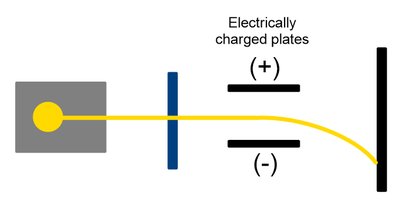
Q10. Is the particle projected between electrically charged plates an electron?
Background
Topic: Subatomic Particles and Electric Fields
This question tests your understanding of how charged particles behave in electric fields, specifically the deflection of electrons.
Key Terms:
Electron: Negatively charged particle.
Beta Ray: Stream of electrons.
Deflection: Negative particles are attracted to positive plates and repelled by negative plates.
Step-by-Step Guidance
Observe the direction of deflection of the particle in the diagram.
Compare the path to that of a beta ray (electron).
Determine if the particle's behavior matches that of an electron in an electric field.
Try solving on your own before revealing the answer!
Final Answer:
a. Yes, the particle is an electron.
The deflection matches the expected path for an electron.
Q11. Rank the following transitions from largest to smallest frequency: n = 8 to n = 5, n = 1 to n = 4, n = 3 to n = 6, n = 6 to n = 7
Background
Topic: Bohr Model and Energy Transitions
This question tests your understanding of how energy transitions between quantum levels relate to frequency.
Key Formula:
Step-by-Step Guidance
Recall that larger energy differences correspond to higher frequencies.
Calculate for each transition using the formula above.
Compare the energy differences to rank the transitions.
Arrange the transitions from largest to smallest frequency.
Try solving on your own before revealing the answer!
Final Answer:
b. I > II > III > IV
The transition with the largest energy difference (n = 8 to n = 5) has the highest frequency.
Q12. Identify the orbitals and provide the n and l quantum numbers for each illustration.
Background
Topic: Quantum Numbers and Orbitals
This question tests your ability to interpret orbital diagrams and assign quantum numbers.
Key Terms:
Principal Quantum Number (n): Indicates the energy level.
Angular Momentum Quantum Number (l): Indicates the shape of the orbital (s: l=0, p: l=1, d: l=2, f: l=3).
Step-by-Step Guidance
Examine the orbital shapes in the illustration.
Identify the type of orbital (s, p, d, f) based on the shape.
Assign the correct n and l values for each orbital.
Match the quantum numbers to the correct answer choice.
Try solving on your own before revealing the answer!

Final Answer:
c. (i) 4dyz: n = 4; l = 2 (ii) 5s: n = 5; l = 0
The d orbital has l = 2, and the s orbital has l = 0.
