 Indietro
General Chemistry Exam Review: Kinetics, Reaction Mechanisms, and Arrhenius Equation
Guida di studio - Note intelligenti
 Appunti personalizzati basati sui tuoi materiali, ampliati con definizioni chiave, esempi e contesto.
Q65. The diagram shows the energy of a reaction as the reaction progresses. Label each blank box in the diagram.
Background
Topic: Reaction Energy Profile
This question tests your understanding of the energy changes during a chemical reaction, including reactants, products, activation energy, and enthalpy change.
Key Terms:
Reactants: Starting materials in a chemical reaction.
Products: Substances formed as a result of the reaction.
Activation Energy (): Minimum energy required to initiate the reaction.
Enthalpy of Reaction (): Overall energy change between reactants and products.
Step-by-Step Guidance
Examine the energy profile diagram and identify the starting point (reactants) and ending point (products).
Locate the highest point on the curve, which represents the transition state; the difference between this point and the reactants is the activation energy ().
Determine the enthalpy change () by comparing the energy levels of reactants and products.
Assign the labels to the boxes based on their positions relative to the curve.
Try solving on your own before revealing the answer!
Final Answer:
A: Reactants
B: Products
C: Activation Energy ()
D: Enthalpy of Reaction ()
Each label corresponds to a key feature of the reaction energy profile.
Q69. The rate constant (k) for a reaction was measured as a function of temperature. A plot of ln k versus 1/T (in K) is linear and has a slope of -7012 K. Calculate the activation energy for the reaction.
Background
Topic: Arrhenius Equation and Activation Energy
This question tests your ability to use the Arrhenius equation in its linearized form to determine the activation energy from experimental data.
Key Terms and Formulas:
Arrhenius Equation:
Linearized Form:
Slope of vs plot:
R (gas constant):

Step-by-Step Guidance
Recall that the slope of the vs plot is .
Set up the equation: , where slope = -7012 K.
Rearrange to solve for : .
Plug in the value for R and the slope, but do not calculate the final value yet.
Try solving on your own before revealing the answer!
Final Answer:
The activation energy is positive, as expected for a chemical reaction.
Q75. A reaction has a rate constant of 0.0117/s at 400.0 K and 0.689/s at 450.0 K. Determine the activation barrier for the reaction. What is the value of the rate constant at 425 K?
Background
Topic: Arrhenius Equation (Two-Point Form)
This question tests your ability to use the Arrhenius equation to calculate activation energy and predict rate constants at different temperatures.
Key Terms and Formulas:
Arrhenius Two-Point Form:
at
at
R (gas constant):

Step-by-Step Guidance
Write the two-point Arrhenius equation: .
Plug in the values for , , , and .
Calculate and .
Rearrange to solve for but stop before plugging in the final numbers.
To find the rate constant at 425 K, use the Arrhenius equation with the calculated and solve for at .
Try solving on your own before revealing the answer!
Final Answer:
Activation barrier:
Rate constant at 425 K:
Both values are calculated using the two-point Arrhenius equation and plugging in the appropriate values.
Q83. Consider this three-step mechanism for this reaction: What is the overall reaction? Identify the intermediates in the mechanism. What is the predicted rate law?
Background
Topic: Reaction Mechanisms and Rate Laws
This question tests your ability to analyze a multi-step reaction mechanism, identify intermediates, and determine the overall rate law based on the slow (rate-determining) step.
Key Terms:
Overall Reaction: The net chemical equation after summing all steps and canceling intermediates.
Intermediates: Species produced in one step and consumed in another, not present in the overall reaction.
Rate Law: Mathematical expression relating reaction rate to concentrations of reactants.
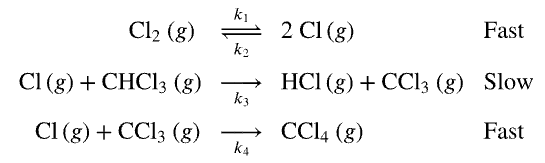
Step-by-Step Guidance
Write out each step of the mechanism and identify which species appear in the intermediate steps but not in the overall reaction.
Sum the steps to determine the overall reaction by canceling intermediates.
Identify the slow step (rate-determining step) and use it to write the predicted rate law.
Express the rate law in terms of reactants involved in the slow step, but do not write the final rate law yet.
Try solving on your own before revealing the answer!
Final Answer:
Overall reaction:
Intermediates: ,
Predicted rate law:
The rate law is based on the slow step, which involves Cl and CHCl3.
