 Indietro
General Chemistry Foundational Concepts: Measurement, Density, and Classification
Guida di studio - Note intelligenti
 Appunti personalizzati basati sui tuoi materiali, ampliati con definizioni chiave, esempi e contesto.
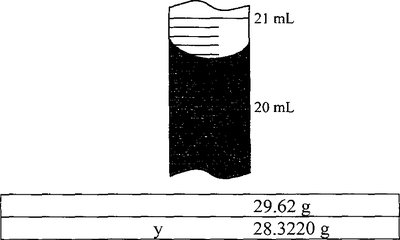
Q1. What is the correct reading of the graduated cylinder to the proper number of significant figures?
Background
Topic: Measurement and Significant Figures
This question tests your ability to read a graduated cylinder accurately and report the measurement using the correct number of significant figures, which is essential for precise scientific communication.
Key Terms:
Meniscus: The curve seen at the liquid's surface in a graduated cylinder. Always read from the bottom of the meniscus.
Significant Figures: Digits in a measurement that are known with certainty plus one digit that is estimated.
Step-by-Step Guidance
Observe the graduated cylinder and identify the scale increments (each line represents 0.1 mL).
Locate the bottom of the meniscus and determine which two lines it falls between.
Estimate the value to the nearest 0.1 mL, including one digit beyond the smallest increment for proper significant figures.
Write the measurement, ensuring you include all certain digits and one uncertain digit.
Try solving on your own before revealing the answer!
Final Answer: 20.8 mL
The meniscus is between 20.7 and 20.8 mL, so the correct reading is 20.8 mL, reported to three significant figures.
This reflects the precision of the graduated cylinder and proper measurement technique.
Q2. Calculate the density of a substance given its mass and volume.
Background
Topic: Density Calculation
This question tests your ability to use the definition of density to solve for the density of a substance using mass and volume measurements.
Key formula:
Where:
Mass: The mass of the substance (in grams).
Volume: The volume occupied by the substance (in milliliters or cubic centimeters).
Step-by-Step Guidance
Identify the mass of the substance from the data table (e.g., 29.62 g).
Determine the volume of the substance by subtracting the initial volume of water from the final volume after adding the substance (e.g., final volume - initial volume).
Convert the volume to cubic centimeters if necessary (1 mL = 1 cm3).
Set up the density formula with the mass and calculated volume.
Try solving on your own before revealing the answer!
Final Answer: 2.96 g/cm3
Using the mass (29.62 g) and the volume (21 mL - 20 mL = 1 mL = 1 cm3), the density is . If the mass is 28.3220 g, then . Double-check which mass and volume are paired for the correct answer.
Density is a fundamental property used to identify substances and compare their physical characteristics.
Q3. Classify the representations of matter as element, compound, or mixture.
Background
Topic: Classification of Matter
This question tests your understanding of how to distinguish between elements, compounds, and mixtures based on particulate diagrams.
Key Terms:
Element: A pure substance consisting of only one type of atom.
Compound: A pure substance consisting of two or more types of atoms chemically bonded.
Mixture: A combination of two or more substances not chemically bonded.
Step-by-Step Guidance
Examine each diagram and identify the types of particles present (single atoms, bonded pairs, or groups).
Determine if the diagram shows only one type of atom (element), bonded atoms of different types (compound), or a mix of different particles (mixture).
Assign the correct classification to each diagram based on your observations.
Try solving on your own before revealing the answer!
Final Answer: Element, Compound, Mixture
The first diagram shows only one type of atom (element), the second shows bonded atoms of different types (compound), and the third shows a mix of different particles (mixture).
Understanding these classifications is essential for recognizing the nature of substances in chemistry.
