 Indietro
General Chemistry: Foundations of Matter, Measurement, and Atomic Theory
Guida di studio - Note intelligenti
 Appunti personalizzati basati sui tuoi materiali, ampliati con definizioni chiave, esempi e contesto.
Chapter 1: Matter, Measurement, and Problem Solving
1.3 The Classification of Matter
Matter is anything that has mass and occupies space. It can be classified based on its composition and uniformity. Understanding these classifications is fundamental to studying chemistry.
Pure Substance: Has a fixed composition and distinct properties. Can be an element (cannot be broken down further) or a compound (can be chemically separated into elements).
Mixture: Composed of two or more substances physically combined. Can be homogeneous (uniform throughout, e.g., tea with sugar) or heterogeneous (not uniform, e.g., wet sand).
Element: A substance that cannot be chemically broken down into simpler substances.
Compound: A substance composed of two or more elements in fixed, definite proportions.
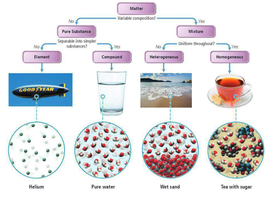
Example: Helium is an element, pure water is a compound, wet sand is a heterogeneous mixture, and tea with sugar is a homogeneous mixture.
1.4 Physical and Chemical Changes and Properties
Properties and changes of matter are classified as physical or chemical, depending on whether the composition of the substance is altered.
Physical Property: Observed without changing the substance's composition (e.g., odor, taste, color, melting point, boiling point, density).
Chemical Property: Observed only by changing the substance's composition (e.g., flammability, corrosiveness, acidity, toxicity).
Physical Change: Alters only the state or appearance, not composition (e.g., water freezing to ice).
Chemical Change: Alters the composition, producing new substances (e.g., burning gasoline).
Example: Freezing water is a physical change; burning natural gas is a chemical change.
1.7 The Reliability of a Measurement
Measurements in chemistry must be reliable and reported with the correct number of significant figures to reflect their precision.
Significant Figures: Digits in a measurement that are known with certainty plus one estimated digit.
Rules for Significant Figures:
All nonzero digits are significant.
Interior zeroes (between nonzero digits) are significant.
Trailing zeroes after a decimal point are significant.
Leading zeroes are not significant.
Exact numbers have unlimited significant figures.
Example: 450. L has 3 significant figures; 0.00023 m has 2 significant figures.
Significant Figures in Calculations
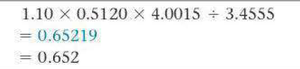
Multiplication/Division: Result has the same number of significant figures as the factor with the fewest significant figures.
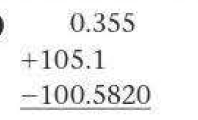
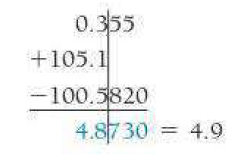
Addition/Subtraction: Result has the same number of decimal places as the quantity with the fewest decimal places.

Exact Numbers
Originate from counting, defined quantities, or integral numbers in equations.
Have no uncertainty and an unlimited number of significant figures.
1.8 Solving Chemical Problems
Problem-solving in chemistry often involves unit conversions and dimensional analysis. The key is to set up conversion factors so that units cancel appropriately, leading to the desired unit.
General Strategy: Sort (identify given and find), strategize (plan steps), solve (carry out calculations), and check (verify units and magnitude).
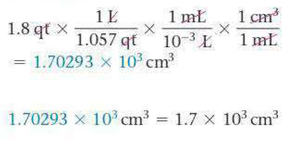
Example: To convert 1.8 quarts to cubic centimeters, use the relationships between quarts, liters, milliliters, and cubic centimeters.
1.9 Analyzing and Interpreting Data
Interpreting data, especially graphical data, is essential for understanding trends and making predictions in chemistry.
Identify values at specific points (e.g., concentration of CO2 in 1960 and 2010).
Calculate changes and average rates of change.
Extrapolate future values based on trends.
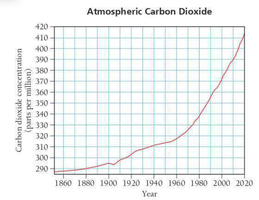
Example: Use the graph to determine the increase in atmospheric CO2 over time and predict future concentrations.
Common SI Prefixes and Unit Conversions
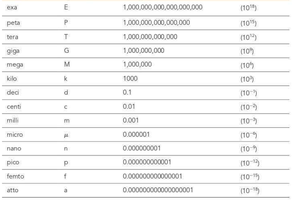
Understanding SI prefixes and unit conversions is crucial for accurate measurement and calculation in chemistry.
Prefix | Symbol | Value |
|---|---|---|
kilo | k | 1,000 |
centi | c | 0.01 |
milli | m | 0.001 |
micro | μ | 0.000001 |
nano | n | 0.000000001 |
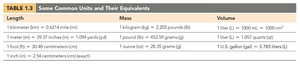
Length | Mass | Volume |
|---|---|---|
1 kilometer (km) = 0.6214 mile (mi) | 1 kilogram (kg) = 2.205 pounds (lb) | 1 liter (L) = 1000 mL = 1000 cm3 |
1 meter (m) = 39.37 inches (in) | 1 pound (lb) = 453.6 grams (g) | 1 U.S. gallon (gal) = 3.785 L |
Chapter 2: Atoms and Elements
2.3 Modern Atomic Theory and the Laws That Led to It
The atomic theory is based on several fundamental laws:
Law of Conservation of Mass: Matter is neither created nor destroyed in a chemical reaction.
Law of Definite Proportions: A compound always contains the same elements in the same proportion by mass.
Law of Multiple Proportions: When two elements form more than one compound, the masses of one element that combine with a fixed mass of the other are in ratios of small whole numbers.
Example: CO and CO2 are both compounds of carbon and oxygen, but the mass ratio of oxygen to carbon differs by a small whole number ratio.
2.6 Subatomic Particles: Protons, Neutrons, and Electrons in Atoms
Atoms are composed of three main subatomic particles:
Proton (p+): Charge +1, located in the nucleus.
Neutron (n0): No charge, located in the nucleus.
Electron (e-): Charge -1, located outside the nucleus.
The number of protons (atomic number, Z) defines the element. The sum of protons and neutrons gives the mass number (A).
Isotopes: Atoms of the same element with different numbers of neutrons.
Ions: Atoms that have gained or lost electrons. Cations are positively charged; anions are negatively charged.
2.7 Finding Patterns: The Periodic Law and the Periodic Table
The periodic table organizes elements by increasing atomic number and recurring chemical properties. Groups (columns) contain elements with similar properties.
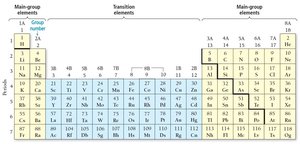
Example Groups:
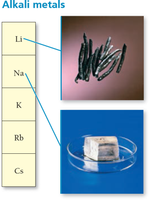
Alkali Metals (Group 1): Highly reactive metals (e.g., Li, Na, K).
Alkaline Earth Metals (Group 2): Reactive metals (e.g., Be, Mg, Ca).
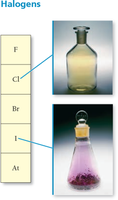
Halogens (Group 17): Reactive nonmetals (e.g., F, Cl, Br, I).
2.8 Atomic Mass: The Average Mass of an Element's Atoms
The atomic mass of an element is the weighted average of the masses of its naturally occurring isotopes.
Calculation: Multiply the mass of each isotope by its fractional abundance and sum the results.
Example: Chlorine has two main isotopes: and . The atomic mass is calculated as:
amu$
2.9 Molar Mass: Counting Atoms by Weighing Them
The molar mass is the mass of one mole of a substance (in grams per mole). It allows conversion between mass and number of moles, and between moles and number of atoms or molecules using Avogadro's number ().
Converting Moles to Atoms: using Avogadro's number.
Converting Mass to Moles: using molar mass.
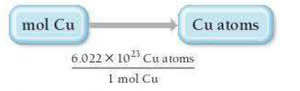


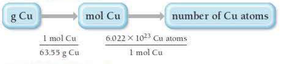

Example: To find the number of copper atoms in 3.10 g of copper:
Additional info:
Some tables and images have been summarized for clarity and brevity. For full details, refer to the corresponding images.
