 Indietro
General Chemistry I: Chemical Reactions, Stoichiometry, and Solutions (Chapters 4 & 5)
Guida di studio - Note intelligenti
 Appunti personalizzati basati sui tuoi materiali, ampliati con definizioni chiave, esempi e contesto.
Chemical Reactions and Equations
Introduction to Chemical Reactions
Chemical reactions involve the transformation of one or more substances (reactants) into different substances (products). Chemical equations represent these changes, showing the formulas, physical states, and relative amounts of each substance involved. The law of conservation of mass requires that the number of atoms of each element is the same on both sides of the equation.
Reactants: Starting substances in a reaction.
Products: Substances formed as a result of the reaction.
Physical States: Indicated as (s) solid, (l) liquid, (g) gas, (aq) aqueous.
Balancing Equations: Use coefficients to balance atoms; never change subscripts.
Mole Relationships: Coefficients indicate the ratio of moles of each substance.
Example: means 2 mol H2 react with 1 mol O2 to produce 2 mol H2O.
Reaction Stoichiometry
Stoichiometric Calculations
Stoichiometry uses the coefficients from balanced equations to relate the amounts of reactants and products. Calculations may involve converting between grams and moles using molar mass, and applying mole ratios from the equation.
Mole-to-Mole: Use the coefficient ratio directly.
Mass-to-Mass: Convert grams to moles, use the mole ratio, then convert back to grams.
Example: How many moles of H2O from 3.00 mol H2?
Limiting Reactant and Yield
Determining Limiting Reactant and Calculating Yield
The limiting reactant is the reactant that is completely consumed first, thus determining the maximum amount of product formed. The excess reactant remains after the reaction. Theoretical yield is the maximum possible amount of product, while actual yield is what is actually obtained. Percent yield measures the efficiency of the reaction.
Percent Yield:
Steps: Balance the equation, convert reactants to moles, determine product from each, identify the limiting reactant, and calculate theoretical yield.
Combustion, Alkali Metal, and Halogen Reactions
Combustion Reactions
Combustion involves a substance reacting with O2 to form oxygen-containing products and release heat. Complete combustion of hydrocarbons produces CO2 and H2O.
Example:
Alkali Metal Reactions
Alkali metals react vigorously with nonmetals and water, forming dissolved ions, hydroxide ions, and hydrogen gas. Reactivity increases down the group.
Halogen Reactions
Halogens react with metals to form metal halides, with hydrogen to form hydrogen halides, and with each other to form interhalogen compounds.
Solutions and Molarity
Properties of Solutions
A solution is a homogeneous mixture of solute (lesser amount) and solvent (greater amount). An aqueous solution uses water as the solvent. Molarity (M) expresses concentration as moles of solute per liter of solution.
Molarity:
Conversions: ,
Example: Dissolving NaCl in water:
Solute–Solvent Interactions
Solute dissolves if solute–solvent attractions are strong enough. For ionic compounds, water molecules surround and separate the ions.
Dilution
Dilution reduces concentration but keeps the amount of solute constant. Use the equation (ensure volume units are consistent).
Example: To prepare 250.0 mL of 0.500 M HCl from 6.00 M HCl:
Solubility of Ionic Compounds
Solubility rules (empirical) determine if an ionic compound dissolves in water. Soluble compounds dissociate into ions; insoluble compounds do not.
Example: (soluble); AgCl is generally insoluble.
Molecular, Complete Ionic, and Net Ionic Equations
Types of Chemical Equations
Chemical reactions in solution can be represented in three ways:
Molecular Equation: Shows complete formulas (e.g., ).
Complete Ionic Equation: Shows all strong electrolytes as ions.
Net Ionic Equation: Shows only the species that actually change during the reaction.
Example: (net ionic equation; AgCl is the precipitate).
Precipitation Reactions and Spectator Ions
Precipitation Reactions
Precipitation occurs when mixing two aqueous solutions forms an insoluble solid (precipitate). If no precipitate forms, no reaction occurs. Spectator ions do not participate in the reaction.
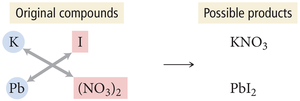
Example: Mixing KI and Pb(NO3)2 can yield KNO3 and PbI2. PbI2 is insoluble and precipitates.
Electrolytes
Types of Electrolytes
Electrolytes are substances that produce ions in solution. Strong electrolytes dissociate completely, weak electrolytes partially, and nonelectrolytes do not produce significant ions.
Strong: NaCl, HCl
Weak: CH3COOH, NH3
Nonelectrolyte: C6H12O6
Example:
Acid–Base Reactions
Neutralization and Polyprotic Acids
Acid–base reactions involve acids (produce H+ in water) and bases (produce OH−). Neutralization forms water and a salt. Polyprotic acids can donate more than one proton, with each ionization step occurring sequentially.
Example:
Net Ionic:
Polyprotic Example: , then
Titration
Titration determines the concentration of an unknown solution using a solution of known concentration (titrant). The equivalence point is when stoichiometric amounts have reacted, often indicated by a color change.
Gas-Evolution Reactions
Formation of Gases in Reactions
Gas-evolution reactions produce a gas, often observed as bubbling. These can overlap with acid–base reactions. For example, acids reacting with carbonates produce CO2 gas.
Example:
Redox Reactions and Oxidation States
Oxidation-Reduction (Redox) Reactions
Redox reactions involve changes in oxidation states. Oxidation is the loss of electrons (increase in oxidation state), and reduction is the gain of electrons (decrease in oxidation state). The reducing agent is oxidized, and the oxidizing agent is reduced.
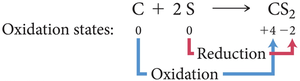
Example: Na: 0 → +1 (oxidized, reducing agent); Cl: 0 → −1 (reduced, oxidizing agent).
Activity Series of Metals
The activity series ranks metals by their tendency to lose electrons (be oxidized). Metals at the top are most reactive and easily oxidized; those at the bottom are least reactive.
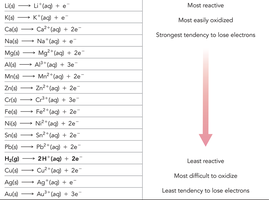
Each reaction in the series is an oxidation half-reaction. The higher the metal, the more likely it is to be oxidized.
Assigning Oxidation States
Rules for assigning oxidation states help identify redox changes:
Free elements: 0
Monatomic ions: equal to their charge
Sum in a compound: 0
Sum in a polyatomic ion: equals the ion charge
Group 1 metals: +1; Group 2: +2; F: −1; O: usually −2 (−1 in peroxides); H: +1 with nonmetals
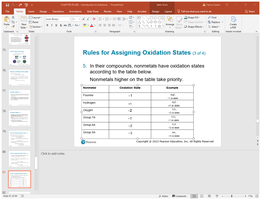
Examples: CoCl2: Cl = −1, so Co = +2 H2SO4: 2(+1) + S + 4(−2) = 0, so S = +6 NO3−: N + 3(−2) = −1, so N = +5 H2O2: O = −1
