 Indietro
General Chemistry: Matter, Measurement, Atoms, and Elements
Guida di studio - Note intelligenti
 Appunti personalizzati basati sui tuoi materiali, ampliati con definizioni chiave, esempi e contesto.
Scientific Method and Classification of Matter
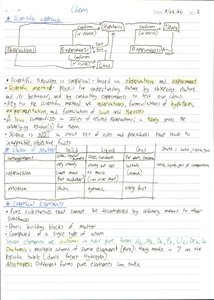
Scientific Method
The scientific method is a systematic approach to understanding the natural world through observation, experimentation, and reasoning. It is foundational to all scientific inquiry and ensures that conclusions are based on evidence.
Observation: Gathering information about phenomena.
Hypothesis: A tentative explanation for observations.
Experiment: Testing the hypothesis under controlled conditions.
Theory: A well-substantiated explanation based on repeated experiments.
Law: A statement describing consistent natural phenomena.
Classification of Matter
Matter is anything that has mass and occupies space. It can be classified based on its physical state and composition.
States of Matter: Solid, liquid, gas
Composition: Pure substances (elements and compounds) and mixtures (homogeneous and heterogeneous)
Pure substances have a fixed composition, while mixtures contain two or more substances physically combined.
Properties of Matter
Matter exhibits various properties that can be used to distinguish between substances.
Physical Properties: Can be observed without changing the substance's identity (e.g., melting point, density).
Chemical Properties: Describe how a substance interacts with other substances (e.g., flammability, reactivity).
Physical and Chemical Changes
Changes in matter can be classified as physical or chemical.
Physical Change: Does not alter the chemical composition (e.g., melting, boiling).
Chemical Change: Alters the chemical composition, forming new substances (e.g., combustion, rusting).
Separation of Mixtures
Mixtures can be separated by physical means based on differences in physical properties.
Filtration: Separates solids from liquids.
Distillation: Separates substances based on boiling points.
Chromatography: Separates based on movement through a medium.
Measurement and Significant Figures
SI Units and Prefixes
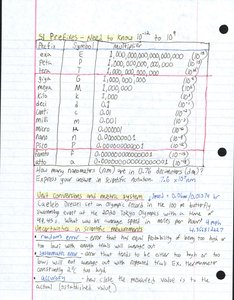
The International System of Units (SI) is used for scientific measurements. Prefixes indicate powers of ten.
Prefix | Symbol | Factor |
|---|---|---|
kilo | k | 1,000 |
centi | c | 0.01 |
milli | m | 0.001 |
micro | μ | 0.000001 |
nano | n | 0.000000001 |
Significant Figures
Significant figures reflect the precision of a measurement. The rules for determining significant figures are:
All nonzero digits are significant.
Zeros between nonzero digits are significant.
Leading zeros are not significant.
Trailing zeros are significant only if there is a decimal point.
When performing calculations, the result should be reported with the correct number of significant figures.
Addition/Subtraction: Result has the same number of decimal places as the measurement with the fewest decimal places.
Multiplication/Division: Result has the same number of significant figures as the measurement with the fewest significant figures.
Scientific Notation
Scientific notation expresses numbers as a product of a coefficient and a power of ten, making it easier to handle very large or small numbers.
General form:
Example:
Accuracy and Precision
Accuracy refers to how close a measurement is to the true value, while precision refers to how close repeated measurements are to each other.
High accuracy: Measurements are close to the true value.
High precision: Measurements are consistent with each other.
Atoms and Elements
Historical Development of Atomic Theory
The concept of the atom has evolved over centuries, with contributions from philosophers and scientists.
Plato and Aristotle: Proposed matter was continuous.
Leucippus and Democritus: Proposed matter is composed of indivisible particles called atoms.
John Dalton: Developed the modern atomic theory, stating that elements are composed of atoms.
Law of Conservation of Mass
The Law of Conservation of Mass states that mass is neither created nor destroyed in a chemical reaction.
Example:
Law of Definite Proportions
This law states that a given compound always contains the same proportion of elements by mass.
Example: Water (H2O) always contains 2 hydrogen atoms for every 1 oxygen atom.
Law of Multiple Proportions
When two elements form more than one compound, the masses of one element that combine with a fixed mass of the other are in ratios of small whole numbers.
Discovery of Subatomic Particles
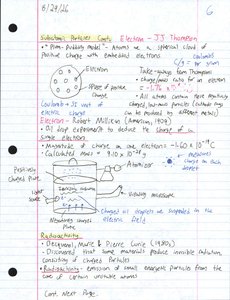
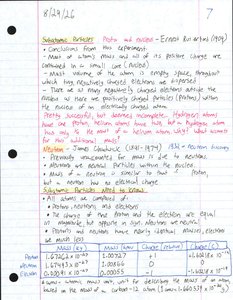
Atoms are composed of smaller particles: electrons, protons, and neutrons.
Electron: Discovered by J.J. Thomson using the cathode ray tube experiment.
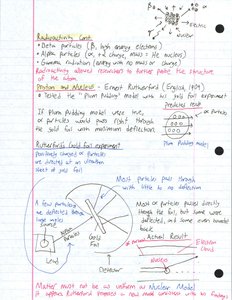
Proton: Discovered by Ernest Rutherford through the gold foil experiment.
Neutron: Discovered by James Chadwick.
Structure of the Atom
Atoms consist of a dense nucleus containing protons and neutrons, surrounded by electrons in a cloud.
Proton: Positively charged, mass ≈ 1 amu
Neutron: Neutral, mass ≈ 1 amu
Electron: Negatively charged, mass ≈ 0.0005 amu
Particle | Mass (amu) | Charge |
|---|---|---|
Proton | 1.0073 | +1 |
Neutron | 1.0087 | 0 |
Electron | 0.00055 | -1 |
Isotopes
Isotopes are atoms of the same element with different numbers of neutrons, resulting in different mass numbers.
Isotopic notation: , where A = mass number, Z = atomic number, X = element symbol.
Example: ,
Element | Atomic # | # Protons | # Neutrons | # Electrons |
|---|---|---|---|---|
Ca | 20 | 20 | 20 | 20 |
H | 1 | 1 | 0 | 1 |
Ar | 18 | 18 | 22 | 18 |
Fe | 26 | 26 | 30 | 26 |
Molecules and Compounds
Molecules and Molecular Compounds
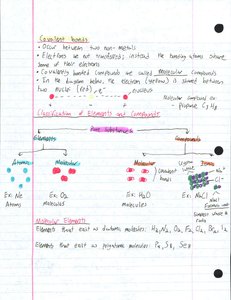
Molecules are groups of two or more atoms bonded together. Molecular compounds are composed of nonmetals and involve the sharing of electrons (covalent bonds).
Examples: H2O, CO2, O2
Common diatomic molecules: H2, N2, O2, F2, Cl2, Br2, I2
Ionic Compounds
Ionic compounds are formed from metals and nonmetals, involving the transfer of electrons to form ions.
Example: NaCl (sodium chloride)
Naming Compounds
The naming of compounds follows specific rules based on the type of compound.
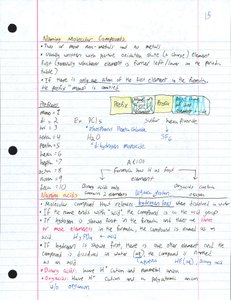
Molecular compounds: Use prefixes to indicate the number of atoms (e.g., CO2: carbon dioxide).
Ionic compounds: Name the cation first, then the anion (e.g., NaCl: sodium chloride).
Acids: Named based on the anion (e.g., HCl: hydrochloric acid).
Calculating Moles and Molecular Mass
The mole is a counting unit in chemistry, representing entities (Avogadro's number). The molar mass is the mass of one mole of a substance.
To convert between mass and moles:
To convert between moles and number of particles:
Additional info:
Some diagrams and tables have been logically reconstructed for clarity.
All images included are directly relevant to the adjacent explanations and reinforce the concepts discussed.
