 Indietro
General Chemistry: Molecular Structure, Ionic Compounds, and Chemical Nomenclature
Guida di studio - Note intelligenti
 Appunti personalizzati basati sui tuoi materiali, ampliati con definizioni chiave, esempi e contesto.
Molecular Structure and Types of Substances
Diatomic Elements and Molecular Compounds
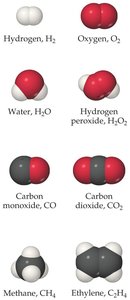
At room temperature, certain elements naturally exist as diatomic molecules, meaning each molecule contains two atoms of the same element. Many compounds formed from nonmetals also exist as discrete molecules, often held together by covalent bonds. Organic compounds, which contain carbon and hydrogen, are a major class of molecular substances.
Diatomic Elements: H2, N2, O2, F2, Cl2, Br2, I2
Molecular Compounds: Compounds formed from nonmetals, often with small, discrete molecules (e.g., H2O, CO2).
Organic Compounds: Molecules containing C-H bonds, such as methane (CH4).
Chemical Bonds: Atoms in molecules are held together by covalent bonds, where electrons are shared.
Examples: Water (H2O), carbon dioxide (CO2), methane (CH4).
Ions, Ionic Compounds, and the Periodic Table
Formation of Ions
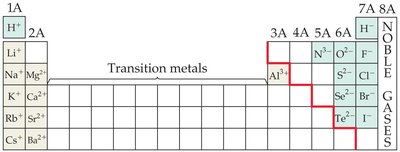
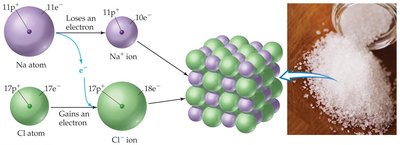
Metals and nonmetals tend to form ions by losing or gaining electrons to achieve the electron configuration of the nearest noble gas. Metals form positively charged cations, while nonmetals form negatively charged anions. These ions combine to form ionic compounds, which are typically crystalline solids.
Cations: Formed by loss of electrons (e.g., Na+, Ca2+).
Anions: Formed by gain of electrons (e.g., Cl-, O2-).
Ionic Compounds: Composed of cations and anions in a ratio that results in electrical neutrality (e.g., NaCl).
Salts: Ionic compounds that dissolve in polar solvents like water to form ions.
Writing Formulas for Ionic Compounds
The formula of an ionic compound reflects the ratio of ions needed to achieve electrical neutrality. The charge on each ion determines the subscripts in the formula.
Rule: The charge on the cation becomes the subscript for the anion, and vice versa. Reduce subscripts to the lowest whole-number ratio.
Example: Magnesium nitride: Mg2+ and N3- combine to form Mg3N2.

Common Ions
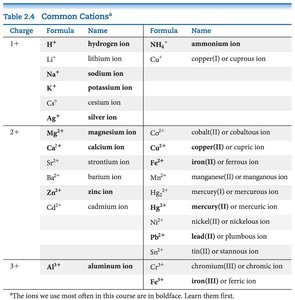
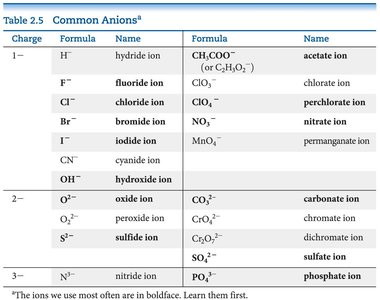
Many ions are encountered frequently in general chemistry, including both monatomic and polyatomic ions. Polyatomic ions are groups of atoms with an overall charge.
Charge | Formula | Name |
|---|---|---|
1+ | H+ | hydrogen ion |
2+ | Mg2+ | magnesium ion |
3+ | Al3+ | aluminum ion |
1- | Cl- | chloride ion |
2- | SO42- | sulfate ion |
3- | PO43- | phosphate ion |
Chemical Nomenclature
Naming Inorganic Compounds
The systematic naming of inorganic compounds follows specific rules depending on the type of compound (ionic, molecular, acids, etc.).
Ionic Compounds: Name the cation first, then the anion. If the cation can have more than one charge, indicate the charge with a Roman numeral in parentheses.
Binary Molecular Compounds: Name the element farther left or lower in the periodic table first. Use prefixes to indicate the number of atoms (except mono- for the first element). The second element ends in -ide.
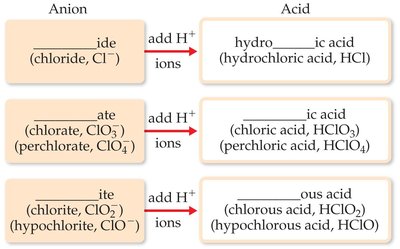
Acids: The name depends on the anion:
If the anion ends in -ide, the acid name is hydro-...-ic acid (e.g., HCl: hydrochloric acid).
If the anion ends in -ite, the acid name is ...-ous acid (e.g., HClO: hypochlorous acid).
If the anion ends in -ate, the acid name is ...-ic acid (e.g., HClO3: chloric acid).
Oxyanion Nomenclature Patterns
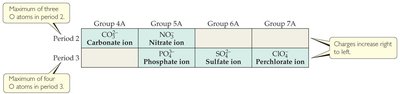
Oxyanions are polyatomic ions containing oxygen. Their names depend on the number of oxygen atoms present.
Fewer oxygens: -ite (e.g., NO2-: nitrite)
More oxygens: -ate (e.g., NO3-: nitrate)
Fewest oxygens: hypo-...-ite (e.g., ClO-: hypochlorite)
Most oxygens: per-...-ate (e.g., ClO4-: perchlorate)
Prefixes for Binary Molecular Compounds
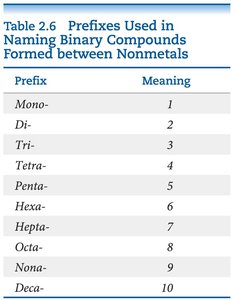
Prefixes are used to indicate the number of each type of atom in binary molecular compounds formed between nonmetals.
Prefix | Meaning |
|---|---|
Mono- | 1 |
Di- | 2 |
Tri- | 3 |
Tetra- | 4 |
Penta- | 5 |
Hexa- | 6 |
Hepta- | 7 |
Octa- | 8 |
Nona- | 9 |
Deca- | 10 |
Nomenclature of Organic Compounds
Alkanes and Functional Groups
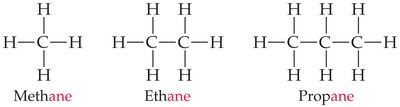
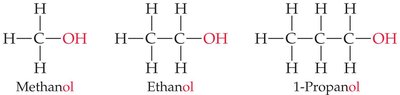
Organic compounds are named according to the number of carbon atoms and the functional groups present. Alkanes are hydrocarbons with only single bonds. When a hydrogen is replaced by a functional group, the compound's name changes accordingly (e.g., alcohols end in -ol).
Alkane Names: Meth- (1 C), Eth- (2 C), Prop- (3 C), etc.
Alcohols: Replace -e with -ol (e.g., methanol, ethanol).
Isomers
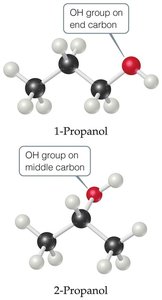
Isomers are compounds with the same molecular formula but different structural arrangements. The position of functional groups is indicated by numbers in the name (e.g., 1-propanol vs. 2-propanol).
Example: 1-propanol (OH on end carbon), 2-propanol (OH on middle carbon).
Stoichiometry and Chemical Equations
Law of Conservation of Mass
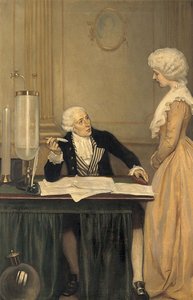
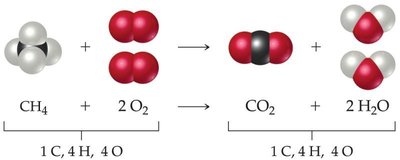
Stoichiometry is the study of mass relationships in chemical reactions. The Law of Conservation of Mass states that matter is neither created nor destroyed in a chemical reaction; the total mass of reactants equals the total mass of products.
Key Principle: The number and type of atoms are conserved in a chemical reaction.
Chemical Equations
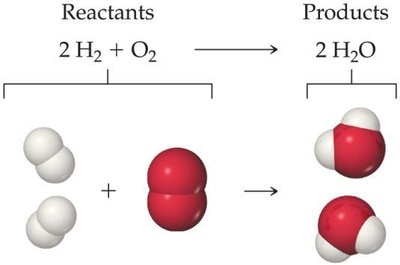
Chemical equations are concise representations of chemical reactions. Reactants are written on the left, products on the right, and coefficients are used to balance the equation according to the law of conservation of mass. The physical state of each substance is indicated in parentheses: (s) for solid, (l) for liquid, (g) for gas, and (aq) for aqueous solution.
Example:
Balancing: Coefficients are adjusted to ensure the same number of each atom on both sides of the equation.
Importance of Coefficients vs. Subscripts
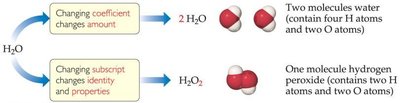
Coefficients in chemical equations indicate the number of molecules, while subscripts indicate the number of atoms in a molecule. Changing a coefficient changes the amount of substance; changing a subscript changes the identity and properties of the substance.
Example: means two molecules of water; is hydrogen peroxide, a different compound.
Summary Table: Common Cations and Anions
Charge | Formula | Name |
|---|---|---|
1+ | Na+ | sodium ion |
2+ | Ca2+ | calcium ion |
1- | Cl- | chloride ion |
2- | SO42- | sulfate ion |
3- | PO43- | phosphate ion |
Additional info: This summary table is a selection from the more comprehensive tables shown above.
