 Indietro
General Chemistry: States of Matter, Intermolecular Forces, and Phase Changes
Guida di studio - Note intelligenti
 Appunti personalizzati basati sui tuoi materiali, ampliati con definizioni chiave, esempi e contesto.
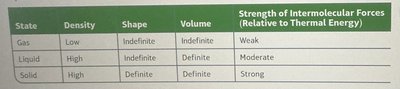
Q1. Compare the properties of solids, liquids, and gases in terms of density, shape, volume, and strength of intermolecular forces.
Background
Topic: States of Matter
This question tests your understanding of the physical properties that distinguish solids, liquids, and gases, and how intermolecular forces influence these properties.
Key Terms and Concepts:
Density: Mass per unit volume of a substance.
Shape: Whether the substance has a fixed or variable shape.
Volume: Whether the substance has a fixed or variable volume.
Intermolecular Forces: Forces of attraction between molecules, which can be weak (gases), moderate (liquids), or strong (solids).
Step-by-Step Guidance
Recall that solids have a definite shape and volume, and their particles are closely packed due to strong intermolecular forces.
Liquids have a definite volume but take the shape of their container, indicating moderate intermolecular forces that allow particles to move past each other.
Gases have neither definite shape nor volume, and their particles are far apart with weak intermolecular forces.
Think about how the strength of intermolecular forces affects the density and compressibility of each state.
Try solving on your own before revealing the answer!
Final Answer:
Solids: High density, definite shape, definite volume, strong intermolecular forces. Liquids: High density, indefinite shape, definite volume, moderate intermolecular forces. Gases: Low density, indefinite shape, indefinite volume, weak intermolecular forces.
The differences in properties are due to the relative strength of intermolecular forces compared to thermal energy in each state.
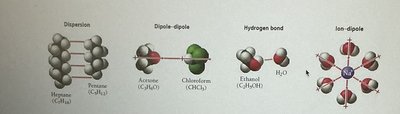
Q2. Identify and describe the four main types of intermolecular forces, and give an example of a molecule or compound that exhibits each type.
Background
Topic: Intermolecular Forces
This question tests your knowledge of the different types of intermolecular forces and your ability to recognize which substances exhibit each type.
Key Terms and Concepts:
Dispersion (London) Forces: Present in all molecules, especially nonpolar ones.
Dipole-Dipole Forces: Occur between polar molecules.
Hydrogen Bonding: A special, strong type of dipole-dipole force involving H bonded to N, O, or F.
Ion-Dipole Forces: Occur between ions and polar molecules.
Step-by-Step Guidance
Recall that dispersion forces arise from temporary fluctuations in electron distribution, present in all molecules.
Dipole-dipole forces occur in molecules with permanent dipoles (polar molecules).
Hydrogen bonding is a strong dipole-dipole interaction when H is bonded to N, O, or F.
Ion-dipole forces occur when an ion interacts with a polar molecule (e.g., Na+ in water).
Try solving on your own before revealing the answer!
Final Answer:
Dispersion: Present in all molecules (e.g., pentane, C5H12).
Dipole-dipole: Present in polar molecules (e.g., acetone, CH3COCH3).
Hydrogen bond: Present in molecules with H bonded to N, O, or F (e.g., H2O, ethanol).
Ion-dipole: Present between ions and polar molecules (e.g., Na+ and H2O).
Each force type is associated with specific molecular features and affects physical properties like boiling point and solubility.
Q3. When you take ice out of the freezer, what is the source of the "vapor" or smoke you see coming from the ice?
Background
Topic: Phase Changes and Condensation
This question tests your understanding of what happens when a very cold solid (ice) is exposed to warmer air, and why you see a visible mist or "smoke."
Key Terms and Concepts:
Condensation: The process by which water vapor in the air turns into liquid droplets.
Phase Change: Transition between solid, liquid, and gas states.
Step-by-Step Guidance
Recall that air contains water vapor, which is invisible in the gas phase.
When ice is removed from the freezer, its surface is much colder than the surrounding air.
The water vapor in the air near the ice cools rapidly and condenses into tiny liquid droplets.
These droplets scatter light, making the "vapor" or "smoke" visible.
Try solving on your own before revealing the answer!
Final Answer:
The "vapor" or "smoke" is actually tiny droplets of liquid water formed by condensation of water vapor from the air onto the cold surface of the ice. It is not water vapor from the ice itself, but condensed atmospheric moisture.
Q4. Arrange these compounds in order of increasing boiling point. Explain your reasoning. a. H2S b. H2Se c. H2O
Background
Topic: Boiling Points and Intermolecular Forces
This question tests your ability to predict boiling points based on molecular structure and the types of intermolecular forces present.
Key Terms and Concepts:
Boiling Point: The temperature at which a liquid turns into a gas.
Intermolecular Forces: Stronger forces generally lead to higher boiling points.
Hydrogen Bonding: Leads to unusually high boiling points for molecules like H2O.
Step-by-Step Guidance
Identify the types of intermolecular forces present in each compound (dispersion, dipole-dipole, hydrogen bonding).
Compare the molar masses: H2S < H2Se < H2O.
Recall that H2O can form hydrogen bonds, while H2S and H2Se cannot.
Consider that higher molar mass increases boiling point due to stronger dispersion forces, but hydrogen bonding has a much larger effect.
Try solving on your own before revealing the answer!
Final Answer:
Order of increasing boiling point: H2S < H2Se < H2O. H2O has the highest boiling point due to hydrogen bonding, while H2Se has a higher boiling point than H2S due to its larger molar mass and stronger dispersion forces.
Q5. For each pair of compounds, pick the one with the higher boiling point. Explain your reasoning. a. CS2 or CSe2 b. CH3OH or CH3SH c. CH4 or CH3CH3
Background
Topic: Boiling Points and Molecular Structure
This question tests your ability to compare boiling points based on molecular mass and the presence of hydrogen bonding or other intermolecular forces.
Key Terms and Concepts:
Boiling Point: Influenced by molecular mass and intermolecular forces.
Hydrogen Bonding: Strongest type of intermolecular force for small molecules.
Dispersion Forces: Increase with molar mass and surface area.
Step-by-Step Guidance
For each pair, identify the types of intermolecular forces present.
Compare the molar masses and the ability to form hydrogen bonds.
Recall that hydrogen bonding leads to higher boiling points than just dispersion or dipole-dipole forces.
For molecules with similar forces, the one with the higher molar mass usually has the higher boiling point.
Try solving on your own before revealing the answer!
Final Answer:
a. CSe2 (higher molar mass, stronger dispersion forces)
b. CH3OH (can hydrogen bond, unlike CH3SH)
c. CH3CH3 (higher molar mass, stronger dispersion forces)
Hydrogen bonding and higher molar mass both contribute to higher boiling points.
Q6. Determine if each pair of compounds forms a homogeneous solution when combined. For those that form homogeneous solutions, indicate the type of forces that are involved. a. CH3CH2CH2CH2CH3 and CH3CH2CH2CH2CH2CH3 b. CBr4 and H2O c. LiNO3 and H2O d. CH3OH and CH3CH2CH2CH2CH3
Background
Topic: Solubility and Intermolecular Forces
This question tests your understanding of "like dissolves like" and the types of intermolecular forces that allow substances to mix.
Key Terms and Concepts:
Homogeneous Solution: A mixture that is uniform throughout.
"Like Dissolves Like": Polar substances dissolve in polar solvents; nonpolar in nonpolar.
Types of Forces: Dispersion, dipole-dipole, hydrogen bonding, ion-dipole.
Step-by-Step Guidance
For each pair, determine if both substances are polar or nonpolar.
Recall that nonpolar substances mix with nonpolar, and polar with polar.
For ionic compounds in water, consider ion-dipole interactions.
Identify the main intermolecular forces for each pair that would allow or prevent mixing.
Try solving on your own before revealing the answer!
Final Answer:
a. Yes, both are nonpolar hydrocarbons; dispersion forces.
b. No, CBr4 is nonpolar and H2O is polar; they do not mix.
c. Yes, LiNO3 is ionic and H2O is polar; ion-dipole forces.
d. No, CH3OH is polar and can hydrogen bond, but CH3CH2CH2CH2CH3 is nonpolar; they do not mix well.
Q7. Explain how the addition of polymers to motor oil might make the viscosity less temperature dependent than a normal liquid.
Background
Topic: Viscosity and Molecular Structure
This question tests your understanding of how molecular structure (such as long-chain polymers) affects the flow properties of liquids and their response to temperature changes.
Key Terms and Concepts:
Viscosity: Resistance of a liquid to flow.
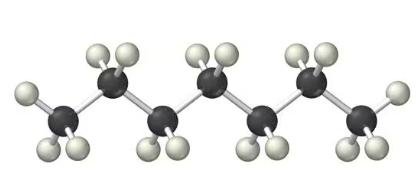
Polymers: Long, chain-like molecules that can coil or stretch depending on temperature.
Step-by-Step Guidance
Recall that normal liquids become less viscous as temperature increases because molecules move faster and overcome intermolecular forces more easily.
Polymers in oil coil up at low temperatures, making the oil thicker (more viscous).
At higher temperatures, polymers unwind and entangle, maintaining viscosity even as temperature rises.
Think about how this entanglement counteracts the normal decrease in viscosity with temperature.
Try solving on your own before revealing the answer!
Final Answer:
The addition of polymers causes the oil to remain more viscous at higher temperatures because the polymers unwind and entangle, preventing the viscosity from dropping as much as it would in a normal liquid. This makes the viscosity less temperature dependent.
Q8. Water in a glass tube that contains grease or oil residue displays a flat meniscus, whereas water in a clean glass tube displays a concave meniscus. Explain this observation.
Background
Topic: Surface Tension, Adhesion, and Cohesion
This question tests your understanding of how intermolecular forces between water, glass, and nonpolar substances affect the shape of the meniscus.
Key Terms and Concepts:
Meniscus: The curve seen at the surface of a liquid in response to its container.
Adhesion: Attraction between liquid molecules and the container.
Cohesion: Attraction between molecules within the liquid.
Step-by-Step Guidance
Recall that water forms a concave meniscus in clean glass due to strong adhesive forces between water and glass.
When grease or oil coats the glass, these nonpolar substances disrupt the adhesive interactions between water and glass.
With reduced adhesion, the meniscus becomes flatter because cohesive forces within water dominate.
Try solving on your own before revealing the answer!
Final Answer:
In a clean glass tube, water's adhesive forces with glass are strong, causing a concave meniscus. When grease or oil is present, these nonpolar substances prevent strong adhesion, resulting in a flat meniscus.
Q9. When a thin glass tube is put into water, the water rises 1.4 cm. When the same tube is put into hexane, the hexane rises only 0.4 cm. Explain.
Background
Topic: Capillary Action and Intermolecular Forces
This question tests your understanding of how the strength of adhesive and cohesive forces affects capillary rise in different liquids.
Key Terms and Concepts:
Capillary Action: The ability of a liquid to flow up a narrow tube against gravity.
Adhesion: Attraction between liquid and tube surface.
Cohesion: Attraction between molecules within the liquid.
Step-by-Step Guidance
Recall that water is polar and forms strong adhesive interactions with glass, leading to a higher rise.
Hexane is nonpolar and cannot form strong adhesive interactions with glass, resulting in a lower rise.
The difference in capillary rise is due to the difference in adhesive forces between the liquids and the glass.
Try solving on your own before revealing the answer!
Final Answer:
Water rises higher in the tube due to strong adhesive forces with glass, while hexane rises less because it is nonpolar and cannot interact strongly with the glass surface.
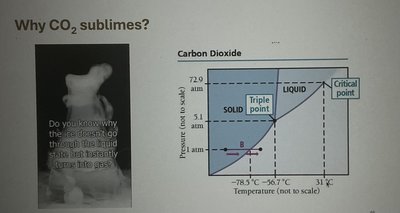
Q10. Consider the phase diagram for iodine. a. What is the normal boiling point for iodine? b. What is the melting point for iodine at 1 atm? c. Which state is present at room temperature and normal atmospheric pressure? d. Which state is present at 186°C and 1.0 atm?
Background
Topic: Phase Diagrams
This question tests your ability to interpret a phase diagram and identify phase transitions and stable phases under different conditions.
Key Terms and Concepts:
Phase Diagram: A graph showing the state of a substance at various temperatures and pressures.
Normal Boiling Point: The temperature at which vapor pressure equals 1 atm.
Melting Point: The temperature at which solid and liquid phases are in equilibrium at 1 atm.
Step-by-Step Guidance
Locate the 1 atm line on the phase diagram for iodine.
Find the intersection points with the fusion (melting) and vaporization (boiling) curves to determine the melting and boiling points at 1 atm.
Identify the phase present at room temperature (about 25°C) and 1 atm by finding the corresponding region on the diagram.
For 186°C and 1.0 atm, locate this point on the diagram and determine the phase present.
Try solving on your own before revealing the answer!
Final Answer:
a. Normal boiling point: 184.4°C
b. Melting point at 1 atm: 113.6°C
c. At room temperature and 1 atm: solid
d. At 186°C and 1.0 atm: gas
These values are determined by reading the phase boundaries at 1 atm on the phase diagram.
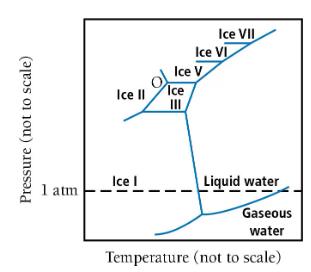
Q11. The high-pressure phase diagram of ice is shown here. Notice that, under high pressure, ice can exist in several different solid forms. Which three forms of ice are present at the triple point marked O? What is the density of ice II compared to ice I (the familiar form of ice)? Would ice III sink or float in liquid water?
Background
Topic: Phase Diagrams and Density
This question tests your ability to interpret a complex phase diagram and reason about the relative densities of different solid phases.
Key Terms and Concepts:
Triple Point: The condition where three phases coexist in equilibrium.
Density: Determines whether a solid will sink or float in a liquid.
Step-by-Step Guidance
Locate the triple point marked O on the phase diagram for ice.
Identify the three phases that meet at this point (e.g., Ice I, Ice II, Ice III).
Compare the slopes of the phase boundaries to infer relative densities (a steeper slope often indicates a denser phase).
Recall that a solid will sink in a liquid if its density is greater than that of the liquid.
Try solving on your own before revealing the answer!
Final Answer:
The three forms of ice at the triple point O are Ice I, Ice II, and Ice III.
Ice II is denser than Ice I.
Ice III would sink in liquid water because it is denser than liquid water.
These conclusions are based on the phase diagram and the relative positions of the phases.
