 Indietro
General Chemistry Study Guidance: Unit 1 Exam – Set 2
Guida di studio - Note intelligenti
 Appunti personalizzati basati sui tuoi materiali, ampliati con definizioni chiave, esempi e contesto.
Q1. Calculate the density of a sphere of persimmon wood (diameter 8.32 cm, mass 234 g), and determine whether it would float in water or petroleum ether.
Background
Topic: Density of Geometric Objects
This question tests your understanding of density calculations for geometric objects and the concept of buoyancy (whether an object will float or sink in a liquid based on density comparisons).
Key Terms and Formulas:
Density ():
Volume of a sphere:
Buoyancy: An object will float if its density is less than the liquid's density.
Step-by-Step Guidance
Calculate the radius of the sphere from the diameter: .
Find the volume of the sphere using .
Calculate the density of the sphere: .
Compare the calculated density to the density of water (1.00 g/mL) and petroleum ether (0.653 g/mL) to determine if the sphere will float in each liquid.
Try solving on your own before revealing the answer!
Final Answer:
The density of the sphere is 0.776 g/mL. The sphere will float in petroleum ether but sink in water.
Since 0.776 g/mL > 0.653 g/mL (petroleum ether), but < 1.00 g/mL (water), the sphere floats in ether and sinks in water.
Q2. Calculate the density of a solid placed in a container and filled with benzene (solid mass: 58.16 g, combined mass: 96.15 g, benzene density: 0.864 g/mL, container volume: 100 mL).
Background
Topic: Density of Non-Geometric Objects
This question tests your ability to determine the density of an irregular solid using displacement and mass measurements.
Key Terms and Formulas:
Density ():
Volume of solid:
Mass of benzene:
Volume of benzene:
Step-by-Step Guidance
Calculate the mass of benzene added: .
Find the volume of benzene using its density: .
Determine the volume of the solid: .
Calculate the density of the solid: .
Try solving on your own before revealing the answer!
Final Answer: 4.18 g/mL
By calculating the mass and volume of benzene displaced, you find the volume of the solid and then its density.
Q3. Octane is a combustible liquid. Is combustibility a physical or chemical property?
Background
Topic: Physical vs. Chemical Properties
This question tests your understanding of the difference between physical and chemical properties of substances.
Key Terms:
Physical property: Can be observed without changing the substance's identity.
Chemical property: Describes a substance's ability to undergo a chemical change.
Step-by-Step Guidance
Recall that combustibility involves a substance reacting with oxygen to produce new substances.
Determine whether this process changes the identity of octane.
Decide if combustibility fits the definition of a physical or chemical property.
Try solving on your own before revealing the answer!
Final Answer: Chemical property
Combustibility describes octane's ability to react and form new substances, so it is a chemical property.
Q4. Using the law of multiple proportions, how much hydrogen reacts with 1.78 g of carbon to produce methane (CH4) and ethylene (C2H2)?
Background
Topic: Law of Multiple Proportions
This question tests your ability to apply the law of multiple proportions to determine mass relationships in compounds.
Key Terms and Formulas:
Law of Multiple Proportions: When two elements form more than one compound, the masses of one element that combine with a fixed mass of the other are in simple ratios.
Mole ratios from chemical formulas: CH4 (1 C : 4 H), C2H2 (2 C : 2 H)
Step-by-Step Guidance
Calculate the mass ratio of hydrogen to carbon in each compound using their formulas.
Determine the mass of hydrogen that would react with 1.78 g of carbon for each compound.
Apply the ratios to find the corresponding hydrogen masses.
Try solving on your own before revealing the answer!
Final Answer:
For CH4: 0.299 g H; for C2H2: 0.149 g H.
The ratios reflect the law of multiple proportions for these compounds.
Q5. Why do chemists classify elements as transition metals or representative elements?
Background
Topic: Periodic Table Classification
This question tests your understanding of the purpose and importance of classifying elements in the periodic table.
Key Terms:
Transition metals: Elements in groups 3–12 with variable oxidation states and complex bonding.
Representative elements: Elements in groups 1, 2, and 13–18 with predictable properties.
Step-by-Step Guidance
Consider how classification helps predict chemical reactions and bonding behavior.
Think about the practical uses of classification in chemistry.
Evaluate the answer choices for the best explanation.
Try solving on your own before revealing the answer!
Final Answer:
To predict chemical reactions and bonding behavior based on element classification.
Classification helps chemists understand and anticipate how elements will react.
Q6. Calculate the number of nicotine molecules in a sample containing 3.561 × 1025 nitrogen atoms (nicotine formula: C10H14N2).
Background
Topic: Mole Concept
This question tests your ability to relate the number of atoms to the number of molecules using chemical formulas and Avogadro's number.
Key Terms and Formulas:
Avogadro's number: particles/mol
Nicotine molecule contains 2 nitrogen atoms.
Number of molecules:
Step-by-Step Guidance
Determine how many nitrogen atoms are in one molecule of nicotine.
Divide the total number of nitrogen atoms by the number per molecule to find the number of nicotine molecules.
Convert the number of molecules to moles using Avogadro's number.
Try solving on your own before revealing the answer!
Final Answer: 29.57 mol
By dividing the total nitrogen atoms by 2 and then by Avogadro's number, you find the number of moles of nicotine molecules.
Q7. What mass of iron can be obtained from 5.00 kg of hematite (Fe2O3) if the first two reactions have 85.6% yield and the third has 95.6% yield?
Background
Topic: Percent Yield
This question tests your ability to calculate the mass of product obtained from a reactant using percent yield and stoichiometry.
Key Terms and Formulas:
Percent yield:
Stoichiometry: Use balanced equations to relate reactant and product masses.
Step-by-Step Guidance
Convert 5.00 kg of hematite to grams.
Calculate the theoretical yield of iron using stoichiometry from the balanced equations.
Apply the percent yields for each step to find the actual mass of iron obtained.
Try solving on your own before revealing the answer!
Final Answer: 3.96 kg Fe
After applying stoichiometry and percent yields, the mass of iron obtained is 3.96 kg.
Q8. Propose a name for the ion AsO43− based on oxyanion naming conventions.
Background
Topic: Polyatomic Ions
This question tests your understanding of naming oxyanions based on their formulas and periodic group similarities.
Key Terms:
Oxyanion: An ion containing oxygen and another element.
"-ate" suffix: Used for the most common oxyanion in a group.
Step-by-Step Guidance
Identify the analogous ion for phosphorus (PO43− is phosphate).
Apply the same naming convention to arsenic.
Choose the correct name from the options.
Try solving on your own before revealing the answer!
Final Answer: Arsenate ion
AsO43− is named "arsenate ion" following the group naming convention.
Q9. Which compound will travel further on a TLC plate if the mobile phase is highly polar?
Background
Topic: Chromatography
This question tests your understanding of how polarity affects compound movement in thin-layer chromatography (TLC).
Key Terms:
Stationary phase: Usually non-polar (silica gel).
Mobile phase: The solvent, here highly polar.
Affinity: Attraction to either phase affects movement.
Step-by-Step Guidance
Recall that compounds with high affinity for the mobile phase move further.
Consider the effect of polarity on compound movement.
Choose the option describing high affinity for the mobile phase.
Try solving on your own before revealing the answer!
Final Answer:
A compound with low affinity for the stationary phase and high affinity for the mobile phase will travel further.
Q10. Convert 5.6 × 10³ to match the exponent of 2.1 × 10⁵ for addition.
Background
Topic: Scientific Notation (Addition/Subtraction)
This question tests your ability to convert numbers in scientific notation to the same exponent for addition or subtraction.
Key Terms and Formulas:
Scientific notation:
To add/subtract, exponents must match.
Step-by-Step Guidance
Identify the exponent you need to match (105).
Rewrite 5.6 × 10³ as a number with exponent 105.
Adjust the coefficient accordingly.
Try solving on your own before revealing the answer!
Final Answer: 0.056 × 10⁵
By shifting the decimal, 5.6 × 10³ becomes 0.056 × 10⁵.
Q11. Which experiment can be used to determine whether a mixture is a solution or a colloid?
Background
Topic: Molarity / Colloids vs. Solutions
This question tests your understanding of the differences between solutions and colloids and how to experimentally distinguish them.
Key Terms:
Colloid: A mixture with particles that scatter light (Tyndall effect).
Solution: Homogeneous mixture with no light scattering.
Step-by-Step Guidance
Recall the Tyndall effect (light scattering) as a test for colloids.
Consider other tests, such as checking for settling or density differences.
Evaluate which experiments can distinguish between solutions and colloids.
Try solving on your own before revealing the answer!
Final Answer: All of the above
Each experiment can help distinguish between a solution and a colloid.
Q12. Which statement is true for the reaction: CH4 (g) + 2 O2 (g) → CO2 (g) + 2 H2O (l)?
Background
Topic: Redox Reactions
This question tests your ability to identify oxidation and reduction in a chemical reaction.
Key Terms:
Oxidation: Loss of electrons (increase in oxidation state).
Reduction: Gain of electrons (decrease in oxidation state).
Redox reaction: Involves both oxidation and reduction.
Step-by-Step Guidance
Assign oxidation states to each element in the reactants and products.
Determine which element is oxidized and which is reduced.
Identify the correct statement based on your analysis.
Try solving on your own before revealing the answer!
Final Answer:
The reaction is a redox reaction where the carbon is reduced and the oxygen is oxidized.
Q13. Identify which ions (Ag+, Sr2+, Zn2+) are present in the solution based on precipitation reactions.
Background
Topic: Molecular Equations / Precipitation
This question tests your ability to use precipitation reactions to identify ions in solution.
Key Terms:
Precipitate: An insoluble solid formed in a reaction.
Solubility rules: Used to predict which ions form precipitates.
Step-by-Step Guidance
Analyze which ions form precipitates with chloride, sulfate, and carbonate.
Use the data to deduce which ions are present.
Match the findings to the answer choices.
Try solving on your own before revealing the answer!
Final Answer: Ag+, Sr2+, and Zn2+
All three ions are present based on the precipitation reactions described.
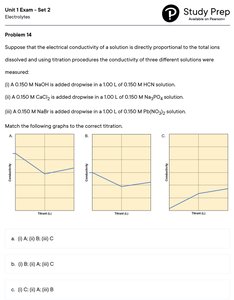
Q14. Match the conductivity graphs to the correct titration scenario.
Background
Topic: Electrolytes / Conductivity
This question tests your understanding of how titration affects the conductivity of solutions based on the ions present.
Key Terms:
Conductivity: Depends on the concentration and type of ions in solution.
Titration: Adding one solution to another to observe changes.
Step-by-Step Guidance
Analyze each titration scenario and predict how the ion concentration changes.
Relate the changes to the conductivity graphs provided.
Match each scenario to the correct graph.
Try solving on your own before revealing the answer!
Final Answer:
A: III, B: I, C: II
Each titration scenario corresponds to a specific conductivity change pattern.
Q15. What is the partial pressure of Ar in a mixture of SO2 and Ar at 289 K in a 25.00-L flask?
Background
Topic: Partial Pressure
This question tests your ability to calculate partial pressures using the ideal gas law and mole fractions.
Key Terms and Formulas:
Partial pressure:
Ideal gas law:
Mole fraction:
Step-by-Step Guidance
Calculate the number of moles of Ar using its mass and molar mass.
Use the ideal gas law to find the partial pressure of Ar.
Convert the pressure to mmHg if needed.
Try solving on your own before revealing the answer!
Final Answer: 3.04 mmHg
By calculating moles and applying the ideal gas law, the partial pressure of Ar is 3.04 mmHg.
Q16. How does the pressure of a gas change if the temperature is doubled while keeping the volume constant?
Background
Topic: Ideal Gas Law Derivations
This question tests your understanding of the relationship between pressure and temperature in the ideal gas law.
Key Terms and Formulas:
Ideal gas law:
At constant volume and moles:
Step-by-Step Guidance
Recall that pressure is directly proportional to temperature at constant volume.
Consider what happens when temperature is doubled.
Predict the change in pressure.
Try solving on your own before revealing the answer!
Final Answer: The pressure will be doubled.
Doubling temperature at constant volume doubles the pressure.
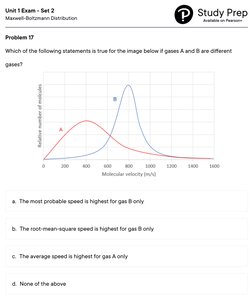
Q17. Which statement is true for the image below if gases A and B are different gases?
Background
Topic: Maxwell-Boltzmann Distribution
This question tests your understanding of molecular speed distributions for different gases.
Key Terms:
Maxwell-Boltzmann distribution: Shows the spread of molecular speeds in a gas.
Most probable speed: Peak of the distribution.
Average speed: Mean value of the distribution.
Step-by-Step Guidance
Examine the graph to identify which gas has a higher most probable speed.
Compare the average and root-mean-square speeds for each gas.
Choose the correct statement based on the graph.
Try solving on your own before revealing the answer!
Final Answer: The average speed is highest for gas A only.
Gas A's distribution is shifted to higher speeds, indicating a higher average speed.
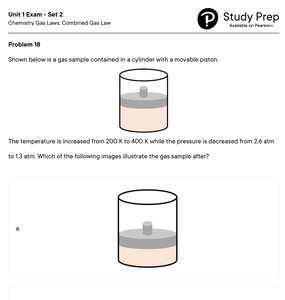
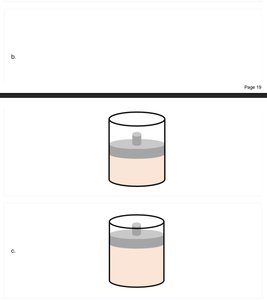
Q18. Which image illustrates the gas sample after the temperature is increased and pressure is decreased in a cylinder with a movable piston?
Background
Topic: Combined Gas Law
This question tests your understanding of how changes in temperature and pressure affect gas volume.
Key Terms and Formulas:
Combined gas law:
Increasing temperature and decreasing pressure increases volume.
Step-by-Step Guidance
Use the combined gas law to predict how the volume changes.
Compare the initial and final conditions to the images provided.
Identify which image shows the increased volume.
Try solving on your own before revealing the answer!
Final Answer: Image c (image_20)
The gas volume increases, so the image with the highest volume (lowest piston position) is correct.
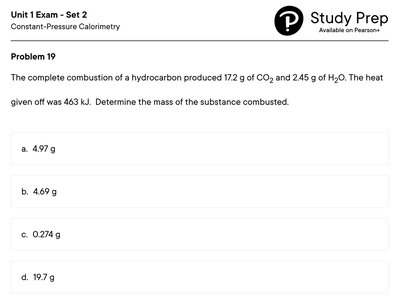
Q19. Determine the mass of a hydrocarbon combusted if 17.2 g of CO2 and 2.45 g of H2O are produced and 463 kJ of heat is given off.
Background
Topic: Constant-Pressure Calorimetry
This question tests your ability to relate the mass of reactant to the heat produced in a combustion reaction.
Key Terms and Formulas:
Stoichiometry: Relate mass of products to mass of reactant.
Heat of combustion:
Step-by-Step Guidance
Calculate moles of CO2 and H2O produced.
Relate these to the hydrocarbon combusted.
Use the heat given off to find the mass of hydrocarbon.
Try solving on your own before revealing the answer!
Final Answer: 4.97 g
By relating the heat produced to the mass combusted, you find the answer is 4.97 g.
Q20. Identify the elements in their standard states for the formation equation of C6H12O6(s) and find the standard enthalpy of formation.
Background
Topic: Formation Equations / Thermochemistry
This question tests your ability to write formation equations and use standard enthalpy values.
Key Terms and Formulas:
Standard enthalpy of formation:
Formation equation: Elements in their standard states form one mole of compound.
Step-by-Step Guidance
Identify the standard states of C, H, and O.
Write the balanced formation equation for C6H12O6(s).
Find the standard enthalpy of formation from the table of values.
Try solving on your own before revealing the answer!
Final Answer: 3 C(s) + 6 H2(g) + 3 O2(g) → C6H12O6(s), ΔHf = -2645.03 kJ/mol
The balanced equation uses elements in their standard states, and the enthalpy value is from the standard table.
