 Indietro
General Chemistry Study Guidance: Unit 1 Exam - Set 1
Guida di studio - Note intelligenti
 Appunti personalizzati basati sui tuoi materiali, ampliati con definizioni chiave, esempi e contesto.
Q1. How does a propanol degree compare to a Fahrenheit degree in terms of size?
Background
Topic: Temperature Scales & Unit Conversion
This question tests your understanding of custom temperature scales and how to relate them to established scales like Fahrenheit. You need to compare the size of a degree on your new propanol scale to a Fahrenheit degree.
Key Terms and Formulas:
Melting point and boiling point: Reference points for temperature scales
Degree size: Difference between boiling and melting points divided by the number of degrees
Conversion formula:
Step-by-Step Guidance
Identify the melting and boiling points for propanol on both the Celsius and your new scale.
Calculate the size of one degree on the propanol scale: (but use the new scale values).
Calculate the size of one degree on the Fahrenheit scale: (but use the Fahrenheit values).
Set up a ratio to compare the size of a propanol degree to a Fahrenheit degree.
Try solving on your own before revealing the answer!
Final Answer: a. 0.770 °P/°F
By calculating the degree size for both scales and comparing them, you find that a propanol degree is about 0.770 times the size of a Fahrenheit degree.
Q2. Determine the larger quantity: 5.3 × 10² mL or 6.4 × 10⁶ μL?
Background
Topic: Metric Prefixes & Unit Conversion
This question tests your ability to convert between metric units (mL and μL) and compare quantities.
Key Terms and Formulas:
mL (milliliter):
μL (microliter):
Conversion: Multiply or divide by to convert between mL and μL
Step-by-Step Guidance
Convert 5.3 × 10² mL to μL by multiplying by .
Compare the converted value to 6.4 × 10⁶ μL.
Alternatively, convert 6.4 × 10⁶ μL to mL by dividing by and compare to 5.3 × 10² mL.
Try solving on your own before revealing the answer!
Final Answer: b. 6.4 × 10⁶ μL
After converting both quantities to the same unit, 6.4 × 10⁶ μL is larger than 5.3 × 10² mL.
Q3. Calculate the volume of water and hexane in a mixture given total volume and mass.
Background
Topic: Density & Mixtures
This question tests your ability to use density to calculate the volume of two substances in a mixture, given their total mass and volume.
Key Terms and Formulas:
Density ():
Total mass:
Total volume:
Step-by-Step Guidance
Write two equations: one for total mass and one for total volume.
Express and in terms of their densities and volumes.
Set up a system of equations using the given total mass and volume.
Solve for and using algebraic methods.
Try solving on your own before revealing the answer!
Final Answer: b. mL, mL
By solving the system of equations, you find the volumes of water and hexane that satisfy both the total mass and volume constraints.
Q4. Is a kilogram larger than a pound? By how much?
Background
Topic: Conversion Factors & Units
This question tests your understanding of mass units and their conversion between metric and imperial systems.
Key Terms and Formulas:
1 kilogram (kg) = 2.20462 pounds (lb)
Conversion factor:
Step-by-Step Guidance
Recall the conversion factor between kilograms and pounds.
Compare 1 kg to 1 lb using the conversion factor.
Determine how many times larger a kilogram is than a pound.
Try solving on your own before revealing the answer!
Final Answer: a. Yes, a kilogram is about 2.2 times larger than a pound
Using the conversion factor, 1 kg is approximately 2.2 times the mass of 1 lb.
Q5. Classify each property as physical or chemical for an unknown element.
Background
Topic: Physical vs. Chemical Properties
This question tests your ability to distinguish between physical and chemical properties of substances.
Key Terms and Formulas:
Physical property: Can be observed without changing the substance's identity
Chemical property: Describes how a substance reacts or changes into another substance
Step-by-Step Guidance
Read each property and decide if it involves a change in chemical identity.
Group properties that describe appearance, density, melting/boiling points as physical.
Group properties that describe reactions or formation of new substances as chemical.
Try solving on your own before revealing the answer!
Final Answer: a. Physical properties: 1, 2, 4; Chemical properties: 3, 5
Physical properties are those that do not involve a chemical change, while chemical properties involve reactions or formation of new substances.
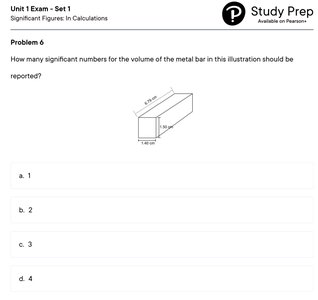
Q6. How many significant figures should be reported for the volume of the metal bar?
Background
Topic: Significant Figures in Calculations
This question tests your understanding of how to determine the correct number of significant figures when reporting calculated values.
Key Terms and Formulas:
Significant figures: Digits in a measurement that are known with certainty plus one estimated digit
Multiplication/Division rule: The result should have as many significant figures as the measurement with the fewest significant figures
Step-by-Step Guidance
Identify the number of significant figures in each dimension of the metal bar.
Multiply the dimensions to find the volume.
Determine which dimension has the fewest significant figures.
Report the volume with that number of significant figures.
Try solving on your own before revealing the answer!
Final Answer: d. 4
The volume should be reported with 4 significant figures, matching the dimension with the fewest significant figures.
Q7. Identify the correct statement about atomic number and mass number of an atom.
Background
Topic: Subatomic Particles
This question tests your understanding of atomic structure, specifically the definitions of atomic number and mass number.
Key Terms and Formulas:
Atomic number (): Number of protons in the nucleus
Mass number (): Sum of protons and neutrons in the nucleus
Step-by-Step Guidance
Recall the definitions of atomic number and mass number.
Compare each statement to the definitions.
Eliminate statements that incorrectly include electrons or misstate the sum.
Try solving on your own before revealing the answer!
Final Answer: b. Atomic number = protons; mass number = protons + neutrons
The atomic number is the number of protons, and the mass number is the sum of protons and neutrons.
Q8. Name the elements with the symbols: Rh, Si, O, P
Background
Topic: Periodic Table & Element Symbols
This question tests your knowledge of element symbols and their corresponding names.
Key Terms and Formulas:
Rh: Rhodium
Si: Silicon
O: Oxygen
P: Phosphorus
Step-by-Step Guidance
Match each symbol to its element name using the periodic table.
Check for common confusions (e.g., Rh vs. Ru).
Try solving on your own before revealing the answer!
Final Answer: c. Rhodium, Silicon, Oxygen, Phosphorus
Each symbol corresponds to the correct element name as listed.
Q9. Which element does NOT exist as a diatomic gas at normal temperature and pressure?
Background
Topic: Elemental Forms
This question tests your knowledge of which elements are diatomic in their natural gaseous form.
Key Terms and Formulas:
Diatomic gases: H2, N2, O2, F2, Cl2
Monatomic gases: Noble gases like Ne
Step-by-Step Guidance
Recall the list of diatomic elements.
Identify which element in the list is a noble gas and not diatomic.
Try solving on your own before revealing the answer!
Final Answer: d. Ne
Neon (Ne) is a noble gas and exists as a monatomic gas at standard conditions.
Q10. Classify each element as alkali metal, alkaline earth metal, halogen, noble gas, etc.
Background
Topic: Periodic Table Classification
This question tests your ability to classify elements based on their position in the periodic table.
Key Terms and Formulas:
Groups: Alkali metals, alkaline earth metals, halogens, noble gases, etc.
Periodic table reference
Step-by-Step Guidance
Identify each element's group or classification using the periodic table.
Match each element to its correct classification.
Try solving on your own before revealing the answer!
Final Answer: a. f) Mg: B, 1) H: I, 3) Cl: E, 4) Ne: K, 5) P: C, 1, 6) Fe: G
Each element is classified according to its group on the periodic table.
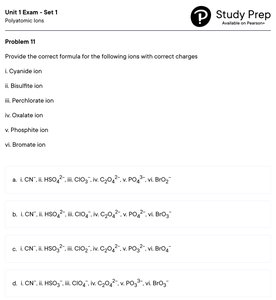
Q11. Provide the correct formula for the following ions with correct charges: Cyanide, Bisulfite, Perchlorate, Oxalate, Phosphate, Bromate
Background
Topic: Polyatomic Ions
This question tests your knowledge of polyatomic ion formulas and their charges.
Key Terms and Formulas:
Cyanide:
Bisulfite:
Perchlorate:
Oxalate:
Phosphate:
Bromate:
Step-by-Step Guidance
Recall the formula and charge for each polyatomic ion.
Match each ion to its correct formula and charge.
Try solving on your own before revealing the answer!
Final Answer: b. i. CN-, ii. HSO3-, iii. ClO4-, iv. C2O42-, v. PO43-, vi. BrO3-
Each polyatomic ion is matched to its correct formula and charge.
Q12. What effect does excess oxygen have on the combustion reaction?
Background
Topic: Combustion Apparatus
This question tests your understanding of combustion reactions and the role of oxygen.
Key Terms and Formulas:
Complete combustion: All fuel is converted to products
Excess oxygen: Ensures complete combustion
Step-by-Step Guidance
Recall what happens when there is insufficient oxygen (incomplete combustion).
Consider the effect of excess oxygen on the reaction and analysis.
Try solving on your own before revealing the answer!
Final Answer: b. It ensures complete combustion, which is necessary for accurate analysis
Excess oxygen helps achieve complete combustion, avoiding unwanted by-products.
Q13. Calculate the empirical and molecular formula for Butyric acid given mass percent composition and molar mass.
Background
Topic: Empirical and Molecular Formulas
This question tests your ability to determine empirical and molecular formulas from percent composition and molar mass.
Key Terms and Formulas:
Empirical formula: Simplest whole-number ratio of atoms
Molecular formula: Actual number of atoms in a molecule
Steps: Convert percent to grams, then to moles, find ratios, and scale to molecular formula
Step-by-Step Guidance
Convert mass percent to grams (assume 100 g sample).
Convert grams to moles for each element.
Find the simplest whole-number ratio for empirical formula.
Calculate the molar mass of the empirical formula and compare to the given molar mass to find the molecular formula.
Try solving on your own before revealing the answer!
Final Answer: a. EF: C2H4O, MF: C4H8O2
The empirical formula is C2H4O, and the molecular formula is C4H8O2 based on the molar mass.
Q14. How does a coffee filter exemplify the principle of filtration?
Background
Topic: Filtration and Evaporation
This question tests your understanding of filtration as a separation technique.
Key Terms and Formulas:
Filtration: Separation of solid from liquid using a filter
Residue: Solid left behind
Filtrate: Liquid that passes through
Step-by-Step Guidance
Recall the function of a coffee filter in separating coffee grounds from liquid coffee.
Identify which answer describes the separation of solid from liquid.
Try solving on your own before revealing the answer!
Final Answer: d. It separates coffee grounds (residue) from the liquid coffee (filtrate)
Filtration separates the solid coffee grounds from the liquid coffee.
Q15. Which is a common error when applying the quadratic formula?
Background
Topic: Quadratic Formula (Math in Chemistry)
This question tests your understanding of common mistakes when using the quadratic formula, which is sometimes used in chemistry calculations.
Key Terms and Formulas:
Quadratic formula:
Common errors: Incorrect use of signs, incorrect operations
Step-by-Step Guidance
Recall the quadratic formula and its structure.
Identify which answer describes a common error (e.g., mixing up signs).
Try solving on your own before revealing the answer!
Final Answer: c. Mixing up the negative signs when calculating the term under the square root
This is a frequent error when applying the quadratic formula.
Q16. Write a balanced equation for the reaction of XBr3 with water.
Background
Topic: Molecular Equations
This question tests your ability to write balanced chemical equations for reactions involving acids and water.
Key Terms and Formulas:
Balanced equation: Reactants and products with equal numbers of atoms
Acid-base reaction: Acid reacts with water to produce ions
Step-by-Step Guidance
Identify the reactants and products in the reaction.
Balance the equation by ensuring equal numbers of each atom on both sides.
Try solving on your own before revealing the answer!
Final Answer: b. XBr3 + 3 H2O → H3XO3 + 3 HBr
The equation is balanced for all atoms and reflects the reaction described.
Q17. Which combination of reagents produces a gas that fills up the balloon?
Background
Topic: Activity Series & Gas Formation
This question tests your understanding of the activity series and which metals react with acids to produce hydrogen gas.
Key Terms and Formulas:
Activity series: List of metals in order of reactivity
Reaction: Metal + acid → hydrogen gas
Step-by-Step Guidance
Recall which metals react with hydrochloric acid to produce hydrogen gas.
Identify the correct combination of reagents based on the activity series.
Try solving on your own before revealing the answer!
Final Answer: e. Nickel and aqueous hydrochloric acid; H2(g)
Nickel reacts with hydrochloric acid to produce hydrogen gas, which fills the balloon.
Q18. What is the balanced net ionic equation for Sr(OH)2 + CoCl3 → ? What are the spectator ions?
Background
Topic: Complete Ionic Equations
This question tests your ability to write net ionic equations and identify spectator ions in a reaction.
Key Terms and Formulas:
Net ionic equation: Shows only the ions and molecules directly involved in the reaction
Spectator ions: Ions that do not participate in the reaction
Step-by-Step Guidance
Write the full molecular equation for the reaction.
Break all soluble compounds into their ions.
Identify the ions that form a precipitate or react.
List the spectator ions.
Try solving on your own before revealing the answer!
Final Answer: d. (A) Sr2+ (aq) + 2 Cl- (aq) → SrCl2 (s) (B) Sr2+ and Cl-
The net ionic equation shows the formation of SrCl2 and the spectator ions are Sr2+ and Cl-.
Q19. Calculate the volume a gas occupies at STP given initial conditions.
Background
Topic: Standard Temperature and Pressure (STP)
This question tests your ability to use the combined gas law to calculate the volume of a gas at STP.
Key Terms and Formulas:
Combined gas law:
STP: ,
Step-by-Step Guidance
Identify initial and final conditions for pressure, volume, and temperature.
Plug values into the combined gas law equation.
Solve for the unknown final volume at STP.
Try solving on your own before revealing the answer!
Final Answer: a. 2.47 × 10² L
Using the combined gas law, the gas occupies 247 L at STP.
Q20. How much energy (in kJ) is required to evaporate 15.4 g of ethanol at its boiling point?
Background
Topic: Thermochemical Equations
This question tests your ability to use heat of vaporization and mass to calculate energy required for phase change.
Key Terms and Formulas:
Heat of vaporization (): Energy required to convert liquid to gas
Energy: (where is in moles)
Convert mass to moles using molar mass
Step-by-Step Guidance
Convert 15.4 g of ethanol to moles using its molar mass.
Multiply the number of moles by the heat of vaporization to find the energy required.
Try solving on your own before revealing the answer!
Final Answer: a. Yes, 25.8 kJ
The energy required to evaporate 15.4 g of ethanol at its boiling point is 25.8 kJ.
