 Indietro
General Chemistry Study Guide: Atomic Theory, Chemical Bonds, Solutions, and Equilibrium
Guida di studio - Note intelligenti
 Appunti personalizzati basati sui tuoi materiali, ampliati con definizioni chiave, esempi e contesto.
Atomic Theory and Molar Mass
Modern Atomic Theory and the Laws That Led to It
Modern atomic theory explains the nature of atoms and their behavior, building on historical laws such as the law of conservation of mass, law of definite proportions, and law of multiple proportions.
Law of Conservation of Mass: Mass is neither created nor destroyed in a chemical reaction.
Law of Definite Proportions: A chemical compound always contains the same elements in the same proportion by mass.
Law of Multiple Proportions: When elements combine, they do so in ratios of small whole numbers.
Atomic Theory: Atoms are the fundamental units of matter, and each element consists of unique atoms.
Molar Mass: Counting Atoms by Weighing Them
Molar mass is the mass of one mole of a substance, allowing chemists to count atoms by weighing samples.
Mole: A unit representing 6.022 x 10²³ particles (Avogadro's number).
Molar Mass: The mass (in grams) of one mole of a substance.
Formula:
Example: 18 g of water (H2O) contains 1 mole of molecules.
Chemical Bonds and Compounds
Chemical Bonds
Chemical bonds are forces that hold atoms together in compounds. The main types are ionic, covalent, and metallic bonds.
Ionic Bonds: Formed by the transfer of electrons between metals and nonmetals.
Covalent Bonds: Formed by the sharing of electrons between nonmetals.
Metallic Bonds: Involve a 'sea' of shared electrons among metal atoms.
Representing Compounds: Chemical Formulas and Molecular Models
Chemical formulas and molecular models represent the composition and structure of compounds.
Empirical Formula: Shows the simplest ratio of elements.
Molecular Formula: Shows the actual number of atoms in a molecule.
Structural Formula: Shows how atoms are connected.
Molecular Models: Visualize the 3D arrangement of atoms.
An Atomic-Level View of Elements and Compounds
At the atomic level, elements consist of one type of atom, while compounds are made of two or more types of atoms bonded together.
Element: Pure substance with only one kind of atom.
Compound: Substance formed from two or more elements chemically bonded.
Molecular Compounds: Formulas and Names (Naming Binary Acids Only)
Molecular compounds are named using prefixes and rules for binary acids.
Binary Acids: Acids composed of hydrogen and one other nonmetal.
Naming: Use 'hydro-' prefix and '-ic' suffix (e.g., HCl is hydrochloric acid).
Formula Mass and the Mole Concept for Compounds
Formula mass is the sum of atomic masses in a compound's formula, used to relate moles to mass.
Formula Mass:
Mole Concept: Relates the number of particles to mass via Avogadro's number.
Composition of Compounds
The composition of compounds is described by percent composition and empirical/molecular formulas.
Percent Composition:
Empirical Formula: Simplest whole-number ratio of elements.
Determining a Chemical Formula from Experimental Data
Experimental data such as mass or percent composition can be used to determine a compound's empirical or molecular formula.
Steps: 1. Find moles of each element. 2. Divide by smallest number of moles. 3. Multiply to get whole numbers if needed.
Example: If a compound contains 40% C, 6.7% H, and 53.3% O, calculate moles and derive the empirical formula.
Solutions and Solution Equilibrium
Solution Concentration
Solution concentration describes the amount of solute dissolved in a given quantity of solvent.
Molarity (M):
Other Units: Percent by mass, percent by volume, molality.
Types of Aqueous Solutions and Solubility
Aqueous solutions are classified by their solubility and the nature of the solute.
Electrolytes: Substances that dissociate into ions in water (strong or weak).
Non-electrolytes: Substances that do not dissociate into ions.
Solubility: The maximum amount of solute that can dissolve in a solvent at a given temperature.
Solution Equilibrium and Factors Affecting Solubility
Solution equilibrium occurs when the rate of dissolution equals the rate of precipitation. Solubility is affected by temperature, pressure, and the nature of solute and solvent.
Saturated Solution: Contains the maximum amount of dissolved solute.
Unsaturated Solution: Can dissolve more solute.
Supersaturated Solution: Contains more solute than is normally possible.
Factors: Temperature (usually increases solubility for solids), pressure (affects gases), and chemical nature.
Acid-Base Equilibrium and pH
Autoionization of Water and pH (Calculations of pH Only)
Water undergoes autoionization, producing H+ and OH- ions. pH is a measure of hydrogen ion concentration.
Autoionization:
pH Calculation:
Neutral Water: [H+] = 1 x 10⁻⁷ M, pH = 7
Spectrophotometry and Beer's Law
Spectrometer and Beer's Law
Spectrophotometry is used to measure the concentration of solutions using light absorption. Beer's law relates absorbance to concentration.
Beer's Law:
Where: A = absorbance, = molar absorptivity, l = path length, c = concentration.
Application: Used to determine concentration of colored solutions.
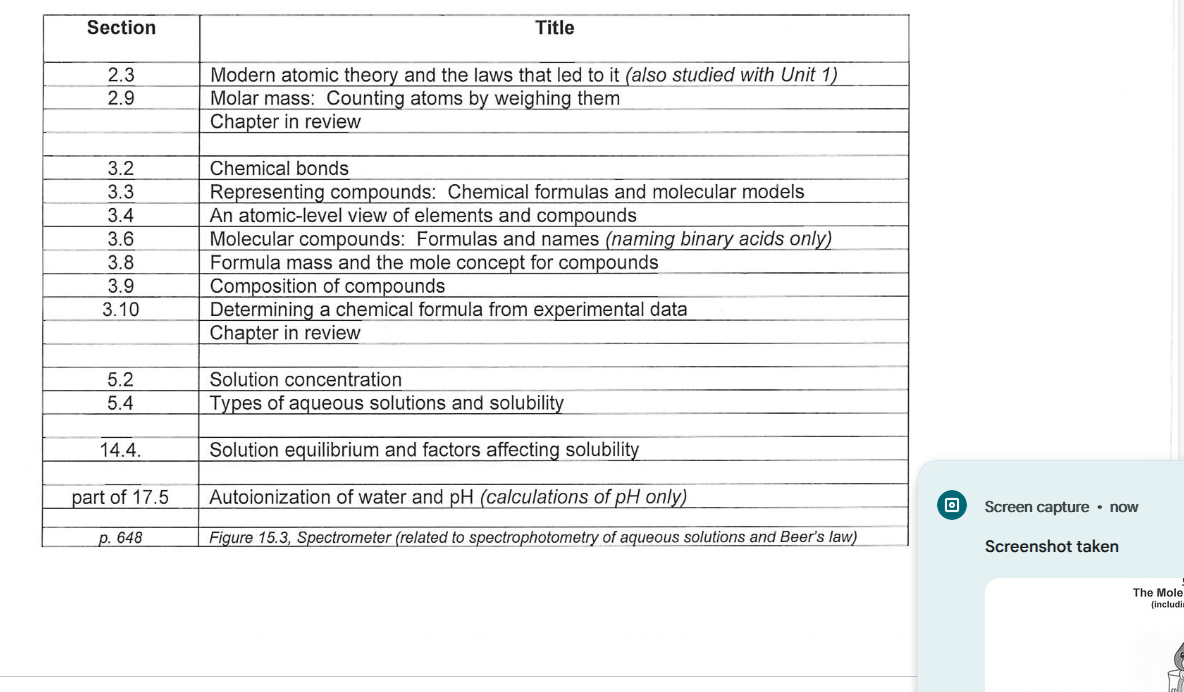
Additional info: The spectrometer image is included as it directly relates to the explanation of Beer's law and solution analysis.
