 Indietro
General Chemistry Study Guide: Atomic Theory, Periodic Table, Chemical Nomenclature
Guida di studio - Note intelligenti
 Appunti personalizzati basati sui tuoi materiali, ampliati con definizioni chiave, esempi e contesto.
Q1. Circle the experiment descriptions that are related to the electron.
Background
Topic: Atomic Theory and Discovery of Subatomic Particles
This question tests your knowledge of historical experiments that led to the discovery and understanding of the electron.
Key Terms:
Electron: Negatively charged subatomic particle
Gold foil experiment: Used to study atomic structure
Cathode ray tube: Used to discover the electron
Millikan oil drop experiment: Measured the charge of the electron
Step-by-Step Guidance
Read each experiment description carefully and identify which ones mention electrons or the discovery of their properties.
Recall that the cathode ray tube experiment (using magnets) was crucial for discovering the electron.
Millikan's oil drop experiment determined the charge of the electron.
Experiments mentioning neutral particles or protons are not directly related to electrons.
Try solving on your own before revealing the answer!
Final Answer:
The following experiment descriptions are related to the electron:
Millikan examined oil droplets by x-rays and discovered the charge on a particle.
Magnets were used to examine the charge to mass ratio of a particle in a cathode ray tube.
These experiments directly contributed to the discovery and understanding of the electron.
Q2. Fill in the blanks below.
Background
Topic: Structure of the Atom
This question tests your understanding of atomic structure, including the nucleus, electrons, and the concept of neutrality in atoms.
Key Terms:
Nucleus: Central part of the atom containing protons and neutrons
Electron cloud: Region surrounding the nucleus where electrons are found
Proton: Positively charged particle
Neutron: Neutral particle
Electron: Negatively charged particle
Step-by-Step Guidance
Recall that most of the mass of an atom is concentrated in the nucleus.
The volume of an atom is mostly empty space, occupied by the electron cloud.
Electrons are negatively charged and surround the nucleus.
A neutral atom must have equal numbers of protons and electrons.
Try solving on your own before revealing the answer!
Final Answer:
Most of the mass of an atom is contained in the nucleus of the atom.
Most of the volume of an atom is empty space.
The nucleus is surrounded by negatively charged particles called electrons.
A neutral atom must contain equal numbers of protons and electrons.
Q3. Identify the number of protons, neutrons, and electrons in the following elements:
Background
Topic: Isotope Notation and Atomic Structure
This question tests your ability to use isotope notation to determine the number of protons, neutrons, and electrons in an atom.
Key Terms and Formulas:
Atomic number (): Number of protons
Mass number (): Number of protons + neutrons
Number of neutrons:
Number of electrons: Equal to protons in a neutral atom
Step-by-Step Guidance
For each isotope, identify the atomic number () from the periodic table, which gives the number of protons.
Subtract the atomic number from the mass number () to find the number of neutrons: .
For a neutral atom, the number of electrons equals the number of protons.
Apply these steps to each isotope: , , .
Try solving on your own before revealing the answer!
Final Answer:
a) : 15 protons, 17 neutrons, 15 electrons
b) : 27 protons, 33 neutrons, 27 electrons
c) : 24 protons, 27 neutrons, 24 electrons
These values are determined using the atomic number from the periodic table and the mass number given in the isotope notation.
Q4. Write the symbol for each of the following ions:
Background
Topic: Ion Notation and Charge Calculation
This question tests your ability to write symbolic notation for ions, including charge, atomic number, and mass number.
Key Terms and Formulas:
Ion: Atom with a net charge due to loss or gain of electrons
Symbolic notation:
Charge:
Step-by-Step Guidance
Identify the element using the atomic number () from the periodic table.
Write the mass number () as the superscript.
Determine the charge based on the difference between protons and electrons.
Combine these into the symbolic notation: .
Try solving on your own before revealing the answer!
Final Answer:
Ion with a 1+ charge, atomic number 55, mass number 133:
Ion with atomic number 15, mass number 31, and a 3− charge:
These notations show the element, mass number, atomic number, and charge.
Q5. Determine the number of protons, neutrons, and electrons in each and name them:
Background
Topic: Isotope and Ion Identification
This question tests your ability to determine atomic structure and name ions based on atomic number, mass number, and charge.
Key Terms and Formulas:
Atomic number (): Number of protons
Mass number (): Number of protons + neutrons
Charge: Difference between protons and electrons
Step-by-Step Guidance
For each ion, use the atomic number to find the element name.
Calculate the number of neutrons: .
Calculate the number of electrons: (for cations) or (for anions).
Write the element name and the numbers for protons, neutrons, and electrons.
Try solving on your own before revealing the answer!
Final Answer:
Atomic number 26, mass number 58, charge of 2+: Iron (Fe), 26 protons, 32 neutrons, 24 electrons
Atomic number 53, mass number 127, charge of 1−: Iodine (I), 53 protons, 74 neutrons, 54 electrons
These values are calculated using the atomic number, mass number, and charge.
Q6. Complete the following table.
Background
Topic: Isotope Notation and Atomic Structure
This question tests your ability to interpret isotope notation and fill in atomic structure information.
Key Terms and Formulas:
Symbolic notation:
Protons: Atomic number ()
Neutrons:
Electrons: Protons minus charge (for cations), protons plus charge (for anions)
Step-by-Step Guidance
For each isotope, identify the element and atomic number from the symbol.
Calculate the number of protons, neutrons, and electrons using the formulas above.
Fill in the mass number and charge as indicated.
Try solving on your own before revealing the answer!
Final Answer:
: 17 protons, 18 neutrons, 17 electrons, mass number 35
: 30 protons, 34 neutrons, 28 electrons, mass number 64
34: Element with 34 protons is selenium (Se), mass number 79, 45 neutrons, 34 electrons
65: Element with 65 protons is terbium (Tb), mass number 158, 93 neutrons, 65 electrons
34: Element with 34 protons is selenium (Se), mass number 36, 2 neutrons, 34 electrons
36: Element with 36 protons is krypton (Kr), mass number 79, 43 neutrons, 36 electrons
79: Element with 79 protons is gold (Au), mass number 197, 118 neutrons, 79 electrons
Q7. Determine the average atomic mass of lithium given isotopic abundances.
Background
Topic: Average Atomic Mass Calculation
This question tests your ability to calculate the average atomic mass of an element using isotopic masses and abundances.
Key Formula:
Step-by-Step Guidance
Convert the percent abundances to decimal (fractional) form.
Multiply each fractional abundance by its corresponding isotopic mass.
Add the products together to get the average atomic mass.
Set up the calculation for lithium using the provided values.
Try solving on your own before revealing the answer!
Final Answer:
amu
This is the weighted average based on the natural abundances of lithium isotopes.
Q8. Determine the average atomic mass of silicon given isotopic abundances.
Background
Topic: Average Atomic Mass Calculation
This question tests your ability to calculate the average atomic mass of silicon using isotopic masses and abundances.
Key Formula:
Step-by-Step Guidance
Convert the percent abundances to decimal (fractional) form for each isotope.
Multiply each fractional abundance by its corresponding isotopic mass.
Add the products together to get the average atomic mass.
Set up the calculation for silicon using the provided values.
Try solving on your own before revealing the answer!
Final Answer:
amu
This is the weighted average based on the natural abundances of silicon isotopes.
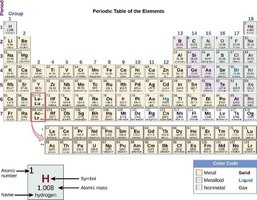
Q9. Answer the following questions about the periodic table.
Background
Topic: Periodic Table Groups and Properties
This question tests your knowledge of the periodic table, including group names and typical charges.
Key Terms:
Halogens: Group 17
Alkali metals: Group 1, always have a +1 charge
Group 2: Alkaline earth metals
Step-by-Step Guidance
Identify the group number for halogens on the periodic table.
Recall the typical charge for alkali metals.
Remember the name for Group 2 elements.
Try solving on your own before revealing the answer!
Final Answer:
a. Halogens: Group 17
b. Alkali metals always have a +1 charge
c. Group 2 is called the alkaline earth metals
Q10. Fill in the following table
Background
Topic: Periodic Table and Element Classification
This question tests your ability to use the periodic table to find element names, symbols, atomic masses, and classify them as metal, nonmetal, or metalloid.
Key Terms:
Elemental symbol: Abbreviation for element
Atomic mass: Average mass of an element's atoms
Classification: Metal, nonmetal, metalloid
Step-by-Step Guidance
Use the periodic table to find the element name for each symbol or atomic mass.
Identify the elemental symbol for each element.
Determine the atomic mass from the periodic table.
Classify each element as metal, nonmetal, or metalloid based on its location and color coding.
Try solving on your own before revealing the answer!
Final Answer:
Iron: Symbol Fe, atomic mass 55.85, metal
Si: Silicon, atomic mass 28.09, metalloid
39.948: Argon (Ar), nonmetal
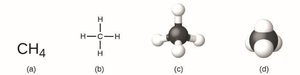
Q11. Match the name to the representation below:
Background
Topic: Chemical Representation of Molecules
This question tests your ability to identify different ways molecules are represented: molecular formula, structural formula, ball-and-stick model, and space-filling model.
Key Terms:
Molecular formula: Shows the types and numbers of atoms (e.g., CH4)
Structural formula: Shows how atoms are connected
Ball-and-stick model: 3D representation with balls for atoms and sticks for bonds
Space-filling model: Shows the relative sizes and positions of atoms
Step-by-Step Guidance
Examine each representation and match it to its name based on its features.
Identify the molecular formula (letters and numbers), structural formula (lines showing bonds), ball-and-stick model (3D with balls and sticks), and space-filling model (atoms shown as spheres touching).
Try solving on your own before revealing the answer!
Final Answer:
(a) Molecular formula: CH4
(b) Structural formula
(c) Ball-and-stick model
(d) Space-filling model
Q12. Write the empirical formula corresponding to the given molecular formula:
Background
Topic: Empirical and Molecular Formulas
This question tests your ability to convert molecular formulas to empirical formulas, which show the simplest whole-number ratio of atoms.
Key Terms:
Molecular formula: Actual number of atoms in a molecule
Empirical formula: Simplest ratio of atoms
Step-by-Step Guidance
For each molecular formula, divide the subscripts by their greatest common factor to get the empirical formula.
Check that the empirical formula represents the simplest ratio.
Try solving on your own before revealing the answer!
Final Answer:
Al2Br6: Empirical formula is AlBr3
B3N3H6: Empirical formula is BN H2
C4H8O2: Empirical formula is C2H4O
Q13–17. Identify as ionic, molecular or acid. Then give the chemical formula or write the chemical name.
Background
Topic: Chemical Nomenclature and Classification
These questions test your ability to classify compounds as ionic, molecular, or acid, and to write their formulas or names.
Key Terms:
Ionic compound: Metal + nonmetal
Molecular compound: Only nonmetals
Acid: Contains hydrogen and a nonmetal or polyatomic ion
Formula: Chemical representation
Name: Systematic nomenclature
Step-by-Step Guidance
For each compound, identify the elements and their types (metal, nonmetal, polyatomic ion).
Classify the compound as ionic, molecular, or acid based on its composition.
Write the chemical formula or name as appropriate.
Use periodic table and nomenclature rules to determine charges and prefixes.
Try solving on your own before revealing the answer!
Final Answer:
Q13: a. copper (II) chloride: Ionic, CuCl2; b. K2SO4: Ionic, potassium sulfate; c. barium hydroxide: Ionic, Ba(OH)2; d. MgO: Ionic, magnesium oxide; e. calcium sulfide: Ionic, CaS
Q14: a. sodium hydride: Ionic, NaH; b. Fe(NO3)2: Ionic, iron(II) nitrate; c. sodium chloride: Ionic, NaCl; d. NiSO4: Ionic, nickel(II) sulfate; e. Al2O3: Ionic, aluminum oxide
Q15: a. lithium hydroxide: Ionic, LiOH; b. AgCl: Ionic, silver chloride; c. NH4OH: Ionic, ammonium hydroxide; d. nitric acid: Acid, HNO3; e. H2SO4 (aq): Acid, sulfuric acid
Q16: a. CO2: Molecular, carbon dioxide; b. PCl5: Molecular, phosphorus pentachloride; c. N2H4: Molecular, hydrazine; d. phosphoric acid: Acid, H3PO4; e. H2CO3 (aq): Acid, carbonic acid
Q17: a. SF6: Molecular, sulfur hexafluoride; b. SO3: Molecular, sulfur trioxide; c. Cl2O: Molecular, dichlorine monoxide; d. hydrobromic acid: Acid, HBr; e. P4O6: Molecular, tetraphosphorus hexoxide
