 Indietro
General Chemistry Study Guide: Ionic Compounds, Lattice Energy, Electronegativity, Lewis Structures, and Bond Properties
Guida di studio - Note intelligenti
 Appunti personalizzati basati sui tuoi materiali, ampliati con definizioni chiave, esempi e contesto.
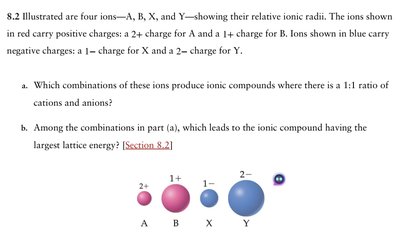
Q1. Four ions—A, B, X, and Y—are shown with their relative ionic radii. A and B are cations (A: 2+, B: 1+), X and Y are anions (X: 1-, Y: 2-). a. Which combinations of these ions produce ionic compounds with a 1:1 ratio of cations and anions? b. Among these combinations, which leads to the ionic compound with the largest lattice energy?
Background
Topic: Ionic Compounds & Lattice Energy
This question tests your understanding of how ions combine to form neutral compounds and how lattice energy depends on ion charge and size.
Key Terms and Formulas:
Lattice energy: The energy released when ions form a solid lattice.
Charge balance: Compounds must be electrically neutral.
Formula for lattice energy (simplified): , where and are ion charges, is the distance between ions.
Step-by-Step Guidance
Identify the possible combinations of cations and anions that result in a neutral compound with a 1:1 ratio (e.g., A with Y, B with X).
For each combination, check the total charge: the sum of cation and anion charges must equal zero.
Consider the charges and sizes of the ions in each combination. Higher charges and smaller radii generally lead to higher lattice energy.
Compare the combinations to determine which has the highest product of charges and the smallest sum of ionic radii.
Try solving on your own before revealing the answer!
Final Answer:
a. The combinations that produce a 1:1 ratio are: A (2+) with Y (2-) and B (1+) with X (1-).
b. The combination A (2+) with Y (2-) leads to the largest lattice energy, because both ions have higher charges and (as shown in the diagram) smaller radii compared to the other pair.
Higher charges and smaller ionic radii increase lattice energy, making A and Y the most favorable pair.
Q2. Does the lattice energy of an ionic solid increase or decrease: i. as the charges of the ions increase? ii. as the sizes of the ions increase?
Background
Topic: Lattice Energy Trends
This question tests your understanding of how lattice energy depends on ion charge and size.
Key Terms and Formulas:
Lattice energy:
Ion charge (, ): The magnitude of the charges on the ions.
Ion size (): The distance between the centers of the ions.
Step-by-Step Guidance
Consider the effect of increasing ion charge on the numerator of the lattice energy formula.
Consider the effect of increasing ion size (distance ) on the denominator of the formula.
Think about how these changes affect the overall value of lattice energy.
Try solving on your own before revealing the answer!
Final Answer:
i. Lattice energy increases as the charges of the ions increase.
ii. Lattice energy decreases as the sizes of the ions increase.
Higher charges mean stronger attraction; larger ions mean weaker attraction due to greater distance.
Q3. Arrange the following substances (MgS, KI, GaN, LiBr) in order from lowest to highest lattice energy.
Background
Topic: Lattice Energy Comparison
This question tests your ability to predict lattice energies based on ion charges and sizes.
Key Terms and Formulas:
Lattice energy:
Consider both the charges and sizes of the ions in each compound.
Step-by-Step Guidance
Identify the charges of the ions in each compound (e.g., MgS: Mg and S).
Consider the relative sizes of the ions (smaller ions lead to higher lattice energy).
Rank the compounds based on the product of ion charges and the sum of ionic radii.
Set up the order from lowest to highest lattice energy based on your analysis.
Try solving on your own before revealing the answer!
Final Answer:
Order from lowest to highest lattice energy: KI < LiBr < MgS < GaN.
KI has the lowest lattice energy due to lower charges and larger ions; GaN has the highest due to high charges and small ions.
Q4. Based on the lattice energies of MgCl2 and SrCl2, what is the expected range for CaCl2? b. Using data and the second ionization energy for Ca, calculate the lattice energy of CaCl2.
Background
Topic: Lattice Energy Estimation and Calculation
This question tests your ability to estimate and calculate lattice energies using reference data and ionization energies.
Key Terms and Formulas:
Lattice energy: (from tables or calculated)
Ionization energy: Energy required to remove an electron from an atom.
Born-Haber cycle: Used to calculate lattice energy from thermodynamic data.
Step-by-Step Guidance
Find the lattice energies for MgCl2 and SrCl2 from the reference table.
Estimate the value for CaCl2 based on its position between Mg and Sr in the periodic table.
For part b, set up the Born-Haber cycle using the provided ionization energy and other relevant data.
Combine the steps to calculate the lattice energy, but stop before the final calculation.
Try solving on your own before revealing the answer!
Final Answer:
a. The lattice energy of CaCl2 is expected to fall between that of MgCl2 and SrCl2.
b. Using the Born-Haber cycle and the second ionization energy for Ca, the calculated lattice energy for CaCl2 is approximately 2250 kJ/mol.
Q5. Place the following pairs of elements in order from smallest to largest difference in electronegativity: K and F, S and O, Br and I, Ca and Se, Li and Cl.
Background
Topic: Electronegativity Differences
This question tests your understanding of how to compare electronegativity values between elements.
Key Terms and Formulas:
Electronegativity: The tendency of an atom to attract electrons in a bond.
Difference in electronegativity:
Step-by-Step Guidance
Look up the electronegativity values for each element (use the periodic table).
Calculate the absolute difference for each pair.
Arrange the pairs from smallest to largest difference.
Try solving on your own before revealing the answer!
Final Answer:
Order: Br and I < S and O < Ca and Se < Li and Cl < K and F.
K and F have the largest difference; Br and I have the smallest.
Q6. Using only the periodic table, select the most electronegative atom in each set: a. Na, Mg, K, Ca; b. P, S, As, Se; c. Be, B, C, Si; d. Zn, Ge, Ga, As.
Background
Topic: Electronegativity Trends
This question tests your ability to identify the most electronegative element in a group using periodic trends.
Key Terms and Formulas:
Electronegativity increases across a period and decreases down a group.
Step-by-Step Guidance
For each set, locate the elements on the periodic table.
Apply the trend: elements further right and higher up are more electronegative.
Identify the most electronegative element in each set.
Try solving on your own before revealing the answer!
Final Answer:
a. Mg; b. S; c. C; d. As.
These elements are furthest right and/or highest in their respective sets.
Q7. Arrange the bonds in each set in order of increasing polarity: a. C—F, O—F, B—F b. O—Cl, S—Br, C—P c. C—S, B—F, N—O
Background
Topic: Bond Polarity
This question tests your understanding of how to rank bonds by their polarity, which depends on the difference in electronegativity between the bonded atoms.
Key Terms and Formulas:
Bond polarity:
Greater difference means greater polarity.
Step-by-Step Guidance
Find the electronegativity values for each atom in the bond.
Calculate the difference for each bond.
Arrange the bonds in each set from smallest to largest difference.
Try solving on your own before revealing the answer!
Final Answer:
a. B—F < C—F < O—F b. C—P < S—Br < O—Cl c. C—S < N—O < B—F
Bond polarity increases with greater electronegativity difference.
Q8. Consider the formate ion, HCO2-: a. Draw a single Lewis structure that satisfies the octet rule. b. Are resonance structures needed? c. Would you predict the C—O bond lengths in formate to be longer or shorter than those in CO2?
Background
Topic: Lewis Structures and Resonance
This question tests your ability to draw Lewis structures, recognize resonance, and predict bond lengths based on resonance.
Key Terms and Formulas:
Lewis structure: Shows how atoms are bonded and where electrons are located.
Resonance: When more than one valid Lewis structure exists for a molecule or ion.
Bond length: Related to bond order; resonance can equalize bond lengths.
Step-by-Step Guidance
Draw the Lewis structure for HCO2- with all atoms satisfying the octet rule.
Check if multiple valid structures exist (resonance).
Consider how resonance affects the C—O bond lengths compared to CO2.
Try solving on your own before revealing the answer!
Final Answer:
a. The Lewis structure has one C=O double bond and one C—O single bond, with resonance between the two O atoms.
b. Yes, resonance structures are needed.
c. The C—O bonds in formate are intermediate in length, shorter than a single bond but longer than a double bond in CO2.
Q9. Write Lewis structures that satisfy the octet rule for the following molecules and ions: NH4+, C2F4, COCl2, HSO4-, HNC, ClO3-.
Background
Topic: Lewis Structures and Octet Rule
This question tests your ability to draw Lewis structures for various molecules and ions, ensuring the octet rule is satisfied.
Key Terms and Formulas:
Lewis structure: Shows bonding and lone pairs.
Octet rule: Atoms (except H) should have 8 electrons around them.
Step-by-Step Guidance
Count the total number of valence electrons for each molecule/ion.
Arrange atoms and connect them with bonds, starting with the central atom.
Distribute remaining electrons as lone pairs to satisfy the octet rule.
Check for formal charges and resonance if needed.
Try solving on your own before revealing the answer!
Final Answer:
Lewis structures for each molecule/ion are as follows: NH4+: N surrounded by 4 H atoms, positive charge. C2F4: Two C atoms double-bonded, each bonded to two F atoms. COCl2: C double-bonded to O, single-bonded to two Cl atoms. HSO4-: S central, bonded to four O atoms, one O bonded to H. HNC: H bonded to N, N bonded to C. ClO3-: Cl central, bonded to three O atoms, negative charge.
Q10. In the following pairs of binary compounds, determine which is molecular and which is ionic. Assign a name to each compound: a. TiCl4 and CaF2 b. ClF3 and VF3 c. SbCl3 and AlF3
Background
Topic: Ionic vs. Molecular Compounds
This question tests your ability to distinguish between ionic and molecular compounds and apply proper naming conventions.
Key Terms and Formulas:
Ionic compound: Formed from metal and nonmetal.
Molecular compound: Formed from two nonmetals.
Naming conventions: Use Roman numerals for transition metals, prefixes for molecular compounds.
Step-by-Step Guidance
Identify whether each compound contains a metal or nonmetal.
Classify each as ionic or molecular.
Assign the correct name based on the classification.
Try solving on your own before revealing the answer!
Final Answer:
a. TiCl4 is molecular (titanium tetrachloride); CaF2 is ionic (calcium fluoride).
b. ClF3 is molecular (chlorine trifluoride); VF3 is ionic (vanadium(III) fluoride).
c. SbCl3 is molecular (antimony trichloride); AlF3 is ionic (aluminum fluoride).
Q11. Describe xenon trioxide, XeO3, using four possible Lewis structures (with zero, one, two, or three Xe—O double bonds). b. Do any satisfy the octet rule for every atom? c. Do any have multiple resonance structures? d. Which yields the most favorable formal charges?
Background
Topic: Lewis Structures, Resonance, and Formal Charge
This question tests your ability to draw multiple Lewis structures, check for resonance, and evaluate formal charges.
Key Terms and Formulas:
Lewis structure: Shows bonding and lone pairs.
Resonance: Multiple valid structures.
Formal charge:
Step-by-Step Guidance
Draw four Lewis structures for XeO3 with varying numbers of double bonds.
Check if each structure satisfies the octet rule for all atoms.
Identify resonance structures and count them.
Evaluate formal charges for each structure to find the most favorable.
Try solving on your own before revealing the answer!
Final Answer:
a. Four structures: all single bonds, one double bond, two double bonds, three double bonds.
b. Only the structure with three double bonds satisfies the octet rule for all atoms.
c. Yes, some structures have resonance.
d. The structure with one double bond yields the most favorable formal charges.
Q12. Draw Lewis structures for NO, BF3, ICl2-, OPBr3, XeF4. Identify where the octet rule is not obeyed and state how many electrons surround these atoms.
Background
Topic: Lewis Structures and Octet Rule Exceptions
This question tests your ability to draw Lewis structures and recognize exceptions to the octet rule.
Key Terms and Formulas:
Lewis structure: Shows bonding and lone pairs.
Octet rule: Atoms should have 8 electrons, but exceptions exist.
Expanded octet: Some atoms (e.g., Xe, P) can have more than 8 electrons.
Step-by-Step Guidance
Draw the Lewis structure for each molecule/ion.
Count the electrons around each atom.
Identify any atoms that do not follow the octet rule and state the number of electrons.
Try solving on your own before revealing the answer!
Final Answer:
NO: N has 7 electrons (odd number, does not obey octet). BF3: B has 6 electrons (does not obey octet). ICl2-: I has 10 electrons (expanded octet). OPBr3: P has 10 electrons (expanded octet). XeF4: Xe has 12 electrons (expanded octet).
Q13. State whether each statement is true or false: a. A carbon–carbon triple bond is shorter than a carbon–carbon single bond. b. There are exactly six bonding electrons in O3. c. The C—O bond in CO is shorter than the C—O bond in CO2. d. The O—O bond in ozone is shorter than the O—O bond in O2. e. The average bond enthalpies of all triple bonds are the same regardless of atoms involved.
Background
Topic: Bond Lengths and Bond Enthalpy
This question tests your understanding of bond properties and how they relate to bond order and enthalpy.
Key Terms and Formulas:
Bond order: Higher bond order means shorter bond length.
Bond enthalpy: Energy required to break a bond.
Step-by-Step Guidance
Recall the relationship between bond order and bond length.
Consider the number of bonding electrons in O3.
Compare bond lengths and enthalpies for the given molecules.
Try solving on your own before revealing the answer!
Final Answer:
a. True b. False c. True d. False e. False
Bond order and bond enthalpy depend on the specific atoms involved.
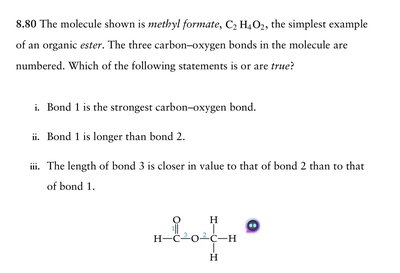
Q14. The molecule shown is methyl formate, C2H4O2. Which of the following statements is or are true? i. Bond 1 is the strongest carbon–oxygen bond. ii. Bond 1 is longer than bond 2. iii. The length of bond 3 is closer in value to that of bond 2 than to that of bond 1.
Background
Topic: Bond Strength and Length in Esters
This question tests your understanding of bond strength and length in organic molecules, specifically esters.
Key Terms and Formulas:
Bond strength: Stronger bonds are shorter.
Bond order: Double bonds are stronger and shorter than single bonds.
Step-by-Step Guidance
Identify the bond types (single or double) for each numbered bond in the structure.
Recall that double bonds are stronger and shorter than single bonds.
Compare the bond lengths and strengths based on bond order.
Try solving on your own before revealing the answer!
Final Answer:
i. True: Bond 1 is a double bond, making it the strongest C–O bond. ii. False: Bond 1 is shorter than bond 2. iii. True: Bond 3 is a single bond, so its length is closer to bond 2 (also single) than to bond 1 (double).
