Indietro
General Chemistry Study Guide: Molar Mass, Percent Composition, Hydrates, Empirical & Molecular Formulas, Solutions, and Spectrophotometry
Guida di studio - Note intelligenti
 Appunti personalizzati basati sui tuoi materiali, ampliati con definizioni chiave, esempi e contesto.
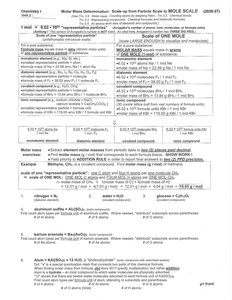
Molar Mass Determination: Scale-up from Particle Scale to Mole Scale
Understanding the Mole and Molar Mass
The mole is a fundamental unit in chemistry used to count particles such as atoms, molecules, ions, or formula units. Avogadro's number () defines the number of representative particles in one mole. Molar mass is the mass (in grams) of one mole of a substance and is numerically equal to the formula mass in atomic mass units (amu).
Monatomic Element: Smallest representative particle is an atom. Example: Na (sodium).
Diatomic Element: Smallest representative particle is a molecule. Example: F2 (fluorine).
Covalent Compound: Smallest representative particle is a molecule. Example: CH4 (methane).
Ionic Compound: Smallest representative particle is a formula unit. Example: NaCl (sodium chloride).
To find molar mass, sum the molar masses of all atoms in the formula, using values from the periodic table to two decimal places.
Example: Molar mass of methane, CH4: g/mol
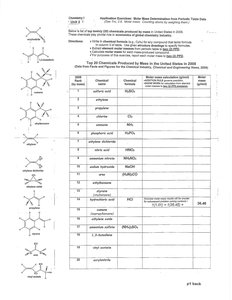
Application Exercises: Molar Mass Determination from Periodic Table Data
Calculating Molar Mass for Industrial Chemicals
Industrial chemicals are produced in large quantities and their molar masses are crucial for economic and practical calculations. The molar mass is calculated by summing the atomic masses of each element in the compound's formula.
Example: Sulfuric acid, H2SO4: g/mol
Rank | Chemical Name | Chemical Formula | Molar Mass (g/mol) |
|---|---|---|---|
1 | Sulfuric acid | H2SO4 | 98.08 |
2 | Ethylene | C2H4 | 28.05 |
3 | Propylene | C3H6 | 42.08 |
4 | Chlorine | Cl2 | 70.90 |
5 | Ammonia | NH3 | 17.04 |
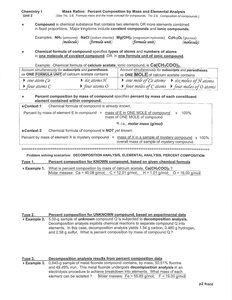
Mass Ratios: Percent Composition by Mass and Elemental Analysis
Percent Composition and Elemental Analysis
Percent composition by mass specifies the percentage by mass of each element in a compound. This can be calculated from a known chemical formula or from experimental decomposition data.
Type 1: Known compound, use formula and molar masses.
Type 2: Unknown compound, use experimental data.
Type 3: Decomposition analysis from percent composition data.
Formula: Percent by mass of element E =
Example: For Ca(CH3COO)2, calculate percent by mass for Ca, C, H, O using their molar masses.
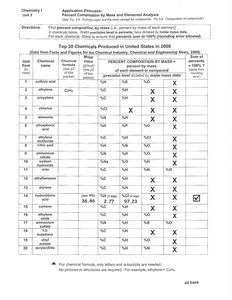
Application Exercises: Percent Composition by Mass and Elemental Analysis
Percent Composition of Industrial Chemicals
Percent composition is calculated for the top 20 chemicals produced in the United States. For each chemical, the percent by mass of each element is determined and checked to ensure the sum is approximately 100%.
Rank | Chemical Name | Chemical Formula | Molar Mass (g/mol) | %H | %C | %N | %O | %S | %Cl |
|---|---|---|---|---|---|---|---|---|---|
1 | Sulfuric acid | H2SO4 | 98.08 | 2.06 | - | - | 65.02 | 32.92 | - |
5 | Ammonia | NH3 | 17.04 | 17.76 | - | 82.24 | - | - | - |
Hydrate Compounds: Experimental Characterization
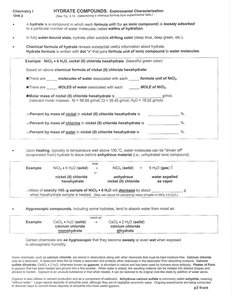
Hydrates and Their Formulas
A hydrate is an ionic compound with water molecules physically adsorbed to each formula unit. The formula is written with a dot (e.g., NiCl2 · 6H2O). Upon heating, water is driven off, leaving the anhydrous compound.
Example: NiCl2 · 6H2O (nickel(II) chloride hexahydrate) contains 6 water molecules per formula unit.
Percent by mass of water:
Application Exercises: Mole Role in Formulas of Hydrate Compounds
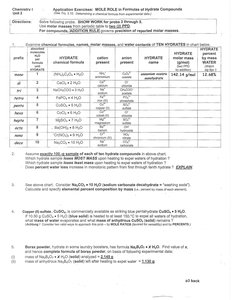
Calculating Water Content and Percent Composition in Hydrates
Hydrate formulas are determined by analyzing the mole ratio of water to anhydrous compound. The percent by mass of water is calculated for various hydrates.
Hydrate Formula | Cation | Anion | Molar Mass (g/mol) | Percent Water by Mass |
|---|---|---|---|---|
(NH4)2C2O4 · H2O | NH4+ | C2O42- | 142.14 | 12.68 |
CaCl2 · 2H2O | Ca2+ | Cl- | 147.02 | 24.54 |
Hydrate Compounds and Molar Math: Further Drill Exercises
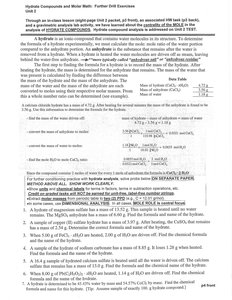
Experimental Determination of Hydrate Formulas
To determine the formula of a hydrate, measure the mass before and after heating to remove water. Calculate the moles of water and anhydrous compound, then find the simplest whole number ratio.
Example: If a hydrate sample loses 1.18 g upon heating, and the remaining anhydrate is 3.56 g, use molar masses to convert to moles and determine the ratio.
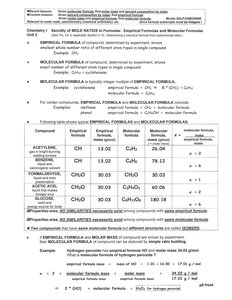
Sanctity of Mole Ratios in Formulas: Empirical Formulas and Molecular Formulas
Empirical and Molecular Formulas
The empirical formula shows the simplest whole number ratio of atoms in a compound, while the molecular formula shows the actual number of atoms. The molecular formula is often an integer multiple of the empirical formula.
Example: Cyclohexane: Empirical formula CH2, molecular formula C6H12.
Formula:
Compound | Empirical Formula | Empirical Formula Mass (g/mol) | Molecular Formula | Molecular Formula Mass (g/mol) | x |
|---|---|---|---|---|---|
Acetylene | CH | 13.02 | C2H2 | 26.04 | 2 |
Glucose | CH2O | 30.03 | C6H12O6 | 180.18 | 6 |
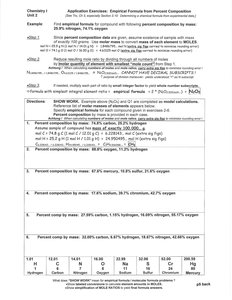
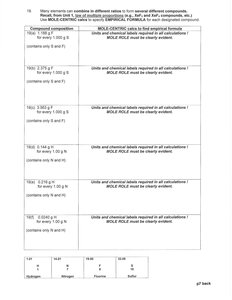
Application Exercises: Empirical Formula from Percent Composition
Finding Empirical Formulas from Percent Composition
To find the empirical formula, assume a 100 g sample, convert mass percentages to moles, and reduce the mole ratio to the simplest whole numbers.
Example: 25.9% N, 74.1% O: mol N, mol O, then reduce ratio.
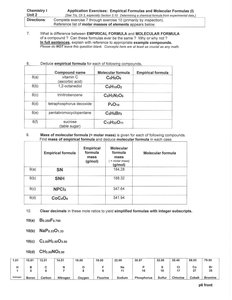
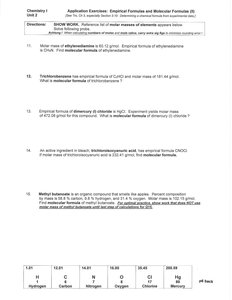
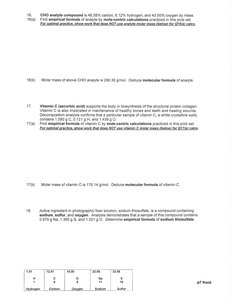
Application Exercises: Empirical Formulas and Molecular Formulas (I & II)
Practice Problems for Empirical and Molecular Formulas
Exercises include deducing empirical formulas from molecular formulas, calculating molecular formulas from empirical formulas and molar masses, and solving for formulas from percent composition data.
Example: Ethylenediamine empirical formula CH4N, molar mass 60.12 g/mol. Find molecular formula.
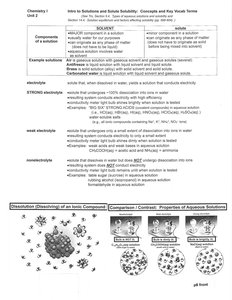
Intro to Solutions and Solute Solubility: Concepts and Key Vocab Terms
Solution Components and Electrolytes
A solution consists of a solvent (major component) and solute (minor component). Electrolytes are solutes that conduct electricity when dissolved in water, classified as strong, weak, or nonelectrolytes based on their degree of dissociation.
Strong Electrolyte: Complete dissociation, high conductivity.
Weak Electrolyte: Partial dissociation, low conductivity.
Nonelectrolyte: No dissociation, no conductivity.
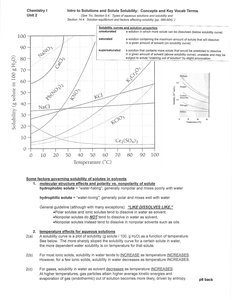
Solubility Curves and Solution Properties
Solubility and Factors Affecting Solubility
Solubility curves show how solubility varies with temperature. Most ionic solids increase in solubility with temperature, while gases decrease. The principle "like dissolves like" guides solubility based on polarity.
Unsaturated: More solute can dissolve.
Saturated: Maximum solute dissolved.
Supersaturated: More solute than predicted, unstable.
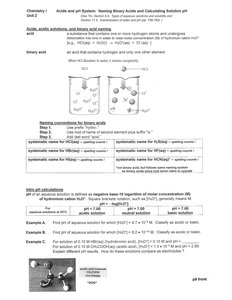
Acids and pH System: Naming Binary Acids and Calculating Solution pH
Acid Naming and pH Calculations
Binary acids contain hydrogen and one other element. Naming uses the prefix "hydro-", root of the second element, and suffix "-ic acid". pH is calculated as the negative logarithm of hydronium ion concentration.
Formula:
Acidic: pH < 7; Neutral: pH = 7; Basic: pH > 7
Spectrophotometry and Beer's Law
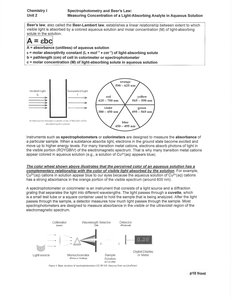
Measuring Concentration of Light-Absorbing Analytes
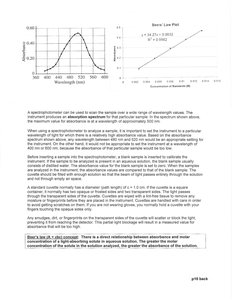
Beer's Law relates absorbance to concentration: , where is absorbance, is molar absorptivity, is path length, and is concentration. Spectrophotometers measure absorbance to determine concentration.
Color Wheel: Perceived color is complementary to absorbed wavelength.
Instrument: Light source, monochromator, cuvette, detector.
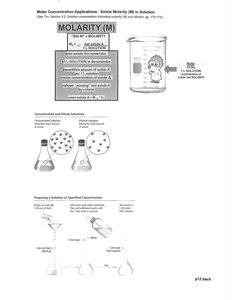
Molar Concentration Applications: Solute Molarity (M) in Solution
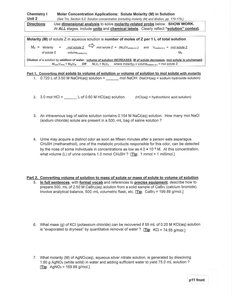
Calculating Molarity and Solution Preparation
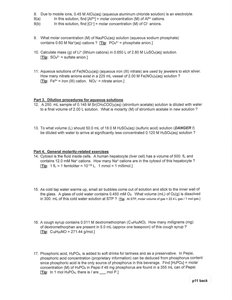
Molarity () is the number of moles of solute per liter of solution. It is used to calculate the amount of solute or solution needed for reactions and preparations.
Formula:
Dilution:
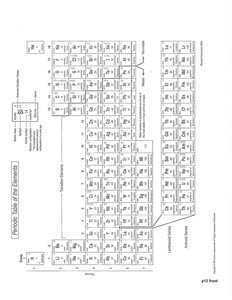
Periodic Table of the Elements
Reference for Atomic Masses and Element Properties
The periodic table provides atomic masses and other properties necessary for calculations of molar mass, percent composition, and empirical formulas.
Molar Concentration Applications: Solute Molarity (M) in Solution (Visual Summary)
Visualizing Concentrated and Dilute Solutions
Concentrated solutions contain a large amount of solute, while dilute solutions contain less. Preparing a solution involves dissolving a measured amount of solute and diluting to a specific volume.