 Indietro
General Chemistry Study Guide: Molecular Orbitals, Bonding, and Electron Configurations
Guida di studio - Note intelligenti
 Appunti personalizzati basati sui tuoi materiali, ampliati con definizioni chiave, esempi e contesto.
Q1. Explain the energetic cost vs. payoff of hybridization in valence bond theory.
Background
Topic: Valence Bond Theory & Hybrid Orbitals
This question tests your understanding of why atoms undergo hybridization and the balance between energy required and energy gained.
Key Terms:
Hybridization: Mixing atomic orbitals to form new hybrid orbitals.
Energetic cost: Energy needed to promote electrons.
Energetic payoff: Energy gained from forming stronger bonds.
Step-by-Step Guidance
Consider that hybridization requires energy to promote electrons from lower-energy orbitals to higher-energy ones.
Think about the benefit: hybrid orbitals allow for better overlap and stronger covalent bonds.
Compare the energy cost of promotion to the energy gained from bond formation.
Reflect on why hybridization is favored in molecules with multiple bonds or lone pairs.
Try solving on your own before revealing the answer!
Final Answer:
The energetic cost of hybridization is offset by the energetic payoff of forming stronger, more stable bonds. Hybridization is favored when the energy gained from bond formation exceeds the energy required for electron promotion.
Q2. Use VSEPR theory to determine electron geometry and hybridization for H2O, CH3O-, and BO2-.
Background
Topic: VSEPR Theory & Hybridization
This question tests your ability to use VSEPR theory to predict molecular geometry and assign hybridization.
Key Terms:
VSEPR: Valence Shell Electron Pair Repulsion theory
Electron geometry: Arrangement of electron groups
Hybridization: Type of orbitals used in bonding
Step-by-Step Guidance
Count the total electron groups (bonding + lone pairs) around the central atom for each molecule.
Use the VSEPR chart to determine the electron geometry based on the number of groups.
Assign the hybridization corresponding to the electron geometry (e.g., 4 groups = sp3).
Check your answers with the VSEPR table.
Try solving on your own before revealing the answer!
Final Answer:
H2O: 4 groups, tetrahedral geometry, sp3 hybridization
CH3O-: 4 groups, tetrahedral geometry, sp3 hybridization
BO2-: 2 groups, linear geometry, sp hybridization
These assignments follow the VSEPR rules for electron group counting and hybridization.
Q3. Complete the electron configuration table for various ions and atoms.
Background
Topic: Electron Configurations, Ions, and Magnetic Properties
This question tests your ability to write electron configurations, identify ions, and determine magnetic properties.
Key Terms:
Electron configuration: Distribution of electrons in atomic orbitals
Ion: Atom with a net charge due to loss/gain of electrons
Paramagnetic: Contains unpaired electrons
Diamagnetic: All electrons are paired
Step-by-Step Guidance
Write the ground-state electron configuration for each atom or ion.
Use the periodic table to determine the number of electrons for each species.
Identify if the species is paramagnetic or diamagnetic based on unpaired electrons.
Check for correct orbital filling and charge.
Try solving on your own before revealing the answer!
Final Answer:
Each configuration should follow the Aufbau principle, Hund's rule, and Pauli exclusion principle. Paramagnetic species have unpaired electrons; diamagnetic species have all electrons paired.
Q4. Draw Lewis dot structures for MgF2 and NO3-.
Background
Topic: Lewis Dot Structures
This question tests your ability to represent ionic and covalent species using Lewis dot notation.
Key Terms:
Lewis dot structure: Diagram showing valence electrons
Ionic compound: Transfer of electrons
Covalent compound: Sharing of electrons
Step-by-Step Guidance
For MgF2, show Mg losing two electrons and each F gaining one electron.
For NO3-, count total valence electrons and distribute them to satisfy the octet rule.
Draw resonance structures for NO3- as needed.
Check formal charges for accuracy.
Try solving on your own before revealing the answer!
Final Answer:
MgF2: Mg2+ ion with two F- ions, each F has a full octet. NO3-: Three resonance structures, each with one double bond and two single bonds, formal charge distributed accordingly.
Q5. Analyze resonance and formal charge for NO3- and other molecules.
Background
Topic: Resonance & Formal Charge
This question tests your ability to draw resonance structures and calculate formal charges.
Key Terms:
Resonance: Multiple valid Lewis structures
Formal charge: Charge assigned to atoms in a molecule
Step-by-Step Guidance
Draw all possible resonance structures for the molecule.
Calculate formal charges for each atom in each structure.
Identify the most stable resonance structure based on formal charge minimization.
Compare resonance contributors for stability.
Try solving on your own before revealing the answer!
Final Answer:
The most stable resonance structure minimizes formal charges and places negative charge on the most electronegative atom.
Q6. Expanded octets and formal charge minimization for SO2 and XeF2.
Background
Topic: Expanded Octets & Formal Charge
This question tests your ability to draw Lewis structures for molecules with expanded octets and minimize formal charge.
Key Terms:
Expanded octet: Central atom has more than 8 electrons
Formal charge: Charge assigned to atoms in a molecule
Step-by-Step Guidance
Draw the Lewis structure for SO2, considering possible expanded octets.
Calculate formal charges for each atom.
Repeat for XeF2, using the correct number of valence electrons.
Identify the structure with minimized formal charges.
Try solving on your own before revealing the answer!
Final Answer:
SO2 and XeF2 can have expanded octets; the most stable structure minimizes formal charges and follows the octet rule where possible.
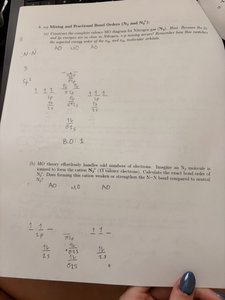
Q7. Draw and analyze molecular orbital (MO) diagrams for H2, He2, N2, and N2+.
Background
Topic: Molecular Orbital Theory
This question tests your ability to construct MO diagrams and calculate bond order.
Key Terms & Formula:
Molecular orbital (MO): Combination of atomic orbitals
Bond order:
Step-by-Step Guidance
Draw the MO diagram for each molecule, filling in electrons according to the Aufbau principle.
Count the number of electrons in bonding and antibonding orbitals.
Set up the bond order formula for each molecule.
Compare bond orders to predict stability and magnetic properties.
Try solving on your own before revealing the answer!
Final Answer:
Bond order for H2 is 1, for He2 is 0 (not stable), for N2 is 3, and for N2+ is 2.5. Higher bond order means greater stability.
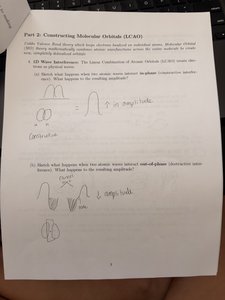
Q8. Construct molecular orbitals using LCAO and analyze constructive/destructive interference.
Background
Topic: Linear Combination of Atomic Orbitals (LCAO)
This question tests your understanding of how atomic orbitals combine to form molecular orbitals.
Key Terms:
LCAO: Linear combination of atomic orbitals
Constructive interference: Orbitals add, increasing electron density
Destructive interference: Orbitals subtract, decreasing electron density
Step-by-Step Guidance
Draw the combination of two atomic orbitals (in-phase and out-of-phase).
Identify which combination leads to constructive (bonding) and which to destructive (antibonding) molecular orbitals.
Relate the shapes to electron density between nuclei.
Predict which combination is more stable.
Try solving on your own before revealing the answer!
Final Answer:
Constructive interference forms bonding orbitals with increased electron density between nuclei; destructive interference forms antibonding orbitals with a node between nuclei.
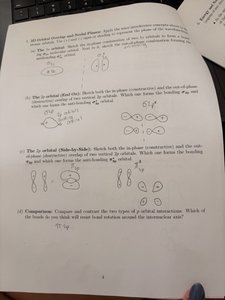
Q9. Sketch and compare sigma and pi orbital overlaps.
Background
Topic: Orbital Overlap & Bond Types
This question tests your ability to distinguish between sigma and pi bonds based on orbital overlap.
Key Terms:
Sigma bond: End-to-end overlap
Pi bond: Side-to-side overlap
Step-by-Step Guidance
Sketch the in-phase and out-of-phase overlap for sigma and pi orbitals.
Identify which overlap leads to stronger bonding.
Compare the bond strength and electron density location.
Predict which bond is more likely to rotate freely.
Try solving on your own before revealing the answer!
Final Answer:
Sigma bonds are stronger due to greater overlap; pi bonds are weaker and restrict rotation due to their side-to-side overlap.
Q10. Draw Lewis structures for acetylamide and identify lone pairs, formal charges, and orbital interactions.
Background
Topic: Lewis Structures & Orbital Interactions
This question tests your ability to draw Lewis structures, assign formal charges, and identify orbital interactions.
Key Terms:
Lone pair: Non-bonding electrons
Formal charge: Charge assigned to atoms in a molecule
Orbital interaction: Overlap between atomic orbitals
Step-by-Step Guidance
Draw the Lewis structure for acetylamide, showing all atoms and bonds.
Identify lone pairs on oxygen and nitrogen.
Assign formal charges to each atom.
Determine which orbitals interact in the molecule.
Try solving on your own before revealing the answer!
Final Answer:
Acetylamide has lone pairs on oxygen and nitrogen; formal charges are minimized. Orbital interactions involve sp2 hybridized atoms and pi bonding between C and O.
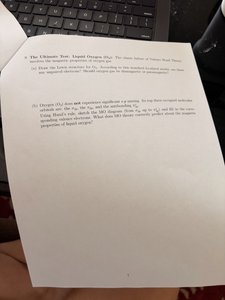
Q11. Explain why O2 is paramagnetic using MO theory.
Background
Topic: Molecular Orbital Theory & Magnetism
This question tests your ability to use MO theory to explain the magnetic properties of O2.
Key Terms:
Paramagnetic: Contains unpaired electrons
MO diagram: Shows electron distribution in molecular orbitals
Step-by-Step Guidance
Draw the MO diagram for O2, filling in electrons according to the Aufbau principle.
Identify the presence of unpaired electrons in the pi* orbitals.
Relate the unpaired electrons to paramagnetism.
Compare to other diatomic molecules.
Try solving on your own before revealing the answer!
Final Answer:
O2 is paramagnetic because its MO diagram shows two unpaired electrons in the pi* antibonding orbitals.
Q12. Draw Lewis structures for NO2- and PO4^3-, calculate formal charges, and analyze expanded octets.
Background
Topic: Lewis Structures, Formal Charge, Expanded Octets
This question tests your ability to draw Lewis structures, calculate formal charges, and recognize expanded octets.
Key Terms & Formula:
Lewis structure: Diagram showing valence electrons
Formal charge:
Expanded octet: Central atom has more than 8 electrons
Step-by-Step Guidance
Draw the Lewis structure for NO2-, distributing electrons to satisfy the octet rule.
Calculate formal charges for each atom.
Draw the Lewis structure for PO4^3-, considering possible expanded octets for phosphorus.
Calculate formal charges for each atom in PO4^3-.
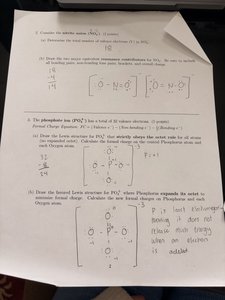
Try solving on your own before revealing the answer!
Final Answer:
NO2- has resonance structures with minimized formal charges; PO4^3- has an expanded octet on phosphorus and formal charges distributed among oxygens.
Q13. Identify incomplete octets, radicals, and multi-centered molecules in Lewis structures.
Background
Topic: Lewis Structures & Special Cases
This question tests your ability to recognize incomplete octets, radicals, and multi-centered bonding in molecules.
Key Terms:
Incomplete octet: Atom has fewer than 8 electrons
Radical: Molecule with an unpaired electron
Multi-centered molecule: Bonding involves more than two atoms
Step-by-Step Guidance
Draw the Lewis structure for the molecule in question.
Identify atoms with fewer than 8 electrons (incomplete octet).
Look for unpaired electrons (radicals).
Analyze bonding patterns for multi-centered bonds.
Try solving on your own before revealing the answer!
Final Answer:
Boron often forms incomplete octets; NO has a radical; multi-centered molecules have delocalized electrons across three or more atoms.
